
Reviewed · ALFAMA & OLD TOWN TOURS
Walk Lisbon Like a Local: Bairro Alto & Downtown Experience
Lisbon’s street corners come with plot twists.
In just 2.5 hours, I love how this walk stitches together Rossio’s grand railway façade, Camões’s literary spotlight, and Bairro Alto legends about plague-era life and royal relics. It’s also a solid way to end up at the Miradouro de Santa Catarina viewpoint with the city spread out in front of you.
The main consideration is effort: Bairro Alto’s area sits higher than Rossio, and the route mixes walking time with a few tighter streets and museum-free stops, so plan on comfortable shoes and a steady pace.
In This Review
- Key highlights you’ll feel right away
- How this Rossio-to-Bairro Alto walk fits your day
- Praça Dom Pedro IV: your orientation anchor in Rossio
- Estação do Rossio: where Lisbon’s 1880s romance shows up
- Praça Luís de Camões: literature that still shapes identity
- Bairro Alto: plague, nobles, relics, and why the streets changed
- Largo do Carmo: a vow that became a Carmelite church and convent
- Ending at Miradouro de Santa Catarina: the payoff moment
- Price and value: why $3.60 can be a good deal
- Smart tips to get the most from the walk
- Who this tour is best for
- Should you book Walk Lisbon Like a Local: Bairro Alto & Downtown?
- FAQ
- FAQ
- How long is the walk?
- What does it cost?
- What language is the tour offered in?
- Where does the tour start and end?
- How big is the group?
- Is there a mobile ticket?
- Are there paid admissions at the stops?
- Is entry to the Santa Justa elevator included?
- What’s the cancellation policy for a full refund?
Key highlights you’ll feel right away
- Neo-Manueline Rossio Station: that temple-like façade and the twin horseshoe portals at the entrance
- Camões Square in context: how Luís de Camões connects to Vasco da Gama and even the idea of Portuguese language identity
- Bairro Alto’s plague-era map: cemetery placement, the Saint Roque hermitage, and who lived where
- King Manuel I in the story: a relic request from Venice that shaped a neighborhood
- Largo do Carmo’s vow-and-win origin: Nuno Álvares Pereira’s promise after Aljubarrota and the Carmelite link
- A finishing viewpoint: you close with the Miradouro de Santa Catarina experience instead of stopping mid-street
How this Rossio-to-Bairro Alto walk fits your day
This tour is built like a smart mini-circuit: start in the big, easy-to-find square area, then move through historic landmarks before reaching the Bairro Alto side of town. The total time is about 2 hours 30 minutes, which is long enough for real context, but short enough that it won’t swallow your whole afternoon.
The price is unusually low for a guided, story-heavy walk at $3.60 per person. For me, that signals good value for your time: you’re paying for guided interpretation and the “why does this place matter” layer, not for paid attractions. Since the stops in the route have free admission, most of what you’re paying for is the guide’s ability to connect dots across centuries.
Group size is capped at 30 travelers, which usually keeps the pace readable and the guide’s explanations audible without feeling like a theme park line.
Deeper into Alfama's lanes and miradouros
- Alfama Tour in Lisbon Old Town
★ 5.0 · 4,936 reviews - Private Lisbon Sightseeing Tuk-Tuk Tour: Alfama, Belém & More
★ 5.0 · 4,277 reviews - Lisbon: Hills, Alfama, and Mouraria Tour by Electric Bike
★ 4.8 · 3,438 reviews - Best of Lisbon Walking Tour: Rossio, Chiado & Alfama
★ 4.9 · 2,700 reviews
Praça Dom Pedro IV: your orientation anchor in Rossio
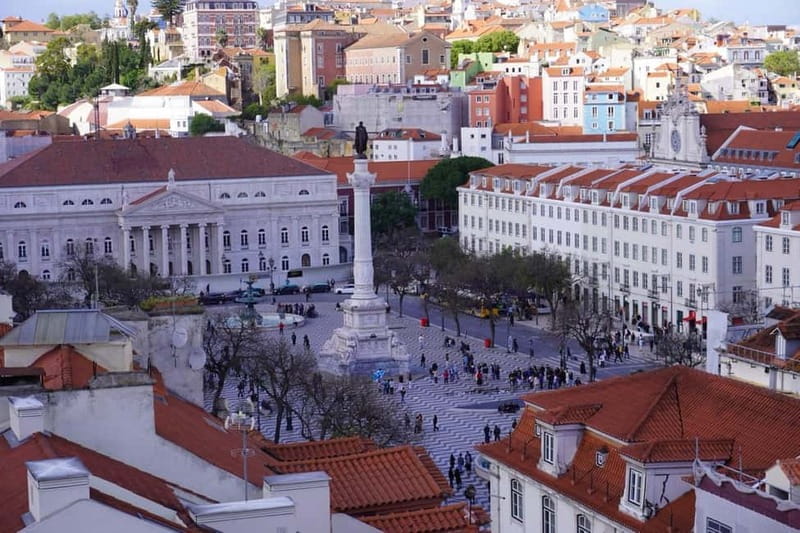
You begin at Praça Dom Pedro IV, in the Rossio area (1100-200 Lisboa). This is a smart starting point because it’s an open square where you can get your bearings fast, then head into the more winding, character-filled streets that come later.
The walk out of Rossio also helps you understand Lisbon’s layout. Even before you reach the famous Bairro Alto segment, you’re learning how the city “turns” from civic square energy into neighborhood logic and hillier streets. Stop time here is about 25 minutes, which is enough for grounding without dragging.
Because there’s no paid entry, you can treat this as part introduction, part warm-up. If you’re traveling with kids or someone who needs breaks, starting with a broad square is helpful.
Estação do Rossio: where Lisbon’s 1880s romance shows up
Next you’ll spend around 25 minutes at Estação do Rossio. This isn’t just a station you pass through. It was commissioned by the Portuguese Royal Railway Company and designed between 1886 and 1887 by Portuguese architect José Luís Monteiro, finishing in 1890.
The façade is Neo-Manueline, a Romantic recreation of the exuberant Manueline style from the early 1500s. In plain terms, it means the building looks like it belongs in an old storybook, not a modern transit hub.
Look closely at the entrance: there are two intertwined horseshoe portals that greet you as Central Station. You’ll also notice the overall effect is temple-like rather than utilitarian. If you’ve only seen Lisbon’s tiles and viewpoints, this is your “railway architecture” moment, and it sets a tone for the rest of the tour: Lisbon loves dramatic storytelling in stone and design.
Praça Luís de Camões: literature that still shapes identity
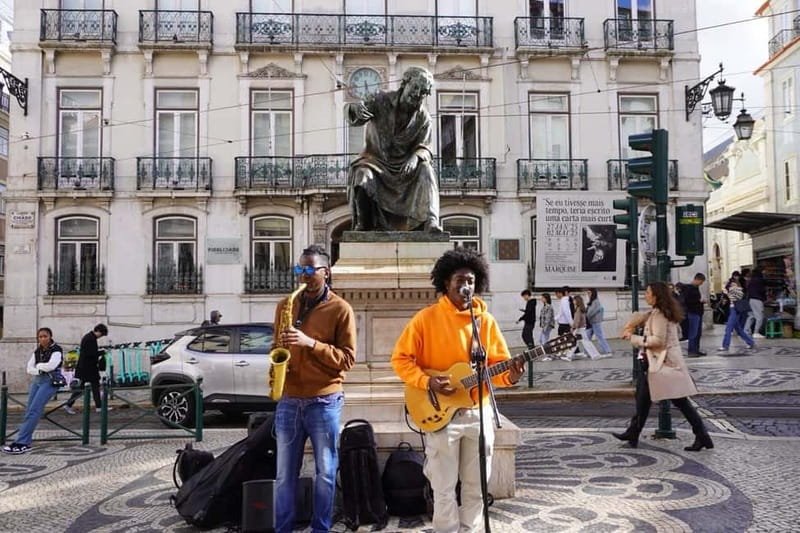
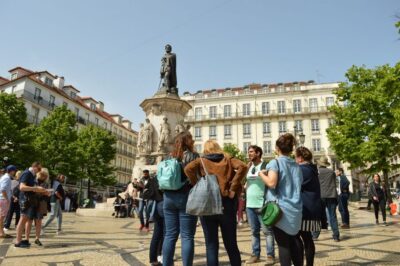
You’ll move on to Praça Luís de Camões for about 30 minutes. This is where the guide’s stories help the square feel personal instead of generic.
Camões is Portugal’s national poet and author of the epic Os Lusíadas, which describes the sea route connected to Vasco da Gama’s journey to India. There’s also a biographical detail people love for its immediacy: it’s said Luís de Camões lost one eye in a battle in Ceuta.
Even better, the influence of his masterpiece is described as so strong that Portuguese language is sometimes called the language of Camões. That’s the kind of line that makes a stop like this worth your time. You’re not just standing in a pretty square; you’re standing in a place that carries an idea about language and nation.
If you enjoy learning why a city repeats certain names, you’ll appreciate how Camões serves as a bridge between Portugal’s exploration-era confidence and the later neighborhood stories you’ll hear in Bairro Alto.
Worth a look before you lock anything else in around Lisbon:

Bairro Alto: plague, nobles, relics, and why the streets changed
Bairro Alto is the heart of this experience, with about 30 minutes devoted to the area. The story starts in the late 15th century when Lisbon became crowded from people arriving due to the discovery period. That population pressure created a need to enlarge the city center, and Camões Square is tied to that earlier urban design as one of the entrances to Lisbon.
Here’s where the details matter. The tour explains that the area you’re looking at had layers: the Fernandine wall and the door of Santa Catarina once structured access. After the earthquake period, the area now includes two churches: Encarnação and Loreto. You’re basically watching the city change its skin across time.
The guide also points to what sat on different sides of the wall. One side relates to areas that belonged to rich noble families. Higher up, there was a cemetery for victims of the black plague. That helps you understand why the later story about religion and relocation wasn’t just symbolic—it affected where people ended up living.
Then comes the relic legend tied to royal power. In 1506, King Manuel I requested a relic of Saint Roque from Venice and placed it in a hermitage near the cemetery. When plague conditions and demographic pressure increased, the less fortunate and sick moved toward the church area, and an urban plan was developed to receive these people.
This stop can be emotional if you let it be. But it’s also practical for your understanding of Lisbon. You’ll start seeing Bairro Alto not as a nightlife shorthand, but as a neighborhood shaped by walls, health crises, and royal decisions that spilled into daily life.
Largo do Carmo: a vow that became a Carmelite church and convent
From Bairro Alto, you’ll head to Largo do Carmo for about 15 minutes. This is a shorter stop, but it’s packed with a clear origin story, which is often what makes the biggest impression.
The church and convent were built in 1389 after Nuno Álvares Pereira, a general who helped King John repel Castilian troops. The legend says he vowed to build what he would call the world’s most beautiful church if he defeated the Castilians at the battle of Aljubarrota in 1385.
Portuguese forces won, and he kept his word by funding a Carmelite church and convent. After completion in 1423, he joined the Carmelite order and spent the rest of his life in the convent.
Even if you only have a short window here, the story gives you a way to read the space. A church built from a military vow sounds dramatic, but that’s exactly why it’s memorable. You’ll probably find yourself noticing different parts of the church complex with more meaning than you would on your own.
Ending at Miradouro de Santa Catarina: the payoff moment
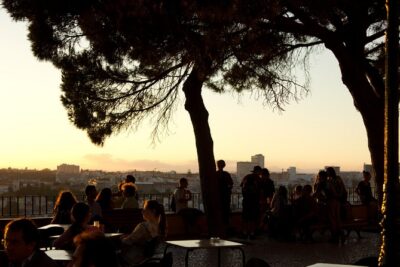
The tour ends at Miradouro de Santa Catarina (1200-262 Lisboa). This matters because it finishes your walking effort with a reward instead of fading out mid-route.
In the guide’s pacing, you reach the viewpoint when your brain is ready for a reset. You get a chance to look out over Lisbon and connect what you learned about streets and squares to the city’s real geography. One thing I like about ending here is that it keeps you from feeling stuck inside the “story stops.” You close with an image that helps it all stick.
If it’s sunny, you’ll see more detail. If it’s windy or overcast, you still get the geography. Either way, it’s a good final note for a walk that’s mostly about legends and historic context.
Price and value: why $3.60 can be a good deal
At $3.60 per person, this tour is priced like a bargain compared to the time you’re getting with a local guide. More importantly, many of the route stops are marked with free admission, so the cost isn’t mostly paying for entrance fees.
So what are you paying for? You’re paying for a guide who can connect architecture, poetry, and neighborhood legends without turning it into a lecture. When a tour is this inexpensive, I look for two things: whether it stays organized and whether the stories feel tied to what you’re actually seeing. This one is structured with short-to-medium stops, which helps it stay moving while still giving each site enough time for a useful explanation.
There is one notable paid option not included: entry to the Santa Justa elevator. If you want that extra vertical city view, plan on doing it separately.
Smart tips to get the most from the walk
This is a walking tour with moderate fitness needs. I’d plan for some uneven pavement and steps, especially as you shift toward the Bairro Alto side and the hillier parts referenced in the neighborhood story.
A few practical ideas:
- Wear shoes you can trust for cobblestones and short stair-like moments.
- Bring water, even if you’re not sweating hard. The stops are short, but the total time still adds up.
- If you’re taking photos, pause for a second at the Rossio Station façade and again around the churches mentioned in Bairro Alto. Those are the spots where the story gives you the right “why am I looking at this” angle.
If you’re someone who likes to understand a city through names, you’ll enjoy how the tour ties together Camões, Vasco da Gama, King Manuel I, and Nuno Álvares Pereira. If you’d rather just enjoy views with minimal facts, it may still work, but you’ll get more out of it if you lean into the stories.
Who this tour is best for
This is a great fit for:
- First-time Lisbon visitors who want an efficient walk through Rossio → Bairro Alto → viewpoint
- Travelers who like connecting street names and landmarks to larger Portuguese stories
- People who want a tour that isn’t only about paid attractions
It’s also a good choice if you’re trying to use your time well. With a total of about 2.5 hours, you can pair it with a longer meal stop afterward or another independent stroll.
Should you book Walk Lisbon Like a Local: Bairro Alto & Downtown?
If you want real Lisbon context without spending a lot, I’d book it. The value is strong for the time, and the route includes several stops you might walk past without knowing what you’re looking at—especially Rossio Station and the Bairro Alto plague-and-relic narrative.
I’d skip it only if you dislike walking in older areas or you’re hoping for a tour anchored by paid museum interiors. This one is about streets, churches, and explainers—plus a viewpoint finish. In other words, it’s a good use of a half-day slot, especially when you’re trying to build a mental map of Lisbon.
FAQ
FAQ
How long is the walk?
The walking tour lasts about 2 hours 30 minutes.
What does it cost?
The price is $3.60 per person.
What language is the tour offered in?
The tour is offered in English.
Where does the tour start and end?
It starts at Praça Dom Pedro IV, 1100-200 Lisboa, Portugal and ends at Miradouro de Santa Catarina, 1200-262 Lisboa, Portugal.
How big is the group?
The maximum group size is 30 travelers.
Is there a mobile ticket?
Yes, the tour uses a mobile ticket.
Are there paid admissions at the stops?
The stops in the route list admission as free.
Is entry to the Santa Justa elevator included?
No, entry to the Santa Justa elevator is not included.
What’s the cancellation policy for a full refund?
You can cancel up to 24 hours in advance of the experience for a full refund.
More Walking Tours in Lisbon
- Lisbon: History, Stories and Lifestyle Walking Tour★ 4.8 · 10,902 reviews
- Best of Lisbon Small-Group Guided Walking Tour★ 5.0 · 4,869 reviews
- Lisbon: Food and Wine Small Group Walking Tour★ 4.9 · 4,082 reviews
- Best of Lisbon Walking Tour: Rossio, Chiado & Alfama★ 4.9 · 2,700 reviews
- Age of Discoveries Walking Tour in Belém★ 5.0 · 1,513 reviews
More Tour Reviews in Lisbon
- Lisbon City Center Tour – The Unmissable Lisbon★ 5.0 · 22,234 reviews
- Lisbon: Sintra, Pena, Regaleira, Cabo da Roca & Cascais★ 4.7 · 19,656 reviews
- Lisbon Card: 24, 48, or 72-Hour Pass★ 4.5 · 17,944 reviews
- Lisbon: Jerónimos Monastery Entrance Ticket★ 4.1 · 14,164 reviews
- Lisbon: History, Stories and Lifestyle Walking Tour★ 4.8 · 10,902 reviews
Keep Wandering Old Alfama
- Alfama Tour in Lisbon Old Town★ 5.0 · 4,936 reviews
- Private Lisbon Sightseeing Tuk-Tuk Tour: Alfama, Belém & More★ 5.0 · 4,277 reviews
- Lisbon: Hills, Alfama, and Mouraria Tour by Electric Bike★ 4.8 · 3,438 reviews
- Best of Lisbon Walking Tour: Rossio, Chiado & Alfama★ 4.9 · 2,700 reviews
- Lisbon: Baixa District Food Tour with Dinner and Drinks★ 4.9 · 1,997 reviews
Just in: fresh Lisbon reviews from the team





Alfama & Old Town Tours, compared.
 ★ 5.0Alfama Tour in Lisbon Old TownFrom $34,936 reviews
 ★ 5.0Private Lisbon Sightseeing Tuk-Tuk Tour: Alfama, Belém & MoreFrom $524,277 reviews
 ★ 4.8Hills, Alfama, and Mouraria Tour by Electric BikeFrom $253,438 reviews
 ★ 4.9Best of Lisbon Walking Tour: Rossio, Chiado & AlfamaFrom $232,700 reviews
 ★ 4.9Baixa District Food Tour with Dinner and DrinksFrom $931,997 reviews
 ★ 5.0Lisbon Small-Group Food Tour with 18 Tastings in Alfama DistrictFrom $1261,967 reviews
 ★ 4.5Lisbon E-Bike Tour Commerce Square, Mouraria and AlfamaFrom $301,688 reviews
 ★ 5.0Old Town TukTuk Tour and Scenic Viewpoints in AlfamaFrom $35974 reviews
Browse the lists this tour appears in