

Reviewed · LISBON WALKING TOURS
Lisbon Walking Tour with Audioguide on Your Smartphone
Lisbon rewards the slow walk, and so does this. This Lisbon walking tour with audioguide on your smartphone turns a 2.5-hour stroll into a self-paced story route through spots like Praça dos Restauradores, Rossio Station, Alfama viewpoints, and the waterfront at Praça do Comércio. I like that it’s all on your phone, so you control the pace instead of matching a group.
Two things I especially liked: the narration comes from a professional historian, and the recordings are built to guide you neighborhood to neighborhood (including Baixa and Alfama). The other big plus is the practical layer—things like tips related to getting around, and extra ideas for what to notice along the way.
One consideration: because it’s self-guided (no human guide on-site), you have to start at the right place and follow the app map closely. If your orientation is off or your GPS is slow, a couple of stops can feel hard to locate, so you’ll want to give yourself time to adjust.
In This Review
- Key highlights you’ll notice fast
- A smartphone audioguide that saves you from “where am I?”
- How the self-guided route works (and why instructions matter)
- Praça dos Restauradores: a clean first stop to set the tone
- Rossio Station’s Neo-Manueline façade: more than a train stop
- Praça Martim Moniz: where the city feels lived-in
- Praça da Figueira and Confeitaria Nacional: pastry with a time machine vibe
- Pedro IV Square (Rossio): cobblestones, fountains, and the theater crowd
- Carmo Convent ruins: when Lisbon’s 1755 story becomes visible
- Luís de Camões Square in Chiado: literature meets street life
- Santa Justa Lift: a viewpoint with ironwork drama
- Rua Augusta to Arco da Rua Augusta: walking to the big finish
- Praça do Comércio (Terreiro do Paço): the waterfront that closes the loop
- Alfama viewpoints and Sé de Lisboa: the part where photos get good fast
- What the $8.45 price buys you (and what it doesn’t)
- Timing and pacing: 2.5 hours with real-world feet
- Who this Lisbon audio tour suits best
- Should you book this Lisbon walking tour?
- FAQ
- What is the price of the Lisbon walking tour with smartphone audioguide?
- How long is the tour?
- Is there a human guide included?
- What language is the audio guide in?
- Do I need to bring my own headphones?
- Do I need internet while walking?
- Where does the tour start and where does it end?
- What’s included in the audio guide?
- Are entrance fees included for stops?
Key highlights you’ll notice fast

- 26 historian-led audio recordings for a steady, story-driven route
- Offline map + route so you’re not stuck hunting for directions online
- English-only audio with one year of access after you book
- A walking mix of major landmarks and “pause here” moments for views and photos
- Low cost ($8.45) compared with tours that add a guide on top
- You bring headphones (not included), and you download the app before you go
A smartphone audioguide that saves you from “where am I?”
This is a classic style of sightseeing that Lisbon does well: you walk. But instead of just getting your bearings from street signs, you get guided context through a phone app. The tour runs about 2 hours 30 minutes and is designed as a full loop that starts at Praça dos Restauradores and returns there when you finish.
The “why this works” part is simple: Lisbon’s highlights are close enough to reach on foot, but the city’s street layout can still throw you off. A good audio route helps you connect what you’re seeing now to what the place meant back then—like why a monument sits where it does, or how a station façade fits into Lisbon’s later architectural style.
Lisbon at walking pace, a few more routes
- Lisbon: History, Stories and Lifestyle Walking Tour
★ 4.8 · 10,902 reviews - Best of Lisbon Small-Group Guided Walking Tour
★ 5.0 · 4,869 reviews - Lisbon: Food and Wine Small Group Walking Tour
★ 4.9 · 4,082 reviews - Best of Lisbon Walking Tour: Rossio, Chiado & Alfama
★ 4.9 · 2,700 reviews
How the self-guided route works (and why instructions matter)
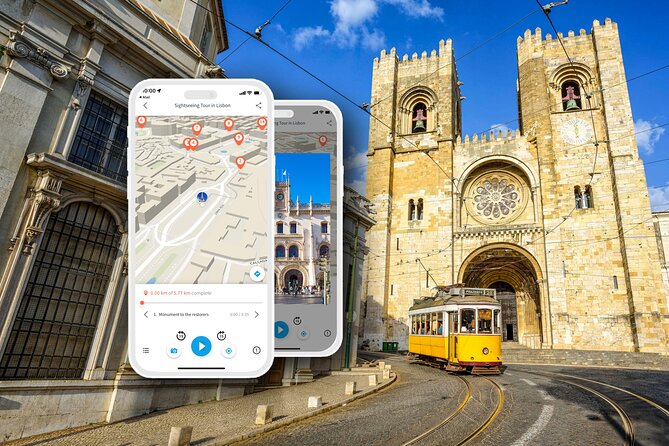
You’ll book a mobile ticket, then download the tour’s app for iPhone or Android. After you activate your purchase, you follow the route using the app map with an offline route. The audio is tied to the stops—so you’ll want to pause and wait for the next segment before you power-walk to the next corner.
Because there’s no human guide at the meeting point, you should assume this is on you in two ways:
- Start at Praça dos Restauradores (not the end of some other plan).
- Keep the phone’s location services on when possible, but also be ready to rely on the offline map.
That last part matters. One issue that can happen with any GPS-based audio tour is that older streets, tight corners, and moving between neighborhoods can make your location bounce a bit. If that happens here, slow down. Let the map catch up, then line up the landmarks described in the narration.
Praça dos Restauradores: a clean first stop to set the tone
Your route begins at Praça dos Restauradores, right in the center of things. This square is built around Portugal’s restoration of independence in 1640, with the Monument to the Restorers as the focal point.
What I like about starting here: it’s a straightforward “anchor.” From early on, you can see the square’s layout and then link the narration to a landmark you can’t miss. It’s also a good warm-up. You’re not climbing stairs yet, and you’re not guessing which street to turn down.
Practical note: the tour time budgets about 10 minutes here. If you like to read details on monuments, spend a little extra—just don’t let it eat your whole day.
Rossio Station’s Neo-Manueline façade: more than a train stop

Next up is Rossio Station, opened in 1890. Even if you don’t plan to ride anywhere, the station is worth seeing for its Neo-Manueline architecture—especially the ornate stonework and the distinctive twin horseshoe arches.
This stop is one of those “transport meets theater” moments in Lisbon. The façade tells you that stations were treated as public architecture, not just infrastructure. And Rossio’s role as a gateway to places like Sintra gives the narration a useful Lisbon-region connection.
If you’re thinking about transit, this is a good time to scan the area. The tour doesn’t add transportation, but it can help you understand why this corridor matters.
Worth a look before you lock anything else in around Lisbon:

Praça Martim Moniz: where the city feels lived-in

At Praça Martim Moniz, you’re in a part of Lisbon known for its mix of cultures and flavors. You’ll see street food energy and hear the sounds of the city doing its normal day-to-day.
What you gain from including this square in a “landmark” audio route: it prevents the tour from becoming only monuments and churches. It’s a reminder that Lisbon’s history lives side-by-side with modern life.
Also, this is a natural moment to do a tiny reset. Take a breath, check the app map, and decide if you want a quick snack break before continuing.
Praça da Figueira and Confeitaria Nacional: pastry with a time machine vibe

Then you move to Praça da Figueira, a central square that historically served as the city’s largest market. Today it still feels practical—shops, cafes, and a view line that brings São Jorge Castle into the scene.
Look for the equestrian statue of King João I as your landmark “handle” in the middle of the square. This stop is also a good photo pause because the castle view is obvious enough to satisfy you even if you’re not planning to enter the fortress right away.
Right in the middle of this area is Confeitaria Nacional, Lisbon’s oldest patisserie, established in 1829. If the audio gives you context about Portuguese sweets, this is where you can convert that listening into tasting. The tour describes its famous Bolo Rei, especially tied to the Christmas tradition.
Value tip: even if you don’t buy a full pastry, a small stop here gives you a Lisbon-specific reward at a very reasonable cost compared with adding paid museum time elsewhere.
Pedro IV Square (Rossio): cobblestones, fountains, and the theater crowd
Next is Praça Dom Pedro IV, also known as Rossio. This square is defined by the wave-pattern cobblestones, grand fountains, and the large statue of King Pedro IV.
The tour also points you toward major surroundings like the D. Maria II National Theatre. Even if you skip performances (no tickets included), the building presence helps you picture Lisbon as a city that puts culture in the street-level experience.
This is another stop where “10 minutes” is enough for your bearings. If you want a coffee, do it here. Then keep moving—because the route tightens afterward.
Carmo Convent ruins: when Lisbon’s 1755 story becomes visible

You’ll then reach the ruins of Carmo Convent, a Gothic structure tied to the 1755 earthquake. The narration highlights the skeletal arches and the open-air nave, with the Carmo Archaeological Museum attached.
Even when you’re standing still, this kind of place makes you notice how Lisbon rebuilds. It’s not only a monument—it’s a physical reminder that disasters reshape cities.
Ticket reality check: entrance fees aren’t included in the tour, so if you want museum time or anything inside, expect to pay separately. If you only want the atmosphere and views of the ruins, you can still enjoy the stop.
Luís de Camões Square in Chiado: literature meets street life
Moving into Chiado, you’ll stop at Luís de Camões Square, named for Portugal’s famous poet. The square includes his statue and sits among cafes and shops, so it’s a comfortable place to pause before heading toward higher views.
This is also a mental shift zone. Earlier you were in monuments and stations; here you’re in Lisbon’s reading-and-shopping rhythm. That mix keeps your ears busy too, because the audio route changes from buildings to culture to city habits.
Santa Justa Lift: a viewpoint with ironwork drama
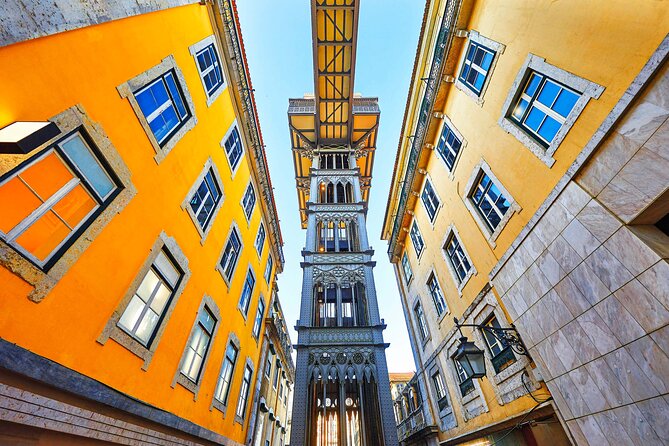
From there, the tour takes you to Santa Justa Lift, an iconic neo-Gothic elevator that opened in 1902. The narration notes that it was designed by Raoul Mesnier du Ponsard, a protégé of Gustave Eiffel.
Even if you don’t ride it, the structure is visually impressive—ironwork, height, and that sense that someone really wanted this to look like a landmark. If you do plan to go up, remember entrance or ride costs aren’t included. Still, the payoff is the panoramic look over Lisbon’s core areas.
This stop is also where you’ll likely appreciate the audio guide’s focus on Lisbon’s transport icons. One of the strongest comments from audio users is that the guide includes practical context around the city’s historic trams and elevators, not just decorative descriptions.
Rua Augusta to Arco da Rua Augusta: walking to the big finish
You’ll continue onto Rua Augusta, the pedestrian stretch in Baixa that runs from Rossio toward the waterfront. The route describes mosaic-style pavement details and the way the street funnels you toward Arco da Rua Augusta.
Once you reach the Rua Augusta Arch, you’re in “Lisbon’s comeback” territory. The arch was built after the 1755 earthquake to mark reconstruction, and it’s crowned with symbolic sculptures and a statue of Glory rewarding Valor and Genius. The narration also encourages you to consider going up for city and Tagus River views.
This is a good section to move at a slower pace if you like angles. Rua Augusta makes it easy to frame buildings and see how the city’s straight lines contrast with its hill neighborhoods.
Praça do Comércio (Terreiro do Paço): the waterfront that closes the loop
The tour ends at Praça do Comércio, also called Terreiro do Paço. This is Lisbon at its grandest “open square” scale: yellow Pombaline buildings, arcades, and an easy connection to the Tagus River.
At the center sits the equestrian statue of King José I, which ties to the city’s post-earthquake reconstruction story. The tour also mentions the Lisbon Story Centre nearby, though any museum time would be separate from the audio tour.
Since the activity says it finishes back at the start, the app route likely guides your return path after this big waterfront moment. Either way, this last stop is a strong way to end: you get space, light, and a sense of where Lisbon opens to the water.
Alfama viewpoints and Sé de Lisboa: the part where photos get good fast
After the central sections, the route includes the older-feeling side of Lisbon: Alfama and its viewpoints and churches.
The audio points you to Miradouro de Santa Luzia, a terrace viewpoint known for azulejo tiles with historical scenes and fragrant bougainvillea. The idea here is simple: stop, look, and let the city’s rooftops and the Tagus come into focus.
Then you’ll reach Lisbon Cathedral (Sé de Lisboa), a Romanesque-Gothic landmark dating back to the 12th century in Alfama. The narration describes the twin bell towers, a rose window, and the chapels and stained glass inside. It also notes the cloisters have archaeological remains from Roman, Visigoth, and Moorish times.
Practical framing: this is the part where the app can help you understand what you’re looking at, because churches and viewpoints can otherwise feel like “yet another stop.” Here, the tour gives you enough context to make the architecture and layering of eras feel meaningful.
What the $8.45 price buys you (and what it doesn’t)
At $8.45 per person, the value is mainly in the audio content and structure. You’re getting:
- 26 audio recordings narrated by a professional historian
- an app for iOS and Android
- illustrations to identify landmarks
- offline map + route
- one year access in your preferred language
What you’re not getting:
- a human guide
- headphones or a smartphone
- transportation
- entrance fees
That last line is key for planning. Some stops are described as free to see in the route notes, but if you decide you want to enter museums, ride a lift, or go inside cathedrals/archaeology spaces, you’ll need to budget extra. The tour is designed for walking and observation first, with optional add-ons later.
Still, one of the best parts of this tour format is that you can choose how much you pay once you’re already in position.
Timing and pacing: 2.5 hours with real-world feet
The time listed is about 2 hours 30 minutes, and the route includes a lot of major stops. That means you’ll want to keep your “linger time” realistic.
A good rhythm:
- Treat each stop as a listen then look cycle.
- Use the app map to avoid detours.
- Save longer photo breaks for Santa Luzia and the Praça do Comércio waterfront.
If you’re traveling in hotter months, plan to pause with water and let the audio do the work while you catch your breath.
Who this Lisbon audio tour suits best
This is a strong match if you:
- like self-paced walking tours with clear stop points
- want context from a historian, not just postcard facts
- prefer a low-cost route rather than paying for a guided group
- enjoy mixing major landmarks with smaller “in-between” squares like Martim Moniz
It may be less ideal if you:
- hate smartphone navigation or don’t keep location services active
- expect a staff member to handle orientation on the ground
- struggle with finding places when the route isn’t physically marked
A small note based on real feedback: if you ever start from the wrong end or at a different time than the route expects, the experience can feel harder to follow. Start at Praça dos Restauradores, and let the app lead.
Should you book this Lisbon walking tour?
I’d book it if you want a structured walk that costs little, gives you historian narration, and helps you connect the dots between Baixa, Chiado, and Alfama. It’s also ideal if you like to move at your pace and sprinkle in food breaks, since the guide is designed around the idea of noticing what’s around you.
Skip it or think twice if you don’t want to rely on an app map, or if you’ve had trouble with finding stops in other self-guided tours. In that case, you might spend extra time correcting your route instead of enjoying the story.
Bottom line: for the price, you’re buying clarity through audio. If you follow the starting point and give the map a chance to lock in, you’ll get a lot out of Lisbon’s highlights without paying for a full guided tour.
FAQ
What is the price of the Lisbon walking tour with smartphone audioguide?
The price is $8.45 per person.
How long is the tour?
The duration is about 2 hours 30 minutes.
Is there a human guide included?
No. This is a self-guided tour, and there is no human guide at the meeting point.
What language is the audio guide in?
The audio guide is offered in English.
Do I need to bring my own headphones?
Yes. Headphones and a smartphone are not included, so you’ll need to bring your own headphones.
Do I need internet while walking?
The tour provides an offline map with the route for GPS navigation, and you access the audio through the app.
Where does the tour start and where does it end?
It starts at Praça dos Restauradores and ends back at the meeting point.
What’s included in the audio guide?
You get 26 audio recordings narrated by a professional historian, a smartphone app for iOS and Android, illustrations to identify landmarks, and one year of access in your preferred language.
Are entrance fees included for stops?
No. Entrance fees or tickets are not included.
More Tours in Lisbon
- Lisbon City Center Tour – The Unmissable Lisbon★ 5.0 · 22,234 reviews
- Lisbon: History, Stories and Lifestyle Walking Tour★ 4.8 · 10,902 reviews
- True 4Hour Private Tuk Tuk Tour: Discover Lisbon with a Local!★ 5.0 · 8,008 reviews
- Winner 2025 Undiscovered Lisbon Food & Wine Tour by Eating Europe★ 5.0 · 6,390 reviews
- Lisbon: Sintra, Pena, Cabo da Roca, Cascais Tour with Pickup★ 4.8 · 5,445 reviews
More Tour Reviews in Lisbon
- Lisbon City Center Tour – The Unmissable Lisbon★ 5.0 · 22,234 reviews
- Lisbon: Sintra, Pena, Regaleira, Cabo da Roca & Cascais★ 4.7 · 19,656 reviews
- Lisbon Card: 24, 48, or 72-Hour Pass★ 4.5 · 17,944 reviews
- Lisbon: Jerónimos Monastery Entrance Ticket★ 4.1 · 14,164 reviews
- Lisbon: History, Stories and Lifestyle Walking Tour★ 4.8 · 10,902 reviews
More of Lisbon, One Hill at a Time
- Lisbon: History, Stories and Lifestyle Walking Tour★ 4.8 · 10,902 reviews
- Best of Lisbon Small-Group Guided Walking Tour★ 5.0 · 4,869 reviews
- Lisbon: Food and Wine Small Group Walking Tour★ 4.9 · 4,082 reviews
- Best of Lisbon Walking Tour: Rossio, Chiado & Alfama★ 4.9 · 2,700 reviews
- Age of Discoveries Walking Tour in Belém★ 5.0 · 1,513 reviews
Just in: fresh Lisbon reviews from the team





Lisbon Walking Tours, compared.
 ★ 4.8History, Stories and Lifestyle Walking TourFrom $2910,902 reviews
 ★ 5.0Best of Lisbon Small-Group Guided Walking TourFrom $234,869 reviews
 ★ 4.9Food and Wine Small Group Walking TourFrom $724,082 reviews
 ★ 4.9Best of Lisbon Walking Tour: Rossio, Chiado & AlfamaFrom $232,700 reviews
 ★ 5.0Age of Discoveries Walking Tour in BelémFrom $31,513 reviews
 ★ 5.0Lisbon Roots – Small group Food & Culture Walking Tour w/tastingsFrom $168910 reviews
 ★ 4.9Starter Walking Tour to the highlights in GermanFrom $33781 reviews
 ★ 4.1Lisbon Tram No. 28 Ride & Walking TourFrom $23766 reviews
Browse the lists this tour appears in