

Reviewed · ALFAMA & OLD TOWN TOURS
Lisbon: Baixa Chiado Quarter Walking Tour
Lisbon’s center reads like a living textbook. This Baixa-Chiado walking tour strings together major downtown sights like Praça do Comércio, Rossio, and the Santa Justa area, while also working in local classics such as Bertrand Bookstore and the viewpoints near São Pedro de Alcântara. You also get a free Vox City app map to keep the momentum going on your own after the walk.
Two things I really like: the tour hits both big, famous buildings and the smaller details that make Lisbon feel real, not staged. And the included Vox City app means you can turn those stops into a longer day of walking without guessing where to go next.
One thing to consider is pacing. The tour is sold as about 2 hours, and there have been signs that timing can get tight if the group slows down, which can throw off the flow.
In This Review
- Key points at a glance
- Getting Oriented in Baixa and Chiado Without Rushing
- Augusta Street Arch to Lisbon City Hall: Symbols of Power and Rebuilding
- Bertrand Bookstore and Luís de Camões Square: Old Lisbon You Can Touch
- Bica Elevator and Bairro Alto Streets: Steep Fun, Tram 28 Moments
- Carmo Convent After 1755: Seeing History Without a Museum Ticket
- Rossio Square: The Public Stage of Lisbon’s Harder Chapters
- Santa Justa, Gloria, and the View Toward São Pedro de Alcântara
- Chiado and Theatres: From National Venues to Trinity Theatre Vibes
- Baixa Pombalina Streets: Shopping, Banking, and a Rebuilt City Core
- Price and Logistics: Is $107 Good Value for Two Hours?
- Who This Tour Suits (and Who Might Want a Different Style)
- Should You Book the Lisbon Baixa Chiado Quarter Walking Tour?
- FAQ
- How long is the Lisbon Baixa Chiado Quarter Walking Tour?
- What landmarks will we see during the tour?
- Is the Vox City sightseeing app included in the price?
- Does the tour price include entry to attractions?
- Is public transportation included?
- Where does the tour start and where does it end?
- How many people are in the group?
- Is there an evening version of the tour?
- Are service animals allowed?
Key points at a glance
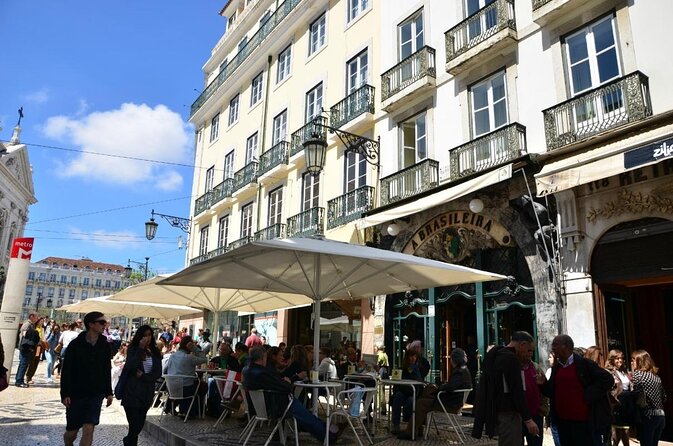
- Major downtown landmarks in one compact route: Praça do Comércio, Rossio, and the Santa Justa area.
- Bertrand Bookstore (founded in 1732): a long-running Lisbon institution you’ll pass on foot.
- Elevators and funiculars as local transport culture: Bica and the view-focused Santa Justa/Gloria areas.
- Bairro Alto street life without needing nightlife plans: plus the famous yellow Tram 28 you’ll likely spot.
- 1755 earthquake scars you can still see: Carmo Convent’s roofless church remains.
- Vox City app included: download the map and add extra self-guided walking routes.
Getting Oriented in Baixa and Chiado Without Rushing

Baixa and Chiado are the heart of Lisbon’s “walkable downtown,” but they’re not flat. You’ll weave through plazas, commercial streets, and viewpoints, with enough variety to avoid the feeling of doing the same street twice. In about 2 hours, the tour gives you a working mental map of how Lisbon’s neighborhoods connect, especially between the lower city and the hills.
This is also one of those tours that helps you later. Once you’ve walked this route, it’s easier to decide where to return for photos, coffee, or a second look at the details you might have been moving past. And because the tour includes a free Vox City app map, you’re not stuck relying on memory once the group disperses.
Group size matters on foot, and this one caps at 25 people, which keeps the pace realistic for a downtown walk. It’s also near public transportation, so it’s easy to plug into the rest of your day.
Deeper into Alfama's lanes and miradouros
- Alfama Tour in Lisbon Old Town
★ 5.0 · 4,936 reviews - Private Lisbon Sightseeing Tuk-Tuk Tour: Alfama, Belém & More
★ 5.0 · 4,277 reviews - Lisbon: Hills, Alfama, and Mouraria Tour by Electric Bike
★ 4.8 · 3,438 reviews - Best of Lisbon Walking Tour: Rossio, Chiado & Alfama
★ 4.9 · 2,700 reviews
Augusta Street Arch to Lisbon City Hall: Symbols of Power and Rebuilding
The walk starts around the Augusta Street Arch, a grand gateway that many people mentally connect to Portugal’s older traditions and national stories. Even if you don’t go deep on symbolism, the location is useful: you get a strong sense of the city axis, plus an easy transition into the open spaces near Praça do Comércio.
From there, you’ll move to Lisbon City Hall, a Neoclassical building completed in 1880. The practical win here is simple: it grounds your walk in “official Lisbon,” not just tourist highlights. You start noticing how the city uses architecture to signal order and governance—especially after the shock of the 1755 earthquake changed so much.
If you like architecture, this section is a good warm-up. If you don’t, it still helps you get your bearings fast, because landmarks are what make later navigation easier.
Bertrand Bookstore and Luís de Camões Square: Old Lisbon You Can Touch
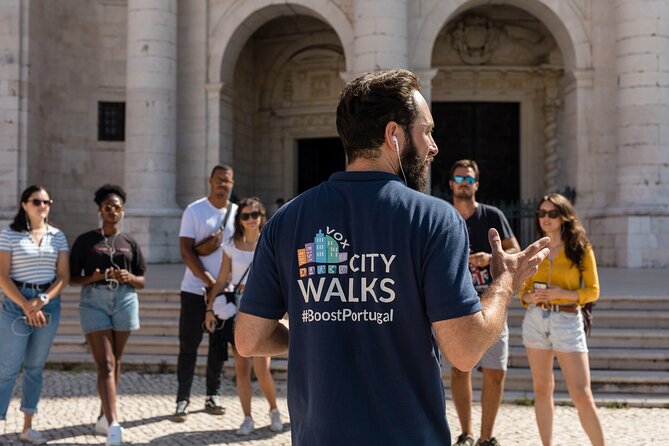
Next up is one of the Lisbon stops people remember: Bertrand Bookstore. It’s the oldest and longest operating bookstore in the world, founded in 1732 by French entrepreneur Pierre Bertrand, and still serving the Chiado neighborhood in its original location. Even from the outside, it’s the kind of place that signals continuity—Lisbon as a city that keeps its corners alive.
Right after that, you’ll head toward Luís de Camões Square. It’s a calmer pause from street movement: trees, stone benches, and the Camões Monument in the center. This kind of stop is more than scenery. It lets you regroup, check your phone or the app, and reset your legs before the walk starts leaning into steeper-feeling neighborhoods.
Practical tip: if you’re planning photos, this is a good moment to slow down. The square gives you a more level viewing experience than the street ramps and stair-adjacent paths elsewhere in the route.
Bica Elevator and Bairro Alto Streets: Steep Fun, Tram 28 Moments
Lisbon loves vertical connections, and this tour shows that using the city’s own systems. You’ll see the Bica elevator, an electrified funicular railway that climbs along Lisbon’s steep ridges. In some sections, the slope reaches around 12 degrees, which is a reminder that “flat Lisbon” is a myth.
Then comes Bairro Alto. This is where downtown turns from showroom Lisbon into lived-in Lisbon. You’ll pass streets where cultural activity, workshops, and boutiques mix with older architecture and street art. The tour also points out the nightlife-friendly vibe, including tascas (family-run taverns), though you don’t need to be out at night for the neighborhood to make sense.
One detail I appreciate is the nod to the iconic yellow Tram 28. Even if it passes quickly, seeing it in the right neighborhood context makes it feel less like an attraction and more like a real part of Lisbon’s daily movement.
If you’re not used to hills, plan your pace here. Bairro Alto can feel like an ongoing incline, and even if the walk isn’t long, your legs will notice it.
Lisbon at walking pace, a few more routes
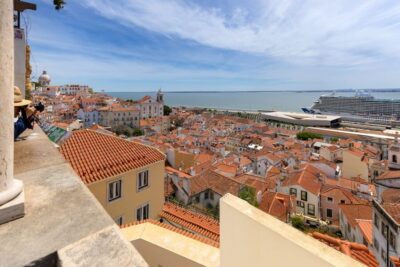


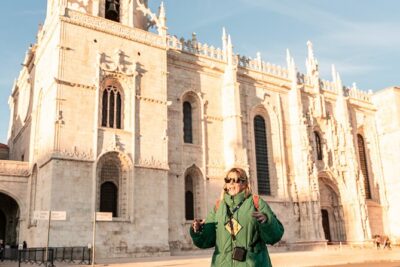
Carmo Convent After 1755: Seeing History Without a Museum Ticket

The tour doesn’t treat the 1755 earthquake as just background noise. You’ll reach the Carmo Convent, devastated by the earthquake and left as roofless stone arches and walls. What used to be a major church never fully returned to its former shape, so today the site reads like a visible before-and-after.
This stop works because it’s not “history talk in the abstract.” You can literally see the damage and the incompleteness of reconstruction. It’s a dramatic way to understand why Lisbon’s city center feels like it does—full of contrast between what was lost and what was rebuilt.
Practical note: because this is a standing, open-air ruin, you’ll want comfortable shoes and a watch for uneven ground. You’ll also want to take your time here. Even if you’re not a “ruins person,” the emotional weight of the place gives it meaning.
Rossio Square: The Public Stage of Lisbon’s Harder Chapters
From Carmo, the route flows toward Rossio, a square with origins that reach back beyond the 1755 earthquake to the 13th century. The tour frames Rossio as a once-central public area accessible to people across social status, which already tells you the square wasn’t only for elites.
Rossio also had heavy-purpose uses over time: bullfights, public shows, and royal declarations. During the Inquisition era it was also connected to public executions. That’s not light subject matter, but it gives Rossio a sharper identity than just “a place for photos.”
You’ll likely also catch sight of major buildings around the square, including the Queen Maria II National Theatre. The theatre is one of Portugal’s most prestigious historical venues, built in 1450, and historically tied to the Portuguese Inquisition and lodging for foreign noblemen. Even if you don’t go inside, the way the square frames the theatre helps you understand Rossio’s importance as a formal stage.
Santa Justa, Gloria, and the View Toward São Pedro de Alcântara

Lisbon’s elevators aren’t only tourist icons; they’re part of how the city makes elevation feel manageable. The tour includes the Santa Justa and Gloria elevator areas in its downtown-to-hills connection story, and it also points you toward viewpoints such as São Pedro de Alcântara.
Santa Justa is especially interesting because the design story is tied to engineering ambition. The elevator opened on 190, and the engineer drew inspiration from the Eiffel Tower model in Paris. Early operation used a steam engine before switching later to an electrical motor, which is a neat reminder that Lisbon’s “modern” looks have deep tech roots.
You may be thinking: will I ride the elevator? The tour doesn’t include entry to attractions, so if you want to go inside or take the ride, expect to pay separately. Even without that, the stop-by-viewpoint approach still gives you what you came for: angles, context, and the feeling of Lisbon’s vertical geography.
For photos, I’d treat this section as your reward. After walking through symbols, squares, and ruins, you get that payoff: seeing the city from a point that makes the whole downtown layout finally click.
Chiado and Theatres: From National Venues to Trinity Theatre Vibes
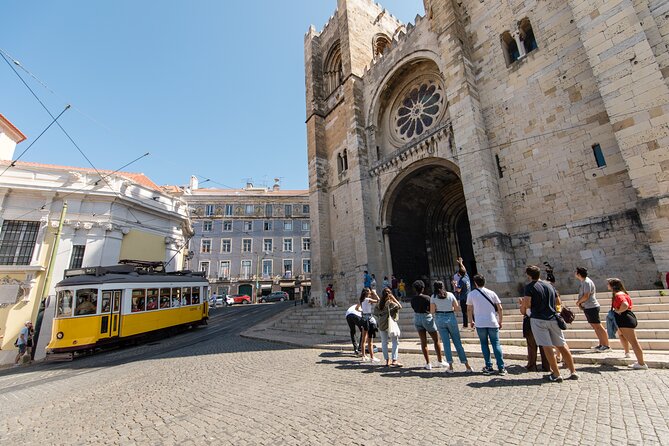
Chiado is where Lisbon feels more “theatre district,” even if you’re just walking through. The tour connects this area with major venues—starting with the Queen Maria II National Theatre and also mentioning the Trinity Theatre in its lineup of cultural spaces.
This matters because it changes how you read Chiado. It’s not only shopping and cafés. It’s also a place where public performance traditions shaped the neighborhood identity. When you see Lisbon’s theatres and know they’re part of the same downtown walking loop, it makes the city feel cohesive.
If your travel style includes stopping for 20 minutes to people-watch, Chiado gives you that option. After the more intense history stops (earthquake damage and Inquisition-era Rossio context), the theatre-focused streets help Lisbon feel human again.
Baixa Pombalina Streets: Shopping, Banking, and a Rebuilt City Core
The tour rounds out with Baixa Pombalina, the neighborhood shaped by reconstruction after 1755 by Marquês de Pombal. This is the main commercial and banking district stretching from the riverfront to Avenida da Liberdade, and it’s a key part of why Baixa feels ordered even compared to the hills.
What I like about this section is that it turns a “historical fact” into a walking reality. You don’t just hear that Lisbon was rebuilt—you see how the streets function as a major downtown corridor for commerce.
This is also where you get to understand Lisbon as an everyday city, not only a museum of monuments. Expect more shops, more street movement, and a more practical rhythm to the sidewalks.
Price and Logistics: Is $107 Good Value for Two Hours?
At $107 for about 2 hours, this is not a budget “quick hits” walk. You’re paying for a guided route through multiple major landmarks plus the included digital perk: the Vox City app with the map and multiple self-guided walking tours.
That app inclusion can shift the value equation in your favor. If you use it to plan more walking later the same day, you effectively stretch your money across a longer timeframe. And if you’re the type who likes to keep going after a tour ends, that matters more than the number of stops.
Also consider what’s not included: entry to attractions and food/drinks. This matters most if you want to go inside the Santa Justa elevator or other ticketed spots. The tour can still be satisfying without entries, but you’ll want to decide in advance if you want to budget extra for paid interiors.
Finally, note the tour ends back at the meeting point, which is convenient for regrouping. The walk is designed for most travelers, but you’ll still feel the city’s hills—so comfortable shoes aren’t optional.
Who This Tour Suits (and Who Might Want a Different Style)
I think this tour is best for you if you want a structured introduction to Lisbon downtown and you like seeing iconic places connected in a logical route. It’s also a strong pick if you enjoy learning just enough history to make each stop meaningful, while still keeping the day moving.
It may be less ideal if you expect extremely in-depth coverage of every stop. Some guiding styles can lean more on broad storytelling than deep analysis. If you know you’re the type who wants detailed historical context at every corner, you’ll want to choose a guide carefully or be ready to ask questions on the spot.
And if your top priority is only riding famous rides or only going inside major attractions, note again that entry fees aren’t included. You may prefer a tour that includes specific tickets. But if your priority is orientation, architecture, and viewpoints, this one fits well.
Should You Book the Lisbon Baixa Chiado Quarter Walking Tour?
Book it if you want a smart, walk-first tour of Lisbon’s downtown core, with Bertrand Bookstore, Rossio, Praça do Comércio-area landmarks, and the elevator/viewpoint connection all in one route. The included Vox City app is the extra value lever, especially if you plan to keep walking the same day.
Consider another option if you dislike time pressure or you want guaranteed deep storytelling at every stop. Because the itinerary includes a lot of major ground in a short window, your experience will depend on pacing and the guide’s emphasis.
If you do book, pack for a real walking day: solid shoes, water, and a calm mindset. Lisbon rewards that kind of pace. And once you’ve walked Baixa and Chiado this way, you’ll navigate the city with confidence the rest of the trip.
FAQ
How long is the Lisbon Baixa Chiado Quarter Walking Tour?
It lasts about 2 hours.
What landmarks will we see during the tour?
You’ll see iconic downtown sights including Santa Justa Elevator, Praça de Comércio, Rossio Square, Tram 28 (the iconic yellow tram), plus stops tied to places like Bertrand Bookstore, Bica elevator, Carmo Convent, Queen Maria II National Theatre, and viewpoints such as São Pedro de Alcântara.
Is the Vox City sightseeing app included in the price?
Yes. The tour includes a free Vox City app with the map of Lisbon and multiple self-guided walking tours.
Does the tour price include entry to attractions?
No. Entry to attractions is not included.
Is public transportation included?
No. Public transportation tickets are not included.
Where does the tour start and where does it end?
The tour starts at R. dos Douradores 16, 1100-161 Lisboa, Portugal, and it ends back at the meeting point.
How many people are in the group?
The tour has a maximum of 25 travelers.
Is there an evening version of the tour?
An evening walking tour is available only in high season.
Are service animals allowed?
Yes. Service animals are allowed.
More Tour Reviews in Lisbon
- Lisbon City Center Tour – The Unmissable Lisbon★ 5.0 · 22,234 reviews
- Lisbon: Sintra, Pena, Regaleira, Cabo da Roca & Cascais★ 4.7 · 19,656 reviews
- Lisbon Card: 24, 48, or 72-Hour Pass★ 4.5 · 17,944 reviews
- Lisbon: Jerónimos Monastery Entrance Ticket★ 4.1 · 14,164 reviews
- Lisbon: History, Stories and Lifestyle Walking Tour★ 4.8 · 10,902 reviews
More of Lisbon, One Hill at a Time
- Lisbon: History, Stories and Lifestyle Walking Tour★ 4.8 · 10,902 reviews
- Best of Lisbon Small-Group Guided Walking Tour★ 5.0 · 4,869 reviews
- Lisbon: Food and Wine Small Group Walking Tour★ 4.9 · 4,082 reviews
- Best of Lisbon Walking Tour: Rossio, Chiado & Alfama★ 4.9 · 2,700 reviews
- Age of Discoveries Walking Tour in Belém★ 5.0 · 1,513 reviews
Keep Wandering Old Alfama
- Alfama Tour in Lisbon Old Town★ 5.0 · 4,936 reviews
- Private Lisbon Sightseeing Tuk-Tuk Tour: Alfama, Belém & More★ 5.0 · 4,277 reviews
- Lisbon: Hills, Alfama, and Mouraria Tour by Electric Bike★ 4.8 · 3,438 reviews
- Best of Lisbon Walking Tour: Rossio, Chiado & Alfama★ 4.9 · 2,700 reviews
- Lisbon: Baixa District Food Tour with Dinner and Drinks★ 4.9 · 1,997 reviews
Just in: fresh Lisbon reviews from the team





Alfama & Old Town Tours, compared.
 ★ 5.0Alfama Tour in Lisbon Old TownFrom $34,936 reviews
 ★ 5.0Private Lisbon Sightseeing Tuk-Tuk Tour: Alfama, Belém & MoreFrom $524,277 reviews
 ★ 4.8Hills, Alfama, and Mouraria Tour by Electric BikeFrom $253,438 reviews
 ★ 4.9Best of Lisbon Walking Tour: Rossio, Chiado & AlfamaFrom $232,700 reviews
 ★ 4.9Baixa District Food Tour with Dinner and DrinksFrom $931,997 reviews
 ★ 5.0Lisbon Small-Group Food Tour with 18 Tastings in Alfama DistrictFrom $1261,967 reviews
 ★ 4.5Lisbon E-Bike Tour Commerce Square, Mouraria and AlfamaFrom $301,688 reviews
 ★ 5.0Old Town TukTuk Tour and Scenic Viewpoints in AlfamaFrom $35974 reviews
Browse the lists this tour appears in