
Reviewed · BELÉM TOURS
Belém District and the Salazar Dictatorship Legacy – Private Walking Tour
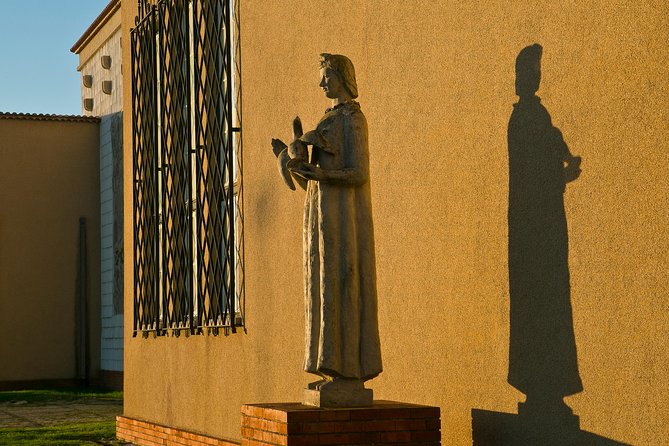
Belem changes after you understand the politics. This private walking tour links the Salazar dictatorship to the showpiece 1940 Portuguese World Exhibition across Lisbon’s riverside. You’ll walk the gardens and monuments where propaganda has been sandwiched into art, architecture, and public space.
One thing I like is the way Luís Maio (your guide) explains the big picture without turning it into a textbook. Two other standouts: the tour is genuinely personal (you can steer it toward your interests), and you also get a professional photographer guide for helpful photo moments along the way.
A fair heads-up: it’s still a 3-hour outdoor walk, and it’s weather-dependent. If you want a full ticketed museum day, you’ll likely need to add time in Belém afterward.
In This Review
- Key takeaways before you go
- Belem District and the Salazar dictatorship: why this walk makes sense
- Afonso de Albuquerque Square: where the story begins with symbols
- Vasco da Gama Garden: seeing what’s left of old Belém
- Mosteiro dos Jerónimos: a cathedral framed by political meaning
- Praca do Imperio: heraldic flowerbeds and the Exhibition’s hub
- Padrão dos Descobrimentos: the icon, and the details people miss
- Museu de Arte Popular: where modernist Lisbon interrupts the pageant
- Torre de Belém garden: closing the loop at the Discoveries end
- The guide experience: Luís Maio’s pacing and teachable style
- Walking, timing, and how to avoid feeling rushed
- Price and value: what $33.55 buys you (and what to watch)
- Best for: who this Salazar-era Belém tour is truly made for
- Should you book this private Belem walking tour?
- FAQ
- How long is the Belem District and Salazar Dictatorship Legacy tour?
- What does the tour cost?
- Is this tour private or group-based?
- Where does the tour start and end?
- What stops are included during the walk?
- Are entrance fees included?
- What’s included in the price?
- Do I need hotel pickup or drop-off?
- Is there a dress code?
- What happens if the weather is bad?
Key takeaways before you go

- Private, guided pace with Luís Maio, plus built-in room for questions and adjustments
- 1940 Exhibition lens: you learn how monuments and street details tie back to Estado Novo messaging
- Specific visual clues you might miss alone, like heraldic garden plantings, seahorses, and the wind-rose pavement
- Monuments-as-evidence approach: symbolism, missing labels, and why certain stories were emphasized or ignored
- Free admission at the stops listed on the route (your guide handles the flow)
- Photo-friendly stops in gardens and waterfront viewpoints, even when weather turns messy
Belem District and the Salazar dictatorship: why this walk makes sense
The Belém waterfront looks like Portugal showing off its Age of Discoveries. But under the surface, those same places were later used to sell a political story—especially during the Salazar years (Estado Novo) and the 1940 Portuguese World Exhibition.
What makes this tour click is the method. Instead of bouncing through history as a straight timeline, you read Belém like a set of clues. You start noticing details on monuments, gardens, and even street-level design that connect older “glory” to a modern dictatorship trying to control what people believed.
For you, that means the stops aren’t just pretty postcards. They become real context: why certain images were built, which themes were pushed, and how everyday public spaces can carry ideology.
More mornings among the monuments of Belém
- Lisbon: Jerónimos Monastery Entrance Ticket
★ 4.1 · 14,164 reviews - Private Lisbon Sightseeing Tuk-Tuk Tour: Alfama, Belém & More
★ 5.0 · 4,277 reviews - Age of Discoveries Walking Tour in Belém
★ 5.0 · 1,513 reviews - Lisbon: Bike Tour from Lisbon to Belém + Liquor & Pastry
★ 4.7 · 688 reviews
Afonso de Albuquerque Square: where the story begins with symbols
You start at Belem River Station, and your first stop is Afonso de Albuquerque Square. The square is a quick introduction to how Belém “layers” eras—your guide points out figures and motifs that connect the Discoveries period with the 1940 Exhibition.
This is also a good place to get your bearings. If you’re the type who likes to know what you’re looking at before you move on, the square works well: you get a set of reference points (people, themes, and time periods) so later stops don’t feel disconnected.
Note: this opening is short. You’ll get direction and key ideas, not a full lecture. Treat it like the warm-up before the waterfront monuments start talking.
Vasco da Gama Garden: seeing what’s left of old Belém

Next you head to the Vasco da Gama Garden. This stop is about the older side of Belém—“old Belém town” as it exists now, or what remains of it.
Here’s why it matters: modern Belém didn’t appear out of nowhere. Waterfront development, exhibitions, and later reshaping left scars and gaps. Your guide uses that idea to show how the city kept rebuilding its public image over time.
If you love urban history, this is the kind of stop that changes how you walk. Instead of treating Belém as a single “theme park” of monuments, you see it as a place that kept rewriting itself.
Mosteiro dos Jerónimos: a cathedral framed by political meaning
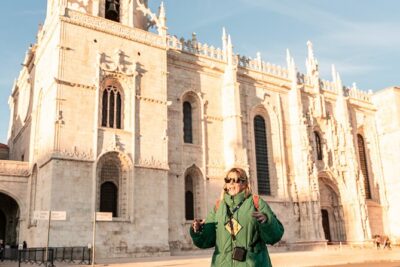
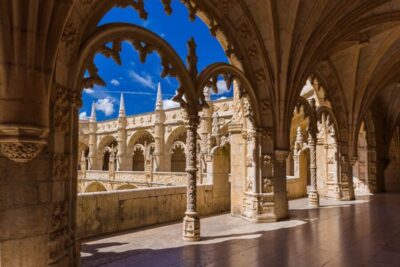
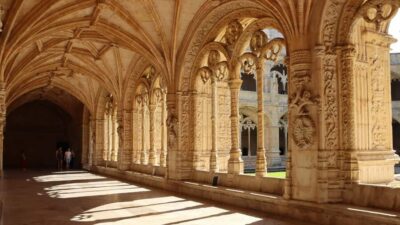
Then comes Mosteiro dos Jerónimos—one of Lisbon’s most famous late Gothic landmarks. During this part of the walk, you’re guided through the facade and interior spaces, with explanations of its historical and even “mystical” meanings.
Why does that fit the tour theme? Because regimes don’t just build posters. They shape the setting. Your guide connects the monastery’s prestige and symbolism to the atmosphere of national pride that the 1940 Exhibition was trying to amplify.
Practical angle for you: the monastery stop is packed with meaning, so don’t try to speed it. Take your time with what the guide highlights—details on layout, design choices, and the way space guides your attention.
Also, bring patience for crowds and shifting light. The tour format is designed to keep you moving, but this is a place where lingering actually helps.
Lisbon at walking pace, a few more routes



Praca do Imperio: heraldic flowerbeds and the Exhibition’s hub

After the monastery, you shift to Jardim da Praca do Imperio (the Praca do Imperio area). This square was the hub of the Portuguese World Exhibition, and it shows.
Your guide makes quick, focused stops around:
- heraldic flower beds
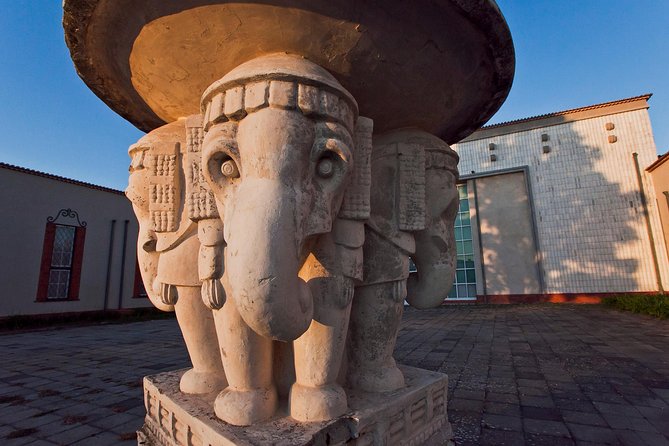
- a monumental fountain
- the famous seahorses
This isn’t just decorative trivia. In authoritarian settings, design is messaging. When you learn how the symbols work—why they appear where they do, and what themes they echo—you start seeing the square as an outdoor propaganda tool, not a neutral public plaza.
If you’re into photography, this is a strong section of the tour. Gardens and water features give you shade angles, reflections, and composition options without needing to hunt for viewpoints.
Padrão dos Descobrimentos: the icon, and the details people miss
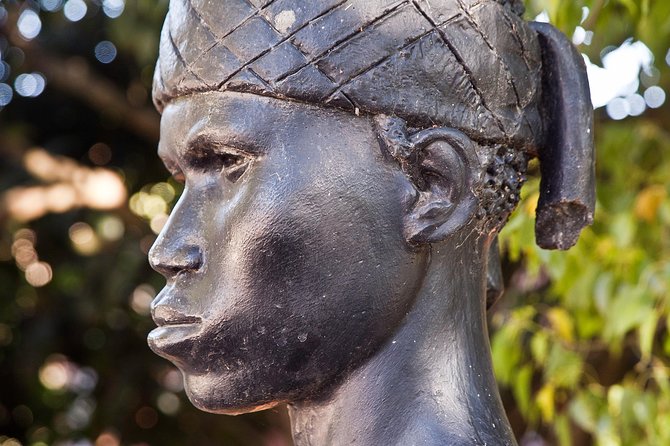
Next, you walk around Padrao dos Descobrimentos, with special attention to its role as the main icon connected to the 1940 Exhibition.
One of the most useful parts here is the way your guide ties artwork to interpretation. You’re encouraged to look for the question behind the monument: who is represented, what story the monument is trying to tell, and why you don’t always see clear labeling explaining it.
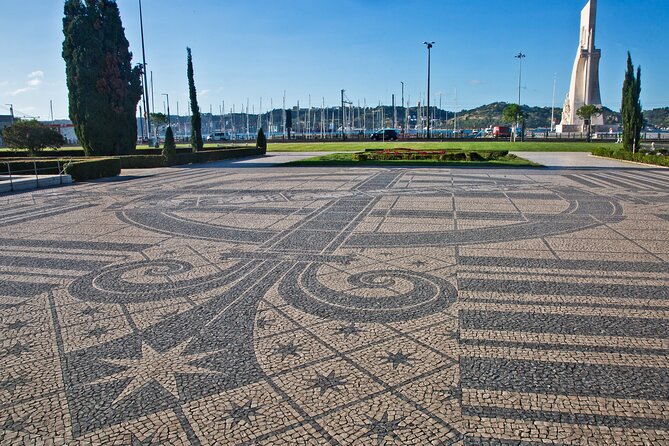
A standout clue is the wind rose that covers the pavement at the monument’s base. Your guide uses it to connect movement, direction, and the Exhibition’s “world” framing—very on-brand for Portugal’s self-image at the time.
If you’re a history buff, this is where you’ll likely have your most “wait, why don’t they explain this?” moments. And those moments are the whole point.
Museu de Arte Popular: where modernist Lisbon interrupts the pageant

Then there’s a quick pivot to Museu de Arte Popular—the Museum of Popular something-your-brain-might-not-expect. It’s described as a conundrum, even an oddity of Modernist Lisbon, and that contrast is part of what makes this tour feel alive.
You’re not spending long here, but the brief stop helps you notice something: the city’s visual language wasn’t only “old glory.” It also shifted into new styles and institutional spaces over time.
For you, this acts like a reality check. If everything feels too curated, this stop gives your eyes a break and reminds you that Belém’s story isn’t only about monuments. It’s also about how Lisbon kept modernizing around them.
Torre de Belém garden: closing the loop at the Discoveries end
Your walk ends near the Torre de Belem Garden area. Here you connect two big threads:
1) the Discoveries Age monument presence (Torre de Belém’s iconic status)
2) the Restelo upper-class neighborhood that grew after the 1940 Exhibition
The closing effect is powerful. By the time you reach the end, you’ve already learned how the dictatorship used the language of history—maritime discovery, national pride, and “Portugal as the center”—to build a persuasive public story.
So when you stand near the tower area, you don’t just see an old landmark. You see how that old landmark became useful for a newer political agenda.
The guide experience: Luís Maio’s pacing and teachable style
The quality of this tour lives or dies with the guide. Here, Luís Maio consistently comes up as careful, detailed, and responsive.
What stands out for your experience:
- He explains in a way that leaves you feeling like you can actually read the place afterward.
- He adjusts the pace based on your interests, even when your group is small.
- He’s attentive to comfort in real weather—choosing stops where you can sit, and steering you toward shade when it’s hot.
- In rain, the vibe doesn’t collapse. The walk keeps going with practical problem-solving.
You also get the advantage of a professional photographer guide. Even if you’re not trying to be a serious photographer, this helps. You’ll get prompts for where to stand, how to frame monuments, and how to capture Belém’s details without turning the day into constant phone-checking.
For you, the best move is simple: ask questions as they come up. When people do, the tour turns from sightseeing into understanding.
Walking, timing, and how to avoid feeling rushed
This is about 3 hours on foot, and the route is designed as a “guided walk with stops,” not a slow crawl.
Plan your day around that:
- Start the tour and treat it as the “orientation chapter” for Belém.
- Afterward, keep time for independent exploring—especially since the tour’s focus is guided viewing and interpretation at key locations.
Also, wear comfortable shoes. You’ll do real walking, and the route moves between river-adjacent areas, gardens, and major landmarks.
Weather matters here. The experience notes that it requires good weather, so if conditions are poor, you might be offered a different date or a refund.
Price and value: what $33.55 buys you (and what to watch)
At $33.55 per person for about 3 hours, this tour isn’t priced like a bare-bones group stroll. You’re paying for a private walking tour, plus a local professional guide and a professional photographer guide.
A practical value point: the listed stops show admission ticket free for what’s on the route, so you’re not constantly adding separate entrance fees while you’re walking and learning.
Two cautions for budgeting:
- Parking isn’t included; a parking fee may be payable at tour check-in.
- Food and drinks aren’t included, so if you’re sensitive to walking on an empty stomach, bring a plan.
One more scheduling note: it’s often booked well ahead (on average, about 89 days). If your travel dates are fixed, booking early is smart.
Best for: who this Salazar-era Belém tour is truly made for
This tour fits you if you want your Lisbon to explain itself—through symbolism, architecture, and political context.
Specifically, it’s a good match if:
- you like history with a strong theme, not just “here’s the monument” facts
- you’re curious about how authoritarian regimes used public spaces
- you care about photo stops and want help getting them without interrupting your learning
- you enjoy guides who can connect big ideas to small details (like pavement design and missing explanations)
It may feel less ideal if you mainly want:
- a long, museum-style inside visit day
- a purely chronological approach with fewer interpretive themes
- minimal walking
If your interest goes deeper into repression and resistance, you may want to pair this with another stop later in Lisbon—one suggestion that comes up is the Museum of the Resistance in Alfama.
Should you book this private Belem walking tour?
Yes, if you want the kind of Belém walk that changes what you notice. This is not just about monuments. It’s about how a specific political moment—Salazar’s era and the 1940 Exhibition—turned the waterfront into a story people were meant to accept.
Book it if:
- you want a private guide who can tailor the day
- you like detailed explanations tied to visible elements
- you’re okay with a steady outdoor pace for a few hours
Skip or rethink it if you:
- expect a museum crawl with lots of ticketed time
- want zero political context and only quick landmark photos
- can’t do outdoor walking, or you’re traveling when weather is unpredictable
FAQ
How long is the Belem District and Salazar Dictatorship Legacy tour?
It’s about 3 hours.
What does the tour cost?
The price is $33.55 per person.
Is this tour private or group-based?
It’s a private tour, so only your group participates.
Where does the tour start and end?
It starts at Belem River Station (Av. Brasília, 1300-598 Lisboa) and ends at Torre de Belém Garden (Av. Brasília, 1400-038 Lisboa).
What stops are included during the walk?
The route includes Afonso de Albuquerque Square, Vasco da Gama Garden, Mosteiro dos Jerónimos, Jardim da Praca do Imperio, Padrao dos Descobrimentos, Museu de Arte Popular, and Torre de Belém Garden.
Are entrance fees included?
The stops listed include admission ticket free.
What’s included in the price?
A local professional guide, a professional photographer guide, and a private walking tour are included.
Do I need hotel pickup or drop-off?
No. Hotel pickup and drop-off aren’t included.
Is there a dress code?
Dress code is smart casual.
What happens if the weather is bad?
This experience requires good weather. If it’s canceled due to poor weather, you’ll be offered a different date or a full refund.
More Tour Reviews in Lisbon
- Lisbon City Center Tour – The Unmissable Lisbon★ 5.0 · 22,234 reviews
- Lisbon: Sintra, Pena, Regaleira, Cabo da Roca & Cascais★ 4.7 · 19,656 reviews
- Lisbon Card: 24, 48, or 72-Hour Pass★ 4.5 · 17,944 reviews
- Lisbon: Jerónimos Monastery Entrance Ticket★ 4.1 · 14,164 reviews
- Lisbon: History, Stories and Lifestyle Walking Tour★ 4.8 · 10,902 reviews
More of Lisbon, One Hill at a Time
- Lisbon: History, Stories and Lifestyle Walking Tour★ 4.8 · 10,902 reviews
- Best of Lisbon Small-Group Guided Walking Tour★ 5.0 · 4,869 reviews
- Lisbon: Food and Wine Small Group Walking Tour★ 4.9 · 4,082 reviews
- Best of Lisbon Walking Tour: Rossio, Chiado & Alfama★ 4.9 · 2,700 reviews
- Age of Discoveries Walking Tour in Belém★ 5.0 · 1,513 reviews
Belém: More Monuments and Pastéis
- Lisbon: Jerónimos Monastery Entrance Ticket★ 4.1 · 14,164 reviews
- Private Lisbon Sightseeing Tuk-Tuk Tour: Alfama, Belém & More★ 5.0 · 4,277 reviews
- Age of Discoveries Walking Tour in Belém★ 5.0 · 1,513 reviews
- Lisbon: Bike Tour from Lisbon to Belém + Liquor & Pastry★ 4.7 · 688 reviews
- Bike Tours Lisbon – Center of Lisbon to Belém★ 5.0 · 686 reviews
Just in: fresh Lisbon reviews from the team





Belém Tours, compared.
 ★ 4.1Jerónimos Monastery Entrance TicketFrom $2114,164 reviews
 ★ 5.0Private Lisbon Sightseeing Tuk-Tuk Tour: Alfama, Belém & MoreFrom $524,277 reviews
 ★ 5.0Age of Discoveries Walking Tour in BelémFrom $31,513 reviews
 ★ 4.7Bike Tour from Lisbon to Belém + Liquor & PastryFrom $46688 reviews
 ★ 5.0Bike Tours Lisbon – Center of Lisbon to BelémFrom $19686 reviews
 ★ 3.7Jerónimos Monastery E-Ticket and Audio GuideFrom $33660 reviews
 ★ 4.9Belém Walking Tour with Jerónimos Monastery TicketFrom $69637 reviews
 ★ 4.0MAAT Gallery and MAAT Central Entry TicketsFrom $17559 reviews
Browse the lists this tour appears in