

Reviewed · TOURS
Roman Lisbon Tour
Roman Lisbon is under your feet.
I love how this tour mixes major visible monuments with the real archaeological stuff you can only see when you go in. You’ll start with a high, Roman-era orientation moment at Portas do Sol, then move through places like the Roman Theatre and Lisbon Cathedral cloister. I also like that the guidance is grounded in history—guides such as Ingo, Paulo, and Sandra are described as prepared, personable, and good at connecting different time periods into one story.
One consideration: this is a 3-hour walking route through standing sites and underground spaces, so comfortable shoes matter, and there’s no meal included. Plan for your energy, not just your curiosity.
In This Review
- Why Roman Lisbon Feels Different From Other Old-City Tours
- Key Highlights You’ll Care About
- Getting Oriented at Portas do Sol Before the Romans
- Roman Theatre: Seeing a Rare Survivor in Lisbon’s City Core
- Lisbon Cathedral Cloister: Walking Past Roman Streets in Plain Sight
- Roman Baths and the Temple of Cibele: Daily Life With a Spiritual Angle
- Casa dos Bicos: Roman Wall Evidence and the Factories Connection
- Going Underground in Lisbon: Garum Factories, Upper-Class Houses, and Pool Spaces
- Price and What You’re Really Paying for at $88
- Tour Flow, Pace, and Group Size: Why Private Works Here
- What to Bring (and What to Skip) for a Smooth Roman Day
- Who Should Book This Tour (and Who Might Want Another Option)
- Should You Book the Roman Lisbon Tour?
- FAQ
- How long is the Roman Lisbon Tour?
- How much does the Roman Lisbon Tour cost?
- Where do I meet the guide?
- What Roman sites will I see?
- Are entrance fees included?
- What languages are available for the live guide?
- Is this tour private?
- What should I bring?
- Is alcohol allowed during the tour?
- FAQ
- Is free cancellation available?
- What’s included in the tour besides the guide?
- Can I reserve and pay later?
Why Roman Lisbon Feels Different From Other Old-City Tours

Lisbon is one of Europe’s oldest cities, with legend crediting its founding to Odysseus. Before the Romans, the city was shaped by Phoenicians and Greeks. During the Roman era, it became an important trading place—so when you walk these streets, you’re not just looking at old buildings. You’re tracing a working city: where people gathered, bathed, worshiped, manufactured goods, and lived.
This tour gives you a focused Roman lens. You don’t get lost in random stops. Instead, you see a tight set of Roman-era layers that explain how the empire’s power showed up in everyday life here—above ground and below it.
Key Highlights You’ll Care About

- A Roman theatre inside a capital city: You see the Roman Theatre as a rare survival inside city walls.
- Cathedral cloister Roman remnants: Parts of Roman street fabric show up where you least expect it.
- Baths and the Temple of Cibele: You get a sense of civic life and religious space in Roman Lisbon.
- Casa dos Bicos Roman wall and factories: You’ll connect architecture to production and trade.
- Underground Lisbon archaeology: You’ll walk past upper-class homes, streets, garum production areas, and more.
Still deciding? See how this one measures up against a few Lisbon favourites.
- Lisbon City Center Tour – The Unmissable Lisbon
★ 5.0 · 22,234 reviews - Lisbon: Sintra, Pena, Regaleira, Cabo da Roca & Cascais
★ 4.7 · 19,656 reviews - Lisbon: Jerónimos Monastery Entrance Ticket
★ 4.1 · 14,164 reviews - Lisbon: History, Stories and Lifestyle Walking Tour
★ 4.8 · 10,902 reviews
Getting Oriented at Portas do Sol Before the Romans
The tour kicks off at Portas do Sol, one of Lisbon’s well-known viewpoints. The point isn’t just getting a nice look. It’s setup. Standing above the city helps you build a mental map of where Roman Lisbon likely sat in relation to the present-day streets.
That matters, because later stops can feel scattered if you approach them like a “see-everything” checklist. Starting with orientation helps you understand why these Roman sites cluster where they do, and how the city’s importance grew during the Roman era.
Also, viewpoints are where you can reset your pace. You’re about to spend time walking through multiple heritage spaces, including indoor and underground sections. Taking a few minutes to settle in right at the beginning makes the rest of the tour smoother.
Roman Theatre: Seeing a Rare Survivor in Lisbon’s City Core

Next up is the Roman Theatre. This is one of the tour’s headline stops for a simple reason: it’s described as the only Roman theatre that exists within the walls of a European capital (after Rome itself). That kind of survival changes how you experience the site. You’re not looking at ruins that feel far away. You’re seeing Roman public life embedded in a living city.
A good guide also helps you picture what theatres meant in Roman culture—public events, civic identity, and entertainment. The key value here is that you’ll connect the theatre to the larger Roman story of Lisbon as a trading hub and administrative center, not treat it like an isolated photo stop.
If you care about architectural survival—how some Roman structures endure while others don’t—this stop will grab you fast. And if you’re bringing kids or Roman-history fans, the theatre is easy to understand: it looks like a theatre, even when it’s a ruin.
Lisbon Cathedral Cloister: Walking Past Roman Streets in Plain Sight
From the theatre, you shift into a completely different mood: the Lisbon Cathedral cloister. Here’s what makes it special on this tour. You don’t just tour a pretty cloister. You find parts of Roman streets of Lisbon within the cathedral area.
That’s the moment where the tour stops being “interesting history” and becomes “how layers stack in a real city.” Lisbon’s long timeline means Roman materials can show up inside later religious and civic buildings. Seeing that in context makes the city feel tangible, not just old.
Why I like this stop for practical travelers: cloisters are often quieter and slower-paced than outdoor streets. It’s a good time to absorb details, ask questions, and let the guide explain how Roman urban life would have felt—then compare it to what’s built above it now.
Comfort note: you’ll still be moving between sites, so keep your shoes steady. Cloisters can mean uneven stone and lots of walking over heritage surfaces.



Roman Baths and the Temple of Cibele: Daily Life With a Spiritual Angle
After the cathedral, the route passes through two more Roman anchors: a Roman bath and the Temple of Cibele. If you’ve only seen Roman ruins as monuments or battle scenes, these stops change the picture.
A bath is about routine. It tells you Romans planned comfort, hygiene, and social space into the city. A temple tells you the city also reflected belief systems and civic religion. Put together, they help you understand that Roman Lisbon wasn’t only about trade and power. It was also about how people spent time, moved through public space, and organized their beliefs.
I also appreciate how this segment keeps the tour varied. You’re not stuck with one building type. Instead, you get multiple windows into Roman priorities: body and community at the baths, and worship and identity at the temple.
This section is a good match if you like tours that tell a “how people lived” story rather than only “what was built.”
Casa dos Bicos: Roman Wall Evidence and the Factories Connection

Then you head toward Casa dos Bicos. This is where the tour leans into archaeology and urban function. The stop is framed around seeing part of the Roman wall and Roman factories.
That combination—fortification plus production—hits an important theme. Roman cities were not just places where leaders ruled. They were systems that produced goods, moved them through trade networks, and kept the infrastructure running.
If you enjoy tours that connect buildings to economic life, this stop is a highlight. It helps you picture Lisbon as an active Roman trading place, not just a location on a map.
For photography lovers: this stop gives you Roman-era structure points without requiring you to imagine everything from scratch. You can see evidence directly and let your guide tie it back to the bigger Roman pattern.
Going Underground in Lisbon: Garum Factories, Upper-Class Houses, and Pool Spaces
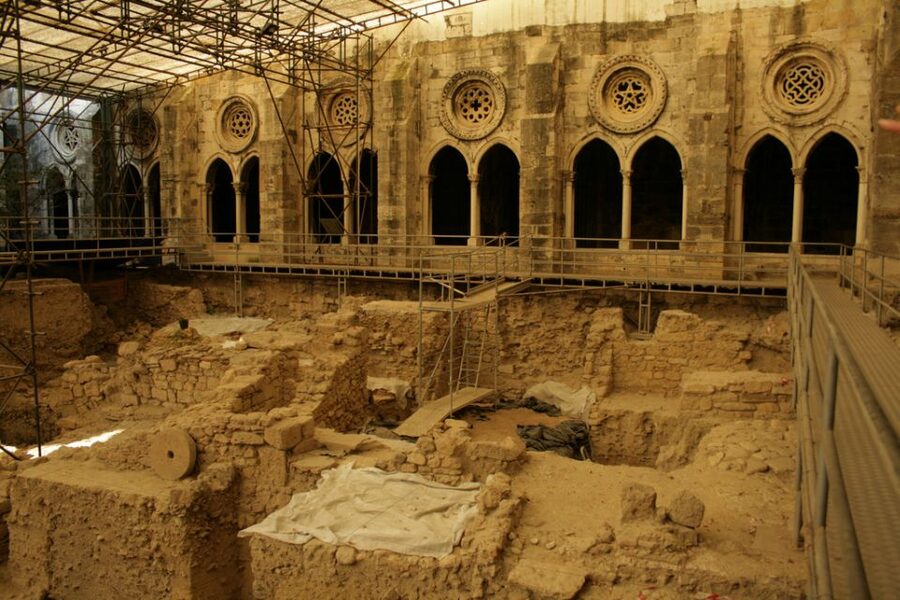
The most unforgettable part of the experience is the walk into the underground of Lisbon. This is where you see archaeological structures that are harder to find on your own: upper-class houses, streets, garum factories, swimming pools, and other artifacts.
Going underground changes the way history lands. Outdoors, you’re often looking at what’s left from the surface. Underground, you’re closer to the original layout of how spaces worked. It’s also where Roman Lisbon starts to feel less like a “chapter” and more like a functioning city that once had rhythms.
A big value of this segment is variety. You’re not only seeing production areas. You’ll move through evidence of different social layers (upper classes), different uses for space (streets), and everyday or specialized facilities (including swimming pool structures).
This is the part I’d point to for families, too, because “what’s underground” naturally pulls attention. Just come prepared for uneven footing and the feel of enclosed heritage spaces.
Price and What You’re Really Paying for at $88
At $88 per person for 3 hours, the real question is value. The tour includes a guided experience managed by a history-graduated guide, plus entrance tickets to the Roman Theatre, the cathedral cloister, and other archaeological sites.
That combination matters more than it sounds. Many city tours advertise “guided history,” but you still end up buying separate admissions. Here, the price bundles the access pieces. When you’re moving between multiple heritage sites—especially ones that involve cloisters and underground areas—entrance fees and logistics can add up fast.
You’re also buying a tight narrative. A focused Roman route is usually worth paying for if you want coherence rather than a long day of random stops. This tour gives you a Roman through-line: from orientation, to public life (the theatre), to daily routines (baths), to worship (Temple of Cibele), to production and walls (Casa dos Bicos), and finally to underground archaeology (garum factories and more).
If you’re the type who likes to see a handful of key places well explained, this price feels reasonable. If you prefer long, self-guided wandering with no structured pacing, you might decide a cheaper format fits you better.
Tour Flow, Pace, and Group Size: Why Private Works Here
This is a private group tour. That can be a quiet advantage on an archaeology-focused day. Roman Lisbon has details that rewards attentive listening—street traces, structure evidence, and the way each stop connects. A private format makes it easier to match pace and ask questions without feeling rushed.
The tour is 3 hours, which is a practical length. It’s long enough to cover a meaningful Roman arc and to include the underground segment. It’s also short enough that you don’t end up exhausted before the best stop.
Languages are Spanish, English, French, and Portuguese, with a live guide. That matters because history tours live or die by explanation quality. The guides described in the experience are credited with strong preparation and a personable delivery, plus a talent for tying the dots across time periods.
What to Bring (and What to Skip) for a Smooth Roman Day
You’ll be on your feet, moving between distinct heritage spaces. Bring:
- Passport or ID card
- Comfortable shoes
Skip:
- Alcohol and drugs
Also plan to go without a meal stop. The tour does not include food or drinks, so consider eating before you start or after you finish. It’s an easy way to avoid the “history fatigue” that hits when you’re hungry but trying to stay engaged.
The meeting point is next to the entrance of the Arts Decorativas Portuguesas Museum. Arriving a few minutes early helps you settle in before the first viewpoint stop.
Who Should Book This Tour (and Who Might Want Another Option)
This tour is a great fit if:
- You want Roman Lisbon focused, not scattered.
- You like archaeology that shows different layers of a city.
- You enjoy a guide who can connect Roman sites into one story. Guides like Ingo, Paulo, and Sandra are specifically highlighted for how they tell that story—prepared facts and a friendly, passionate approach.
- Your group wants a structured 3-hour experience with entrances handled.
You might skip or consider an alternative if:
- You hate walking or closed spaces, since the route includes underground sections.
- You want a free-roaming day with lots of unscheduled time. This is designed as a set route, not a choose-your-own-adventure.
Should You Book the Roman Lisbon Tour?
I’d book it if your Lisbon time is limited and you want Roman Lisbon done in a smart, efficient way. For $88, you get a history-trained guide, entrance access to major Roman and cathedral areas, and the standout underground archaeology segment—garum factories, upper-class houses, streets, and more.
If you’re deciding between this and a general old-city walk, choose this one. The difference is focus. You’ll leave with a clearer sense of how Roman power and daily life shaped Lisbon—not just isolated sights.
Book it when you can wear comfortable shoes and when you’re ready for a route that moves from skyline orientation down into the Roman layers beneath the city.
FAQ
How long is the Roman Lisbon Tour?
The tour lasts 3 hours.
How much does the Roman Lisbon Tour cost?
The price is $88 per person.
Where do I meet the guide?
You meet next to the entrance of the Arts Decorativas Portuguesas Museum.
What Roman sites will I see?
You’ll visit major Roman locations including the Roman Theatre, areas connected to the Lisbon Cathedral cloister, a Roman bath, the Temple of Cibele, Casa dos Bicos, and archaeological spaces underground.
Are entrance fees included?
Yes. Entrance is included for the Roman Theatre, the cathedral cloister, and other archaeological sites.
What languages are available for the live guide?
The live guide offers tours in Spanish, English, French, and Portuguese.
Is this tour private?
Yes, it’s a private group tour.
What should I bring?
Bring your passport or ID card and comfortable shoes.
Is alcohol allowed during the tour?
No. Alcohol and drugs are not allowed.
FAQ
Is free cancellation available?
Yes. You can cancel up to 24 hours in advance for a full refund.
What’s included in the tour besides the guide?
You get a guided tour managed by a guide graduated in history, plus entrance to the Roman Theatre and the cathedral cloister and other archaeological sites. No meal or drinks are included.
Can I reserve and pay later?
Yes. The activity offers a reserve now & pay later option.
More Tours in Lisbon
- Lisbon City Center Tour – The Unmissable Lisbon★ 5.0 · 22,234 reviews
- Lisbon: History, Stories and Lifestyle Walking Tour★ 4.8 · 10,902 reviews
- True 4Hour Private Tuk Tuk Tour: Discover Lisbon with a Local!★ 5.0 · 8,008 reviews
- Winner 2025 Undiscovered Lisbon Food & Wine Tour by Eating Europe★ 5.0 · 6,390 reviews
- Lisbon: Sintra, Pena, Cabo da Roca, Cascais Tour with Pickup★ 4.8 · 5,445 reviews
More Tour Reviews in Lisbon
- Lisbon City Center Tour – The Unmissable Lisbon★ 5.0 · 22,234 reviews
- Lisbon: Sintra, Pena, Regaleira, Cabo da Roca & Cascais★ 4.7 · 19,656 reviews
- Lisbon Card: 24, 48, or 72-Hour Pass★ 4.5 · 17,944 reviews
- Lisbon: Jerónimos Monastery Entrance Ticket★ 4.1 · 14,164 reviews
- Lisbon: History, Stories and Lifestyle Walking Tour★ 4.8 · 10,902 reviews
Just in: fresh Lisbon reviews from the team





Tours, compared.
 ★ 5.0Lisbon City Center Tour – The Unmissable LisbonFrom $322,234 reviews
 ★ 4.8History, Stories and Lifestyle Walking TourFrom $2910,902 reviews
 ★ 5.0True 4Hour Private Tuk Tuk Tour: Discover Lisbon with a Local!From $1088,008 reviews
 ★ 5.0Winner 2025 Undiscovered Lisbon Food & Wine Tour by Eating EuropeFrom $1256,390 reviews
 ★ 4.8Sintra, Pena, Cabo da Roca, Cascais Tour with PickupFrom $585,445 reviews
 ★ 5.0Alfama Tour in Lisbon Old TownFrom $34,936 reviews
 ★ 5.0Best of Lisbon Small-Group Guided Walking TourFrom $234,869 reviews
 ★ 4.11-or 2-Day Hop-On Hop-Off Bus TourFrom $254,774 reviews