
Watch horses rehearse like clockwork. This Lisbon morning at the Portuguese School of Equestrian Art gives you a rare peek at Lusitano riders getting ready for showtime, then walking you through what makes the tradition tick. You’ll end at Henrique Calado Arena, where the work turns into choreographed training moments.
My favorite part is the behind-the-scenes viewing: you get warm-up and agility drills with riders in period-style costume, so you can see how the training starts and why it looks so controlled. I also like that you can spend time looking around the stables area at your own pace and use an audioguide if you want extra context while you’re there.
One heads-up: the main training block at the arena can feel short, and if you’re expecting a long, commentary-heavy lesson, you may find it disappointing. Also, one booking experience reported missing a voucher, so it’s smart to keep confirmation handy in case you need to handle anything at the desk.
In This Review
- Key moments worth your morning
- Inside Lisbon’s Portuguese School of Equestrian Art: what you’re really buying
- Queluz gardens setting: why the location matters
- Behind the scenes: warm-ups, handlers, and Lusitano agility
- Nora Pateo interpretive route: how Portuguese equestrian art is explained
- Henrique Calado Arena training: where it turns into court spectacle
- Price and value: why $9 can still be a fair trade
- Practical tips: meeting point, timing, and what to plan for
- Accessibility and who can comfortably enjoy it
- Who this Lisbon equestrian training morning fits best
- Should you book the Portuguese School of Equestrian Art training morning?
- FAQ
- Where is the meeting point?
- How long is the experience?
- What does the ticket include?
- Do I need tickets for Queluz Palace or Queluz Gardens?
- What happens during the morning?
- When does the arena session happen, and does it change on Wednesday?
- Is it wheelchair accessible?
Key moments worth your morning
- Warm-up + agility practice up close, not just the final performance
- Period-style rider presentation, which helps you read the movements
- Time to wander the stables area, with options like an audioguide
- Nora Pateo interpretive route, focused on the techniques behind Portuguese equestrian art
- Henrique Calado Arena training (or Wednesday exhibitions) with lighting that makes the routines feel stage-ready
Inside Lisbon’s Portuguese School of Equestrian Art: what you’re really buying
For about $9 per person, you’re not buying a big, flashy show. You’re buying access to a living training culture—how horses and riders prepare, how the work is structured, and how the same discipline becomes stage-ready at Henrique Calado Arena.
The best value here is timing. You’re there during the hours when the site runs its daily rhythm: a guided interpretive portion in the Nora Pateo area, then the training or exhibitions in the arena. In other words, you’re not just arriving after the horses have done their best tricks. You see the process.
Worth a look before you lock anything else in around Lisbon:
- Sailboat Tour in Lisbon with drinks included | Morning and Sunset
★ 4.5 · 867 reviews - Lisbon: Tagus River Cruise, Morning, Day, Sunset, or Night
★ 4.9 · 640 reviews - Lisbon: Morning of Equestrian Art with Lusitano Horses
★ 4.4 · 87 reviews - Morning Sailing Tour in Tagus River from Lisbon
★ 5.0 · 68 reviews
Queluz gardens setting: why the location matters
This experience happens in the gardens connected to the National Palace of Queluz. That’s not just a pretty backdrop. The setting helps you understand why this equestrian tradition was built for court life—formal, measured, and meant to be seen at a distance and up close.
As you move through the grounds, keep an eye on how the day is staged. Even when you’re not watching the arena, the choreography of preparation—handlers working with horses, riders moving into position, equipment checks—sets the tone for what you’ll later see in the ring.
You’ll also want to plan around the opening window. The visit runs between 11am and 1pm, with specific times for each part (more on that below). If you show up late, you’ll miss part of the rhythm.
Behind the scenes: warm-ups, handlers, and Lusitano agility
The morning starts with preparation—the part many people never get to see. You’ll watch how handlers and horses get ready, then observe riders doing warm-up and agility exercises.
This is where you learn to look differently. Instead of treating the training as entertainment, you can spot the practical goals: getting horses attentive, loosening and organizing movement, and bringing riders into balance before any staged routine begins. The drills are controlled, and you’ll notice how much of the look comes from repetition and timing.
One review detail that stuck with me: you can end up close enough to feel the scale of the animals and see the work firsthand, not from some far-off viewpoint. If you’re the kind of person who likes to understand how things are built—how tack is used, how horses respond to signals—this segment is a strong match.
Nora Pateo interpretive route: how Portuguese equestrian art is explained
After the initial viewing, you’ll follow an interpretative route at Nora Pateo. Think of this as the bridge between watching the work and understanding why it’s done that way.
The route focuses on the history and techniques of Portuguese equestrian art, tied to the 18th-century Portuguese court tradition. That matters because without context, the training can look like only artistry. With context, you start seeing it as a system: discipline, schooling, and movement controlled for performance.
If you’re an audio person, you’ll likely appreciate the option of using an audioguide during your time at the site. One of the standout review comments was that this self-paced option helped make the stables and surroundings feel more meaningful, not just observational.



Henrique Calado Arena training: where it turns into court spectacle
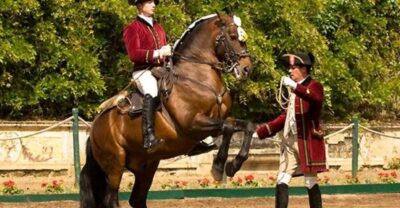
The highlight of the day is the session at Henrique Calado Arena. This is where riders and horses perform choreographed routines to music, recreating the ambiance of the Portuguese court.
Expect a stage-like setup. The arena has stage lighting that makes a difference: you’ll see movements more clearly, and the atmosphere feels more like a real presentation than a casual training moment. For many people, this is the emotional payoff—the part where the morning’s prep clicks into something you can really appreciate.
Important timing detail:
- The training at Henrique Calado Riding Ring runs 12pm to 1pm, except Wednesday.
- On Wednesday, that 12pm to 1pm block becomes exhibitions instead.
If you care about the exact type of session you’ll see, check your day of the week before you book. You’ll be happier if you align your expectations with what’s scheduled.
Price and value: why $9 can still be a fair trade
At $9 per person for a full morning slot (roughly 1 day, with a structured timetable), the price can feel like a bargain—especially if you like horses, craft, and process.
Here’s the honest breakdown:
- You get the Portuguese School of Equestrian Art entry ticket.
- You get access to Henrique Calado Arena.
- You get the interpretative route at Nora Pateo.
- It’s also designed to skip the ticket line, which saves time.
What you should not expect at this price:
- Food is not included.
- Entry to the Queluz National Palace and the Queluz National Gardens is not included.
- And the arena training portion is time-boxed. One review basically boiled down to: the personal tour could be good, but the training viewing alone wasn’t worth it. That doesn’t mean the training is bad—it means your money may stretch further if you’re the type who uses the interpretive route and stables time to get more meaning out of what you’re watching.
So the “value question” is really about you. If you want a longer narrated lesson about technique, you might need extra context beyond this morning. If you want an authentic, close look at how the court-style rhythm is practiced, the price is hard to beat.
Practical tips: meeting point, timing, and what to plan for
Meeting point: CALÇADA DA AJUDA (near number 23). Arrive a bit early so you don’t spend your morning hunting for the start point.
Opening hours: 11am to 1pm. Within that, the schedule breaks down like this:
- Nora Pateo visits: 11am to 12pm
- Henrique Calado training: 12pm to 1pm (except Wednesday)
- Henrique Calado exhibitions: 12pm to 1pm (Wednesday)
That means if you arrive late, you can lose either the interpretive route or the arena segment. And since the whole experience is built as a sequence—prep → interpretation → performance—missing a piece changes the impact.
What to bring:
- Water, since food and drinks aren’t included.
- Comfortable shoes. You’ll spend time moving through the site, and parts of the experience involve walking.
- Your phone for timing checks and maps, but keep in mind you might also want to rely on the on-site flow rather than constant re-navigation.
If you’re one of the people who double-checks bookings: one person reported arriving without the application/voucher they expected and had to buy a ticket at the desk. So have your confirmation ready, even if everything is supposed to be smooth.
Accessibility and who can comfortably enjoy it
The good news: the experience is wheelchair accessible.
The fine print: there are accessibility restrictions to the cabin and the south stall, and that area involves stairs. If you use a wheelchair and want full access to every area, it’s worth keeping this in mind so there are no surprises about where you can and can’t go.
Who this Lisbon equestrian training morning fits best
This is a great choice if you:
- love horses and want to see how training is built step by step
- enjoy seeing crafts and routines up close, not only watching a finished show
- want a cultural experience tied to Portuguese court tradition, in an accessible format
- like interpretive context, especially if you’ll use an audioguide
It’s not ideal if you:
- expected a long, detailed coaching session
- mainly came for food, wandering gardens, or a palace visit (those are not included)
Should you book the Portuguese School of Equestrian Art training morning?
Yes, I’d book it if you want a morning that blends process and presentation. The combination of watching warm-ups, taking the Nora Pateo interpretive route, and then seeing the arena segment at Henrique Calado gives you a full arc, not just a single highlight.
I’d think twice if your main goal is extensive commentary or a longer lesson format. In that case, you may find the training window a little brief for your taste, and you might be happier pairing this with added interpretation from the site.
If you’re arriving in Lisbon and want something genuinely practical and cultural—hands-on viewing of trained Lusitano movement—this is one of the easier ways to do it.
FAQ
Where is the meeting point?
Meet at CALÇADA DA AJUDA (near number 23).
How long is the experience?
It’s a 1-day activity with sessions scheduled within 11am to 1pm.
What does the ticket include?
It includes the Portuguese School of Equestrian Art entry ticket, access to Henrique Calado Arena, and the interpretative route at Nora Pateo.
Do I need tickets for Queluz Palace or Queluz Gardens?
No. Queluz National Palace entry and Queluz National Gardens entry are not included.
What happens during the morning?
You’ll start with behind-the-scenes viewing and warm-up/agility work, then do the Nora Pateo interpretive route, and finish with a session at Henrique Calado Arena from 12pm to 1pm.
When does the arena session happen, and does it change on Wednesday?
The arena session is 12pm to 1pm. It’s training except on Wednesday, when it becomes exhibitions.
Is it wheelchair accessible?
Yes, it’s wheelchair accessible, but there are stairs and limitations for access to the cabin and the south stall.
More Morning in Lisbon
- Sailboat Tour in Lisbon with drinks included | Morning and Sunset★ 4.5 · 867 reviews
- Lisbon: Tagus River Cruise, Morning, Day, Sunset, or Night★ 4.9 · 640 reviews
- Lisbon: Morning of Equestrian Art with Lusitano Horses★ 4.4 · 87 reviews
- Morning Sailing Tour in Tagus River from Lisbon★ 5.0 · 68 reviews
- Lisbon Original Morning Food Tour by Food Lover Tour★ 5.0 · 57 reviews
More Tour Reviews in Lisbon
- Lisbon City Center Tour – The Unmissable Lisbon★ 5.0 · 22,234 reviews
- Lisbon: Sintra, Pena, Regaleira, Cabo da Roca & Cascais★ 4.7 · 19,656 reviews
- Lisbon Card: 24, 48, or 72-Hour Pass★ 4.5 · 17,944 reviews
- Lisbon: Jerónimos Monastery Entrance Ticket★ 4.1 · 14,164 reviews
- Lisbon: History, Stories and Lifestyle Walking Tour★ 4.8 · 10,902 reviews
Just in: fresh Lisbon reviews from the team



Morning, compared.
 ★ 4.5Sailboat Tour in Lisbon with drinks included | Morning and SunsetFrom $36867 reviews
 ★ 4.9Tagus River Cruise, Morning, Day, Sunset, or NightFrom $25640 reviews
 ★ 4.4Morning of Equestrian Art with Lusitano HorsesFrom $1787 reviews
 ★ 5.0Morning Sailing Tour in Tagus River from LisbonFrom $3068 reviews
 ★ 5.0Lisbon Original Morning Food Tour by Food Lover TourFrom $8357 reviews
 ★ 4.9Early Morning TukTuk Tour – hotel/cruise ship pickupFrom $7645 reviews
 ★ 4.6Original Morning Food TourFrom $7626 reviews
 ★ 4.53 Elevators in the Morning or at SunsetFrom $3712 reviews