
Reviewed · LISBON TUK-TUK TOURS
Tuk Tuk Lisbon: Exploring Urban Art
Lisbon’s walls talk back. This tuk tuk street art tour lets you move fast between neighborhoods while a private guide turns murals into stories you can actually use, not just something you glance at. I also like how the ride works for photos, with guides and drivers ready to slow down or stop when traffic allows, so you can get the shot you came for.
One thing to consider: it’s not a great fit if you have reduced mobility, since you’ll be getting in and out of the tuk tuk and walking to view the street art up close.
In This Review
- Key highlights to look for
- Lisbon street art by tuk tuk: why the ride matters
- Santa Apolónia and Pichi&Avo: tags meet sculptural color
- Campo de Santa Clara’s André Saraiva wall of tiles
- Vhils in Travessa das Merceeiras: Alexandre Farto and carved faces
- Graça literary murals: Sophia de Mello Breyner and the neighborhood viewpoints
- Avenida Fontes Pereira de Melo: Os Gémeos, Blu, Eric Il Cane, Sam3
- Lx Factory street art stops with Bordalo II’s garbage bee
- Price, timing, and what you really get in 2–3 hours
- Who should book this Tuk Tuk Lisbon urban art route
- Should you book? My straight answer
- FAQ
- How long is the Tuk Tuk Lisbon urban art tour?
- What’s the price per person?
- Is pickup included?
- Is the tour private?
- What language is the guide in?
- Do I need to buy monument tickets?
- Are food and drinks included?
- Is the tour suitable for reduced mobility or pregnancy?
- Is there free cancellation?
Key highlights to look for
- Real urban-art names, from Pichi&Avo to Vhils (Alexandre Farto)
- Tile-mural scale at Campo de Santa Clara: 170 meters and about 53,000 tiles
- Graça literature faces, with viewpoints nearby for a natural pause
- International wall power on Avenida Fontes Pereira de Melo, including Os Gémeos and Blu
- Lx Factory energy, with works by Bordalo II (including a bee made from garbage)
Lisbon street art by tuk tuk: why the ride matters
Urban art in Lisbon isn’t all in one neat museum block. It’s scattered: hills, viewpoints, walls by markets, and streets where you’ll want to look both ways because life is still happening. A tuk tuk tour solves the biggest problem—getting from mural to mural without burning half your day on planning and transit.
What makes this one work is the private guide setup. You’re not listening to a generic script for strangers; you’re getting city context tied directly to what you’re seeing: why a mural is here, how it connects to the neighborhood, and what to notice when you’re standing in front of it. Guides from past bookings (like Nuno, Filipe, and Pifas) are known for mixing art facts with Lisbon street-level talk, which is exactly what you want on a 2 to 3 hour outing.
And yes, the tuk tuk format is also practical. You get quick transfers, then short walking moments for the best wall angles. It’s a good plan for a first or mid-trip Lisbon day, especially if you’re the type who likes your sightseeing to feel personal, not rushed.
The hills done the easy way, more tuk-tuk runs
- True 4Hour Private Tuk Tuk Tour: Discover Lisbon with a Local!
★ 5.0 · 8,008 reviews - Lisbon: Private Guided Tuk-Tuk Tour with Hotel Pickup
★ 4.9 · 4,552 reviews - Private Lisbon Sightseeing Tuk-Tuk Tour: Alfama, Belém & More
★ 5.0 · 4,277 reviews - Lisbon Highlights: Private Tuk Tuk Tour Adventure Sightseeing
★ 5.0 · 3,284 reviews
Santa Apolónia and Pichi&Avo: tags meet sculptural color
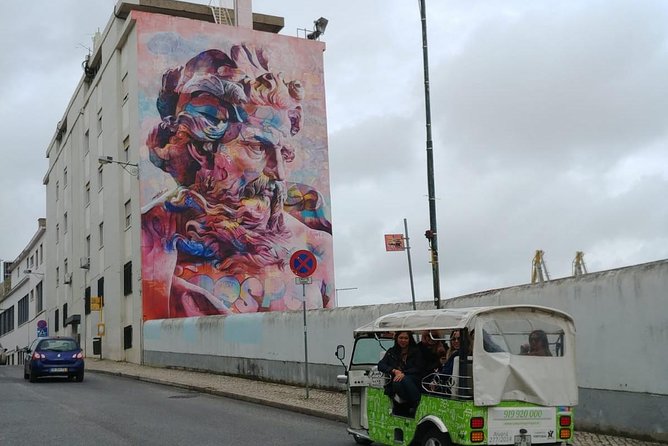
You start on the sidewalk of Santa Apolónia, with the Pichi&Avo mural on Calçada de Santa Apolónia. The piece is hard to miss once you’re standing there: a sculptural figure layered over what feels like an endless field of tags and marks. That contrast is part of the point—classic-looking form and rebellious graffiti energy sharing the same surface.
Here’s what I’d tell you to do when you arrive: slow down and scan in layers. From a distance, focus on the big figure and its silhouette. Then step closer and notice the brushwork. Pichi&Avo’s style is known for coarser brush strokes meeting more careful drawing, and you can actually see that tug-of-war between roughness and precision when you take your time.
This stop also ties urban art to Lisbon’s contemporary gallery world. The mural was created within the scope of an exhibition called Versus at the Underdogs Gallery, which gives you a useful angle: these walls aren’t just random paint. They’re part of the broader street-art ecosystem—where galleries, artists, and the city conversation overlap.
Potential drawback at this stop: you may feel a little competition from passing pedestrians and street noise, since it’s right where people live and walk. Go at the speed of photos: grab your key shots first, then linger for the details.
Campo de Santa Clara’s André Saraiva wall of tiles
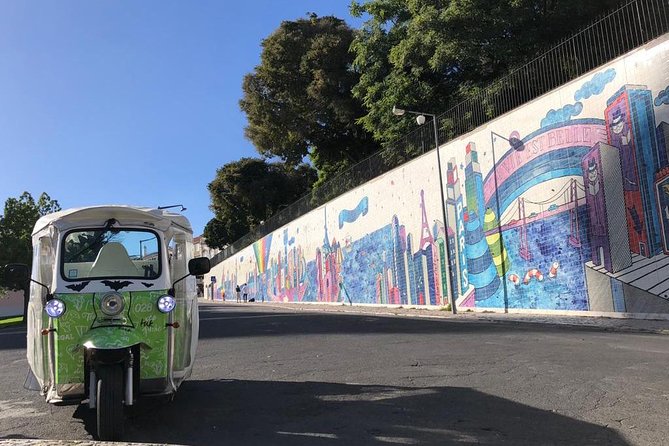
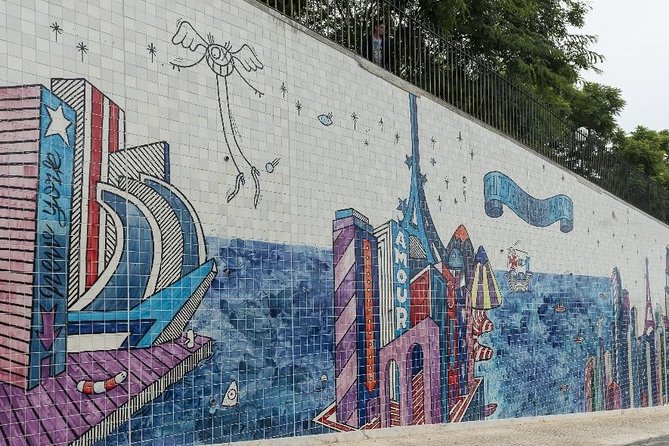
Next up is Santa Clara Field, where the old wall of Jardim Botto Machado (near Campo de Santa Clara / Feira da Ladra) becomes a long-format gallery wall. André Saraiva’s tile mural stretches for 170 meters and covers about 1,000 square meters, made with roughly 53,000 tiles. That scale is the story.
The first thing you’ll notice is how tile changes the mood. Paint can fade or look flat in certain light; tiles keep their presence, and they catch the sun and shadow in a way that makes the wall feel deeper. With a mural this long, you’ll get a natural “walk-and-read” experience even if you’re not trying—your eyes keep moving, and the imagery repeats just enough to keep you engaged.
The other thing I love about this stop is the way it balances urban and craft. Urban art often gets filed as quick and messy, but tile work requires planning, patience, and engineering of the surface. You end up appreciating the mural not just as a picture, but as an object built into the city.
A practical tip: wear shoes that handle uneven paving. You’ll want to move a little along the wall to catch different tile angles without turning it into a chore.
Vhils in Travessa das Merceeiras: Alexandre Farto and carved faces
In Travessa das Merceeiras, you hunt for a piece by Vhils—whose real name is Alexandre Farto. In Lisbon, he’s one of the first big names people mention when they talk about carving street art into walls, and this is the kind of work that rewards getting close.
With Vhils, the art isn’t only on the surface. It’s in the way the wall itself becomes part of the picture. From the right angle, you see depth that looks like relief sculpture. From another angle, the face shifts—because light does the moving for you. That’s why stopping matters here more than speed.
This is also a good moment to ask your guide for what to look for. A strong guide won’t just say the artist’s name; they’ll point you to the visual tricks: where the carving suggests shadow, where the roughness reads as texture, and how the composition uses the building’s existing structure.
If you like urban art that feels tactile—like you could almost touch it—this stop is one of the best on the route.
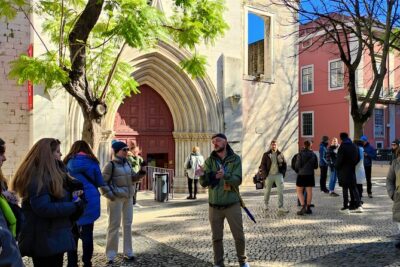



Graça literary murals: Sophia de Mello Breyner and the neighborhood viewpoints
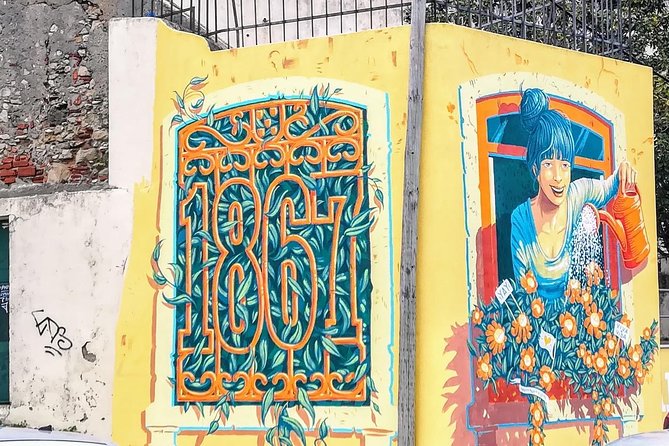
Then the tour turns toward Graça, where art goes beyond global street styles and starts honoring national literature. In 2014, artists created portraits of writers tied to the Graça district, and you’ll see their faces embedded into the streets around you.
You’ll spot Sophia de Mello Breyner, made by the artist Eime, on Rua Josefa de Óbidos. Nearby, you’ll also find work connected to other authors: Natália Correia and Florbela Espanca portrayed on Travessa do Monte by Mariana Dias Coutinho. This isn’t just “pretty street art.” It’s public art with cultural memory built in.
I also like that this part of the route gives you a payoff beyond the murals themselves. The area includes viewpoints of Graça and Senhora do Monte nearby, so you can use the moment to reset your eyes and breathe after staring at wall details. It’s a reminder that Lisbon’s art scene lives inside real neighborhoods, not in isolated spots.
Consideration: Graça streets can be hilly. If you’re prone to getting tired on inclines, plan to take the walking parts at a slow pace and lean on the tuk tuk transfers as your energy-saving tool.
Avenida Fontes Pereira de Melo: Os Gémeos, Blu, Eric Il Cane, Sam3
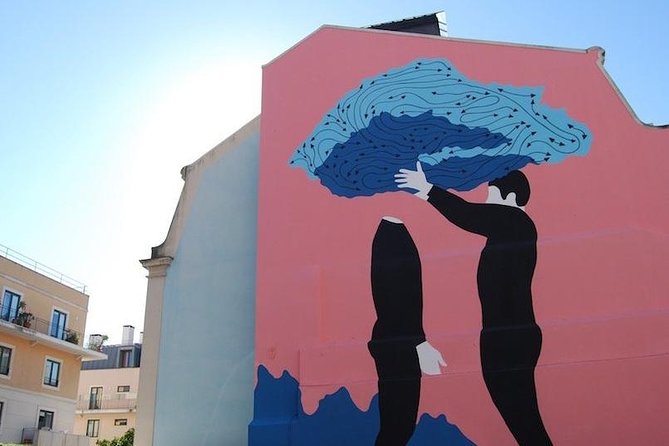
On Avenida Fontes Pereira de Melo, the tour shifts scale again. Several international artists—Os Gémeos, Blu, Eric Il Cane, and Sam3—created a work across three vacant buildings on one of Lisbon’s busier avenues. That emptiness matters. When the buildings aren’t lived in, the street art becomes the living layer.
This stop is where you really feel the “global Lisbon” effect. The artists come from different countries and styles, and yet the wall project reads like one big conversation. The design also has a documentary feel: vacant space turned into public statement.
One helpful lens for this stop: treat it like an art history snapshot. It was considered one of the 10 best in the world by The Guardian, and even if you don’t care about lists, it tells you something practical—this isn’t a random alley mural. It’s a major work people go looking for, and that usually means the images are meant to be seen from a distance and from street-level angles.
Photo advice: this is one of those places where getting the full building context can be as important as photographing the details. If your guide stops when traffic allows, use that moment for both wide and close shots before moving on.
Lx Factory street art stops with Bordalo II’s garbage bee
To close, you head to Lx Factory, a creative factory space where you’ll find more than a dozen works by well-known names. This isn’t only about one mural on a corner; it’s about walking through a concentration of contemporary street-art energy.
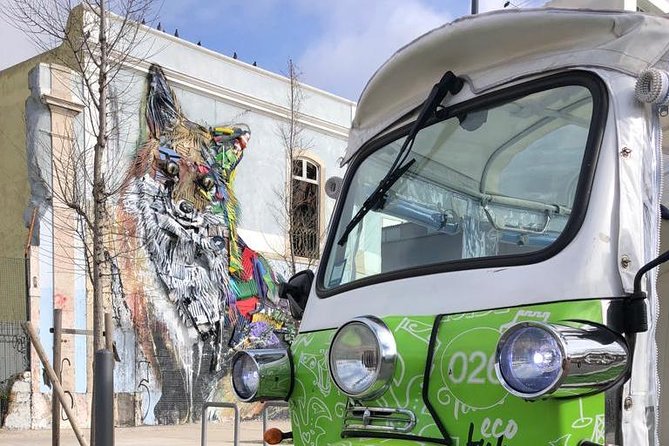
Bordalo II is one of the stars you’ll likely encounter here, including his huge bee made of garbage. The concept is simple but smart: take waste, reshape it, and force attention back onto what we normally ignore. In a tour full of murals on walls, this stop feels like a different setting—still urban art, but with a more curated, wanderable structure.
I also like that Lx Factory makes the tour feel complete. You’ve spent the day reading the city’s exterior walls. Then you get a space where art feels part of the daily flow—something you can keep exploring at your own pace, even after the tuk tuk drops you back.
If you’re someone who enjoys ending a tour with one last “wow” moment, this is usually it.
Price, timing, and what you really get in 2–3 hours
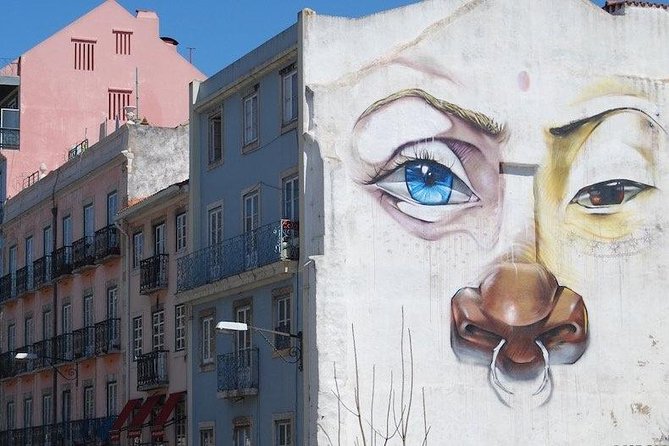
At $93.73 per person for a 2 to 3 hour experience, you’re paying for three things: a private guide, private transportation, and an itinerary designed around urban art that’s spread out across Lisbon. If you tried to DIY this on your own, you’d either spend extra time getting around or you’d miss the context that makes the murals click.
The value is also in the small-group feel. The tour is private, so only your group rides and you’re not forced into a slow shuffle with a larger crowd. The tuk tuk vehicle capacity is listed at up to 6 seats, and the max weight capacity is 400 kg, which tells you this setup is designed for manageable groups—not a mass-coach style day.
You also get a mobile ticket, and the tour runs in English. Pickup is offered near the historic center, including hotels and Airbnbs, and also in cruise terminals and nearby restaurants. If you don’t want to coordinate a pickup location, it’s handy that Time Out Market and Alto do Parque Eduardo VII are suggested meeting points because they’re easy to find and typically functional.
One more reason this price can make sense: no museum-ticket add-ons are included. Street art can be free to view, but some experiences still charge entry fees. Here, monument tickets aren’t included, and food and drinks aren’t included either—so you can plan your spending around what you actually want to eat.
Who should book this Tuk Tuk Lisbon urban art route
You should book this if you want street art with context and you’d rather spend your time looking at murals than figuring out logistics. It fits well for first-timers who want a strong “Lisbon modern” day, and it also works for return visitors who feel like they’ve seen the classics but haven’t focused on the city’s contemporary wall culture.
You’ll especially enjoy it if you care about details: tile texture, carving depth, portrait meaning, and the way different artists use the same city as their canvas. And if you like a guide who can connect art to neighborhood reality, you’re in the right place.
You may want to skip or rethink if you have reduced mobility or you’re traveling with someone who needs easier access and fewer stairs. The tour also doesn’t allow children under 7, so it’s best for families with older kids.
Should you book? My straight answer
If your Lisbon trip includes street art on your must-do list, this is a solid choice. The route concentrates big names and big formats, and the guide component is what turns it from a photo walk into something you’ll remember.
Book it if you want a practical plan—tuk tuk between neighborhoods, then focused mural time. Consider a different option if mobility is an issue for you or your group, because you’ll be doing short walks and frequent getting on and off the vehicle.
If you’re ready to trade museum lines for painted and carved city walls, this tour hits a good balance of art focus and real-world convenience.
FAQ
How long is the Tuk Tuk Lisbon urban art tour?
It runs about 2 to 3 hours.
What’s the price per person?
The price is listed as $93.73 per person.
Is pickup included?
Yes. Pickup is offered at Lisbon hotels and Airbnbs near the historic centre, and also at Lisbon cruise terminals and nearby restaurants.
Is the tour private?
Yes. It’s private, so only your group participates.
What language is the guide in?
The tour is offered in English.
Do I need to buy monument tickets?
No. Monument tickets are not included.
Are food and drinks included?
No. Food and drinks are not included.
Is the tour suitable for reduced mobility or pregnancy?
It’s not recommended for pregnant women or people with reduced mobility.
Is there free cancellation?
Yes. You can cancel up to 24 hours in advance for a full refund.
More Tour Reviews in Lisbon
- Lisbon City Center Tour – The Unmissable Lisbon★ 5.0 · 22,234 reviews
- Lisbon: Sintra, Pena, Regaleira, Cabo da Roca & Cascais★ 4.7 · 19,656 reviews
- Lisbon Card: 24, 48, or 72-Hour Pass★ 4.5 · 17,944 reviews
- Lisbon: Jerónimos Monastery Entrance Ticket★ 4.1 · 14,164 reviews
- Lisbon: History, Stories and Lifestyle Walking Tour★ 4.8 · 10,902 reviews
More Hills by Tuk-Tuk
- True 4Hour Private Tuk Tuk Tour: Discover Lisbon with a Local!★ 5.0 · 8,008 reviews
- Lisbon: Private Guided Tuk-Tuk Tour with Hotel Pickup★ 4.9 · 4,552 reviews
- Private Lisbon Sightseeing Tuk-Tuk Tour: Alfama, Belém & More★ 5.0 · 4,277 reviews
- Lisbon Highlights: Private Tuk Tuk Tour Adventure Sightseeing★ 5.0 · 3,284 reviews
- Welcome Lisbon Tour with Local Guide in Private Eco Tuk Tuk★ 5.0 · 1,691 reviews
Just in: fresh Lisbon reviews from the team





Lisbon Tuk-Tuk Tours, compared.
 ★ 5.0True 4Hour Private Tuk Tuk Tour: Discover Lisbon with a Local!From $1088,008 reviews
 ★ 4.9Private Guided Tuk-Tuk Tour with Hotel PickupFrom $1534,552 reviews
 ★ 5.0Private Lisbon Sightseeing Tuk-Tuk Tour: Alfama, Belém & MoreFrom $524,277 reviews
 ★ 5.0Lisbon Highlights: Private Tuk Tuk Tour Adventure SightseeingFrom $843,284 reviews
 ★ 5.0Welcome Lisbon Tour with Local Guide in Private Eco Tuk TukFrom $171,691 reviews
 ★ 4.9Private City Tour by Eco Tuk TukFrom $281,215 reviews
 ★ 5.0Old Town TukTuk Tour and Scenic Viewpoints in AlfamaFrom $35974 reviews
 ★ 5.0Explore Lisbon by Tuk Tuk: History and ViewpointsFrom $19840 reviews