
Lisbon gets steep fast, so I love any tour that keeps you moving without tiring your legs to death. This one strings together the seven-hill viewpoints you’d usually chase on foot, then adds a strong slice of Belem with major monuments and a stop for Pastéis. It’s a practical way to see a lot of ground in about 4 hours, especially if you want photos at the right angles.
My favorite parts are the quick hits at the best miradouros (with real time for photos, not just a drive-by) and the guide-style storytelling from José Lago and José Lobo, who both bring the streets and landmarks to life. One more plus: it’s private, so your group can set a calmer pace instead of feeling rushed with strangers.
The main drawback to plan around is that several of the big sights later in the route have entry tickets not included, and the stops are time-boxed. If you want long museum time inside Jerónimos or Tower of Belém, you’ll need to pair this tour with another visit.
In This Review
- Quick hits you can bank on
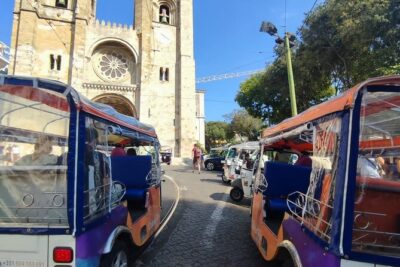
- Why an electric tuk-tuk makes Lisbon’s 7 hills feel doable
- Restauradores start point: where your Lisbon route gets rolling
- Miradouro das Portas do Sol: the classic Tejo-and-Alfama view
- Alfama on foot: narrow lanes, oldest Lisbon vibes
- Senhora do Monte: sweeping city views and the Christ King angle
- São Pedro de Alcântara: the castle-and-city panorama stop
- Chiado, Bairro Alto, and Baixa: monumental avenues and quick cultural context
- Lisbon’s cathedral area (Lisbon See) and the late-12th-century story
- National Pantheon: where the tour nods to Lisbon’s notable figures
- Belem monuments: Jerónimos Monastery, Tower of Belém, and the Pattern of Discoveries
- Jerónimos Monastery (ticket not included)
- Tower of Belém (ticket not included)
- Padrão dos Descobrimentos (ticket not included)
- Pastéis de Belém factory: the sweet payoff after the monuments
- Timing, photos, and what to wear for a 4-hour loop
- Who this tour suits best (and who should look elsewhere)
- Should you book this 7 hills and Bethlehem electric tuk-tuk tour?
- FAQ
- How long is the 7 hills and Bethlehem tour in an electric tuk-tuk?
- Where does the tour start and where does it end?
- Is this a private tour or shared with other groups?
- What’s included in the tour price?
- Are admission tickets included for Jerónimos Monastery, Tower of Belém, and the Padrão dos Descobrimentos?
- What happens if the weather is bad?
- What is the cancellation policy?
Quick hits you can bank on
- Electric tuk-tuk transport saves your knees on Lisbon’s hills while still getting you close to the viewpoints
- Three top miradouros in sequence: Portas do Sol, Senhora do Monte, and São Pedro de Alcântara
- Alfama time to wander narrow streets in the city’s oldest quarter
- Belem monuments included on the route, with Jerónimos Monastery, Tower of Belém, and Padrão dos Descobrimentos stops
- Guide-led pacing that works well for short attention spans and early sunsets
- Pastéis de Belém factory stop for a sweet payoff after the monuments
Why an electric tuk-tuk makes Lisbon’s 7 hills feel doable
Lisbon’s 7 hills are famous for a reason: the climbs are part of the experience, but they can also beat you up. The electric tuk-tuk helps you keep the best viewpoints in the plan without turning the day into a leg workout. You still get the romance of narrow lanes and sudden panoramas, but you’re not constantly climbing between stops.
Because it’s private (only your group), the guide can adjust how long you pause for photos or viewpoints. And since the tour is built around a circuit, you don’t waste your time figuring out transport between neighborhoods with different vibes.
One practical point: the tour duration is about 4 hours, so expect short stops. This is not a slow wandering day—it’s a “see the highlights, get your bearings fast, then decide what to return to” kind of tour.
The hills done the easy way, more tuk-tuk runs
- True 4Hour Private Tuk Tuk Tour: Discover Lisbon with a Local!
★ 5.0 · 8,008 reviews - Lisbon: Private Guided Tuk-Tuk Tour with Hotel Pickup
★ 4.9 · 4,552 reviews - Private Lisbon Sightseeing Tuk-Tuk Tour: Alfama, Belém & More
★ 5.0 · 4,277 reviews - Lisbon Highlights: Private Tuk Tuk Tour Adventure Sightseeing
★ 5.0 · 3,284 reviews
Restauradores start point: where your Lisbon route gets rolling
The tour starts back at Restauradores Carpark (S. Entrance), on R. Condes 2 in central Lisbon. It’s a good launch spot because it keeps you near major transit options and the heart of the city, so you’re not relying on a far-flung pickup.
From there, your guide steers the route toward the hills and viewpoints that define Lisbon. What I like about this kind of setup is that you’re not spending the first hour trying to orient yourself. You hit viewpoints and neighborhoods early, while your energy is still high.
Also, you’ll typically travel with a mobile ticket confirmation process, and the company provides liability and personal injury insurance. That doesn’t change the scenery, but it does make the experience feel more secure and professional.
Miradouro das Portas do Sol: the classic Tejo-and-Alfama view
The tour hits Miradouro das Portas do Sol for a short photo-focused break. This is one of those places where the view snaps Lisbon into focus: the Tagus (Tejo) curves into the distance, and Alfama sprawls down below with its maze-like street grid.
Because the stop is about 10 minutes, the guide’s job is to help you aim your phone or camera. You’ll want to take a few shots quickly, then spend another minute soaking it in—especially if you’re coming from flatter European cities where Lisbon’s angles are new.
This stop is listed as free admission, which matters. It’s a way to get a high-impact viewpoint without adding ticket costs early in the day.
Alfama on foot: narrow lanes, oldest Lisbon vibes
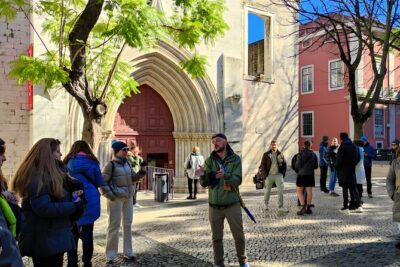
After the first viewpoint, you transition into Alfama, Lisbon’s oldest neighborhood. This is where Lisbon feels less like a postcard and more like a lived-in place—tight lanes, old textures, and the kind of street corners where you can actually feel the city’s age.
You get about 15 minutes here, which is just enough to walk a small loop and enjoy the atmosphere. It’s not enough to explore Alfama like you would on your own for a full afternoon, but it’s a strong introduction.
What to do with your limited time? I’d treat it like orientation. Find one or two streets you’d want to return to later, and get a quick feel for where the higher viewpoints connect back to the lower streets.


Senhora do Monte: sweeping city views and the Christ King angle
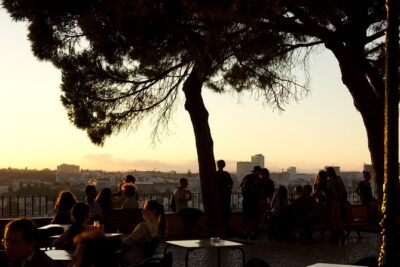
Next up is Miradouro da Senhora do Monte, another big-name lookout with some of the broadest views in Lisbon. This stop is also about 10 minutes and is listed as free admission.
The view frames Lisbon’s river, the 25 de Abril bridge, and the silhouette of the Christ King statue. It’s the kind of panorama that helps you understand why people built the city here—and why later it became so famous for views rather than just defense or trade.
I also like that the stop gives you a clean “second perspective” after Portas do Sol. You’re not just seeing the same view from a new corner; you’re seeing how Lisbon opens up across multiple layers.
São Pedro de Alcântara: the castle-and-city panorama stop
Miradouro de São Pedro de Alcântara is another about-10-minute pause, and it’s a strong one for photos of Lisbon’s castle area. The plan keeps moving, but this viewpoint is the type where you can step out, look around, take a few photos, and then immediately understand how the city’s higher areas connect.
It’s listed as free admission, so you’re stacking payoff without stacking ticket expenses.
If you’re the type who likes to plan your later self-guided walk, this is a great stop. You’ll start noticing where the viewpoints line up with major streets you’ll want to revisit.
Chiado, Bairro Alto, and Baixa: monumental avenues and quick cultural context
From the viewpoints, the route continues through the central neighborhoods that shape Lisbon’s city rhythm: Chiado, Bairro Alto, and Baixa.
- You’ll pass by areas described as commercial, artistic, and intellectual, which is a polite way of saying this is where Lisbon shows you its theater and café energy.
- You’ll also get a look at the city’s main avenue and monumental architecture, which helps you balance the older quarters you’ve already seen.
There’s also a mention of a classic funicular dating from 1885, one of the city’s icons. You’ll likely see it as part of the route through these central areas, giving you an idea of how Lisbon moves people up and down when stairs would be too much.
This segment is the “context” part of the tour. It’s where Lisbon stops being just hills and viewpoints and starts becoming a real map you can navigate on your own later.
Lisbon’s cathedral area (Lisbon See) and the late-12th-century story
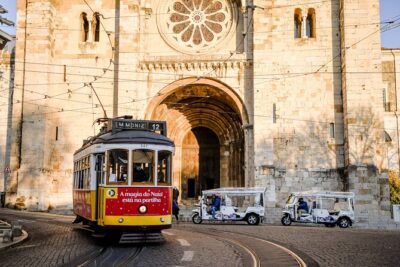
One of the early stops is tied to a site whose construction began in the second half of the 12th century, after the conquest of the city by D. Afonso Henriques. This is the heart of the Lisbon See area, and it provides a different kind of perspective than the miradouros: instead of looking outward, you look back at how the city took shape.
Even with a short stop, this type of historical anchor is useful. It’s a reminder that Lisbon’s viewpoints aren’t just scenic—they’re set on top of centuries of power, faith, and rebuilding.
If you’re into architecture or want a calmer moment between hills, this stop works well. If you want more time inside, you can always return later since the tour is clearly paced to fit everything into a 4-hour circuit.
National Pantheon: where the tour nods to Lisbon’s notable figures
The overview also includes a stop at the National Pantheon and the Lisbon See. Even if your time there is limited, it’s the kind of stop that helps you understand Lisbon beyond scenery—Portugal’s national memory gets a place in the route.
Think of it as a “culture check.” You’re seeing viewpoints, yes, but you’re also being guided toward monuments that represent national identity. If you return on your own later, you’ll already know what you’re looking for.
Belem monuments: Jerónimos Monastery, Tower of Belém, and the Pattern of Discoveries
Now you shift from Lisbon’s hills into the riverfront importance of Belém.
Jerónimos Monastery (ticket not included)
Jerónimos Monastery is presented as a late-15th-century Portuguese architectural masterpiece linked to King D. Manuel I, and it’s listed as a UNESCO World Heritage Site. Admission is not included, so plan on paying separately if you want to enter.
Even with a short stop, this is one of those structures that makes you stop walking. Details in Portuguese Gothic-style stonework are hard to absorb if you rush, so if you love architecture, consider coming back later with longer time.
Tower of Belém (ticket not included)
Next is the Torre de Belém, described as an architectural icon of D. Manuel I’s reign and also a UNESCO World Heritage Site. It’s additionally listed as one of the Seven Wonders of Portugal.
Admission is not included, which is important for budgeting. Like Jerónimos, the tour time window is short, so this works best as a quick “see it, frame it, move on” visit unless you build in extra time afterward.
Padrão dos Descobrimentos (ticket not included)
You also visit the Padrão dos Descobrimentos, a monument on the right bank of the Tejo, built in 1960 to honor figures involved in the Portuguese Discoveries. It’s another photo stop where the monument’s scale and riverside location do most of the talking, even if you don’t spend a lot of time inside.
Admission is not included here either, so check entry plans ahead of time if you’re hoping to go in.
Pastéis de Belém factory: the sweet payoff after the monuments
After the big monuments, the route includes the famous factory of the Pastéis of Belém. This is the reward stop, and it’s a smart way to end a sightseeing-heavy loop.
One thing to keep in mind: the data says monuments have ticket status, but it doesn’t specify ticket inclusion for the pastry stop. Treat any pastry purchase as on you, and use your time there to relax after walking and looking at stone and river views.
If you’re traveling with someone who wants photos but also cares about a proper snack, this addition is one of the best value touches of the whole plan.
Timing, photos, and what to wear for a 4-hour loop
Because the stops are short—often around 10 minutes, with one longer Alfama slot—you’ll want to move efficiently without feeling like you’re sprinting. I like to do this:
- Pick your must-have photo angles at the miradouros first, then linger a little.
- Wear comfortable shoes even though you’re on an electric tuk-tuk for the hills.
- Bring a light layer. Viewpoints can feel cooler near the river and higher areas.
Weather matters here. The experience requires good weather, and if it’s canceled due to poor conditions, you’ll be offered a different date or a full refund. That’s a big deal in Lisbon, where sun can vanish fast.
Also, since some of the key sites have tickets not included, your best move is to decide in advance which interiors matter most to you. This tour shines as a highlights route, and you’ll likely want to return to any place that grabs you.
Who this tour suits best (and who should look elsewhere)
This is a great fit if:
- You want major Lisbon viewpoints plus Belém monuments in one smooth afternoon.
- You like guided route planning that minimizes hill fatigue.
- Your group includes people with different walking stamina, because the electric tuk-tuk does the heavy lifting.
It might not be ideal if:
- You want long, slow museum time at Jerónimos or Tower of Belém.
- You’re trying to cover everything without paying any extra entry fees. Several major stops list admission as not included.
If you fall into the second group, you can still book it, just treat it as your “route + orientation” day and plan your deeper visits for later.
Should you book this 7 hills and Bethlehem electric tuk-tuk tour?
I’d book it if you want Lisbon’s best viewpoint chain without turning your trip into a staircase marathon. The electric tuk-tuk keeps the day fun and moving, and the guide experience from José Lago and José Lobo adds the kind of explanations that make the stops feel connected, not random.
It’s also good value if you treat the route as a curated highlights plan. You’re paying for transportation, guidance, and a tight sequence of viewpoints and monuments, not for long interior time everywhere.
I would only hesitate if you know you want deep entry into Jerónimos Monastery or Tower of Belém and prefer a slower pace. In that case, you’ll still get the panoramas, but you may end up wishing for more time at the places with extra tickets.
FAQ
How long is the 7 hills and Bethlehem tour in an electric tuk-tuk?
It’s approximately 4 hours.
Where does the tour start and where does it end?
The tour starts at Restauradores Carpark (S. Entrance), R. Condes 2, 1250-147 Lisboa, Portugal, and it ends back at the meeting point.
Is this a private tour or shared with other groups?
This is private. Only your group participates.
What’s included in the tour price?
Included are liability insurance and personal injury insurance, private transportation in an electric tuk-tuk, and a professional and experienced guide.
Are admission tickets included for Jerónimos Monastery, Tower of Belém, and the Padrão dos Descobrimentos?
No. Admission for those stops is not included. Some viewpoints and areas on the route are listed as free.
What happens if the weather is bad?
The experience requires good weather. If it’s canceled due to poor weather, you’ll be offered a different date or a full refund.
What is the cancellation policy?
You can cancel for free up to 24 hours in advance for a full refund. If you cancel less than 24 hours before the start time, the amount paid will not be refunded.
More Tours in Lisbon
- Lisbon City Center Tour – The Unmissable Lisbon★ 5.0 · 22,234 reviews
- Lisbon: History, Stories and Lifestyle Walking Tour★ 4.8 · 10,902 reviews
- True 4Hour Private Tuk Tuk Tour: Discover Lisbon with a Local!★ 5.0 · 8,008 reviews
- Winner 2025 Undiscovered Lisbon Food & Wine Tour by Eating Europe★ 5.0 · 6,390 reviews
- Lisbon: Sintra, Pena, Cabo da Roca, Cascais Tour with Pickup★ 4.8 · 5,445 reviews
More Tour Reviews in Lisbon
- Lisbon City Center Tour – The Unmissable Lisbon★ 5.0 · 22,234 reviews
- Lisbon: Sintra, Pena, Regaleira, Cabo da Roca & Cascais★ 4.7 · 19,656 reviews
- Lisbon Card: 24, 48, or 72-Hour Pass★ 4.5 · 17,944 reviews
- Lisbon: Jerónimos Monastery Entrance Ticket★ 4.1 · 14,164 reviews
- Lisbon: History, Stories and Lifestyle Walking Tour★ 4.8 · 10,902 reviews
More Hills by Tuk-Tuk
- True 4Hour Private Tuk Tuk Tour: Discover Lisbon with a Local!★ 5.0 · 8,008 reviews
- Lisbon: Private Guided Tuk-Tuk Tour with Hotel Pickup★ 4.9 · 4,552 reviews
- Private Lisbon Sightseeing Tuk-Tuk Tour: Alfama, Belém & More★ 5.0 · 4,277 reviews
- Lisbon Highlights: Private Tuk Tuk Tour Adventure Sightseeing★ 5.0 · 3,284 reviews
- Welcome Lisbon Tour with Local Guide in Private Eco Tuk Tuk★ 5.0 · 1,691 reviews
Just in: fresh Lisbon reviews from the team




Lisbon Tuk-Tuk Tours, compared.
 ★ 5.0True 4Hour Private Tuk Tuk Tour: Discover Lisbon with a Local!From $1088,008 reviews
 ★ 4.9Private Guided Tuk-Tuk Tour with Hotel PickupFrom $1534,552 reviews
 ★ 5.0Private Lisbon Sightseeing Tuk-Tuk Tour: Alfama, Belém & MoreFrom $524,277 reviews
 ★ 5.0Lisbon Highlights: Private Tuk Tuk Tour Adventure SightseeingFrom $843,284 reviews
 ★ 5.0Welcome Lisbon Tour with Local Guide in Private Eco Tuk TukFrom $171,691 reviews
 ★ 4.9Private City Tour by Eco Tuk TukFrom $281,215 reviews
 ★ 5.0Old Town TukTuk Tour and Scenic Viewpoints in AlfamaFrom $35974 reviews
 ★ 5.0Explore Lisbon by Tuk Tuk: History and ViewpointsFrom $19840 reviews