
Reviewed · SINTRA DAY TRIPS
Sintra Cascais 4×4 Land Rover Photo Panoramic Private Tour
Four wheels make Sintra feel easy. This private 4×4 Land Rover photo tour strings together coastal viewpoints and fairy-tale hills, with stops you can tweak to your pace.
I love how the day is built around great photo timing—ocean, cliffs, and overlooked corners that you’d miss if you’re only hopping between major sights. I also like the pure time-saver of hotel pickup and drop-off, so you spend the day sightseeing instead of solving Lisbon logistics.
One thing to plan for: lunch isn’t included, and the big ticket stop—Sintra National Palace—is not included, so budget for that extra cost and time.
In This Review
- Key highlights to know before you go
- 4×4 Land Rover route: why this setup works in Sintra-Cascais
- Cascais old town and Estoril’s casino-era connection
- Guincho viewpoint time, then Peninha’s hilltop sanctuary
- Cabo da Roca: where you actually stand at the edge
- Ulgueira and Adraga Beach: the coast beyond the obvious stops
- Colares-area towns, big-sand beaches, and dinosaur-footstep lore
- Azenhas do Mar: white-and-blue cliff village for that signature Sintra photo
- Monteiro the Millionaire’s palace complex: symbol-heavy and very strange
- Sintra historic center: cobbles, shops, and easy sweet stops
- Sintra National Palace and the Moorish Castle: quick hits, different vibes
- Pena Palace: romantic architecture with big views and garden time
- Time, tickets, and the food reality
- What I’d do to get the best day from it
- Who this tour is best for (and who might want a different plan)
- Should you book the Sintra Cascais 4×4 Photo Panoramic Private Tour?
- FAQ
- Is this tour private?
- How long is the Sintra Cascais 4×4 photo tour?
- Where does pickup happen?
- Is hotel drop-off included?
- What language is the tour offered in?
- Are tickets included for Sintra National Palace?
- Is lunch included?
- Are most other stops free?
- Are service animals allowed?
- Can I cancel for a full refund?
- What are the operating hours for the tour?
Key highlights to know before you go
- Hotel pickup and drop-off keep the day moving from the start
- 4×4 dirt-road access to beaches and viewpoints other routes can’t reach
- Photo-first pacing with short, well-placed stops for sky-and-sea panoramas
- Cascais to Estoril to Sintra in one day, with minimal backtracking
- Iconic Sintra monuments plus lesser-visited scenery along the coast
- Flexible timing for your preferences, since it’s a private tour
4×4 Land Rover route: why this setup works in Sintra-Cascais
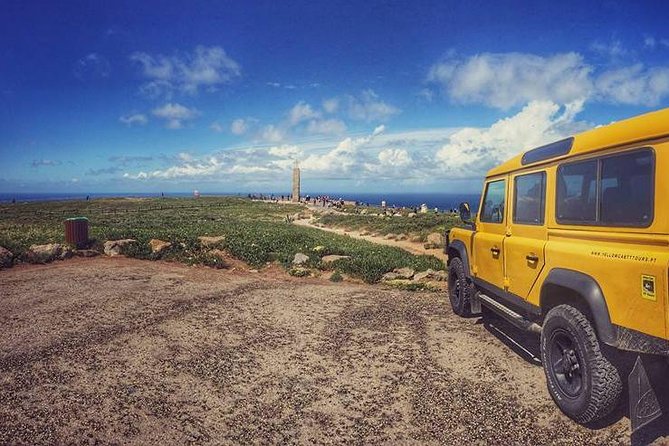
Sintra-Cascais is the kind of place where public transport can get you close, but it rarely gets you to the best angles or fastest routes. A private Land Rover solves that with straight-up convenience—and with the ability to roll out to less expected viewpoints along the coast.
This route is designed for “stop, look, shoot, move” travel. You’re not stuck on a single lane of traffic with long delays between sights. Instead, you get short windows at key spots—like cliff viewpoints and beach overlooks—then you’re off to the next photo moment.
I’d also call out the balance here: you’re not only doing palaces. The day spreads energy between dramatic coasts (Guincho and Adraga style stops), small villages, and the classic Sintra center. That mix makes the day feel complete.
More runs up the hill to Pena and Regaleira
- Lisbon: Sintra, Pena, Regaleira, Cabo da Roca & Cascais
★ 4.7 · 19,656 reviews - Lisbon: Sintra, Pena, Regaleira, Cabo da Roca, and Cascais
★ 4.7 · 10,147 reviews - Sintra and Cascais Small-Group Day Trip from Lisbon
★ 5.0 · 7,018 reviews - Lisbon: Sintra, Pena, Regaleira, Cabo Roca Coast & Cascais
★ 4.8 · 6,499 reviews
Cascais old town and Estoril’s casino-era connection
The day starts in the Cascais area with a visit to the Centro Histórico de Cascais. Cascais has been a seaside escape since the late 19th century, when King Luís I and the royal family used it as a summer base. Later, during World War II and afterward, the town’s royal ties pulled in European royalty and other exiles.
Estoril is part of this same story—and it’s worth understanding the vibe even if you don’t plan to gamble. Estoril became an international tourist hub early in the 20th century thanks to one of Europe’s biggest and oldest casinos. During Portugal’s neutrality in World War II, it also drew royalty, businessmen, and even intelligence services. The name Ian Fleming shows up in this connection because he later wrote the novels behind James Bond.
In practical terms, that means you’re not just “going somewhere pretty.” You’re driving through places that were power and refuge zones, then stopping for views and a stroll where you can actually feel the town.
Guincho viewpoint time, then Peninha’s hilltop sanctuary
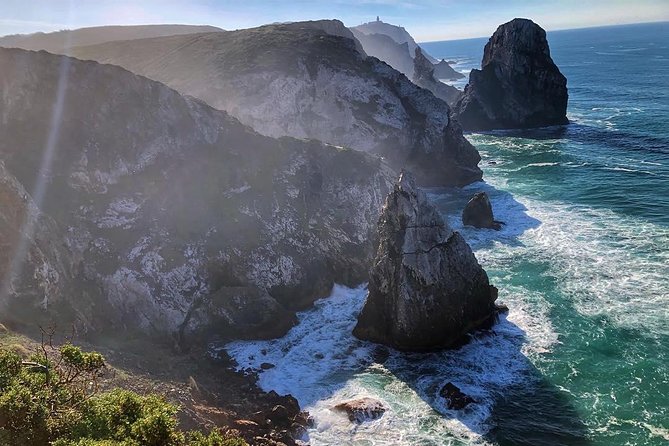
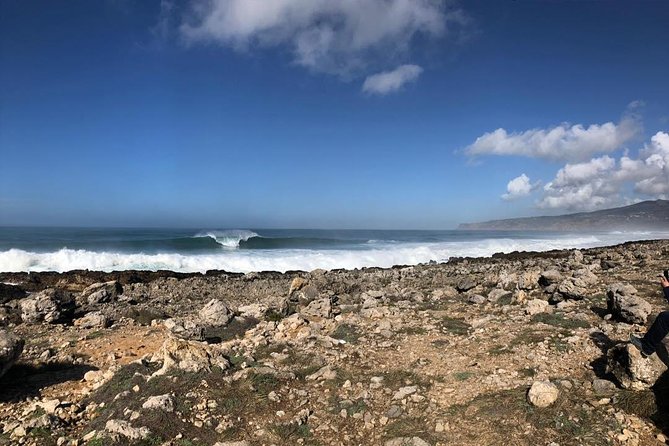
Next, the route heads for Guincho Beach, a standout stop by Sintra’s mountain. Guincho is known for water sports like surfing and kite surfing, and it’s also famous for a viewpoint where ocean, dunes, and cliffs form a wide, layered panorama.
If you like photos, Guincho is exactly the kind of stop that pays off even with just a short stop window. From above, the coastline reads like a diagram—windy beach lines, jagged cliffs, and open water all visible at once.
Then it’s up to Santuario da Peninha, perched high over the ocean and countryside. This sanctuary sits on the Peninha hills, where a small hermitage existed since the early foundation of Christianity in Portugal. So you’re not only getting a “pretty overlook,” you’re getting a spot with deep spiritual roots tied to the hilltop geography.
A quick note: hilltop stops can be breezy. Bring a light layer if you’re traveling in shoulder seasons.
Cabo da Roca: where you actually stand at the edge
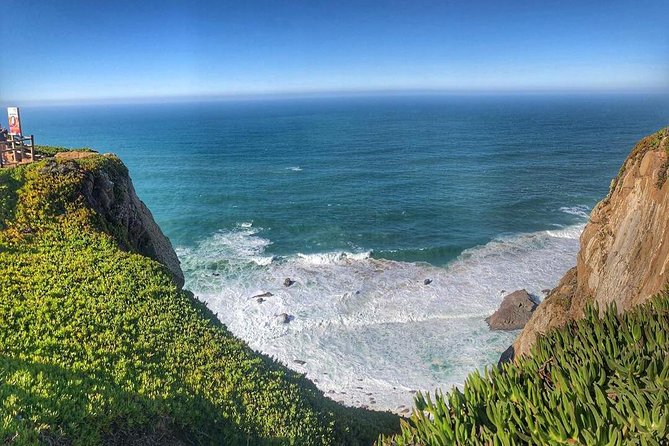
Cabo da Roca is one of those Portugal places that makes sense immediately: you’re at the westernmost point of continental Europe, and the scenery does the talking. You’ll see the lighthouse area, and the day gives you time to enjoy the moment where land meets sea.
The classic idea here is poetic—where land ends and the sea begins—but the practical benefit is that Cabo da Roca gives you huge open views without needing a ticket-heavy attraction.
Expect this to be a “look outward” stop. Even if your photos aren’t perfect, the scale tends to land. You’re standing at a real geographic edge, with the Atlantic doing what the Atlantic does: moving and sounding loud even when you’re just standing still.
Down the coast: other Cascais and Estoril days

Ulgueira and Adraga Beach: the coast beyond the obvious stops
After Cabo da Roca, you shift to smaller, quieter settings that help balance the day. Ulgueira is a village inside the Sintra-Cascais Natural Park, between the Sintra mountain and the Atlantic. The draw is the rural feel—its ability to maintain a rural environment and keep a look tied to the region.
Then you head to Praia da Adraga, a beach tucked behind rocky cliffs. It’s reached by a winding road through the protected landscape, and the reward is a sheltered-feeling shoreline with a more “myth and legend” atmosphere attached to the place.
This is also where the value of the 4×4 approach shows up. Coastal areas like this can feel hard to stitch together on your own, especially if you want viewpoints and short walks without turning the day into a full-day transit project.
Practical tip: this portion is more about walking and standing than “staying in one restaurant area.” Wear shoes you’re happy to move in.
Colares-area towns, big-sand beaches, and dinosaur-footstep lore
The coast keeps unfolding with stops tied to the Colares area vibe. One town here is described with an Arabic-origin name, possibly meaning mosque, and it keeps traditions like a weekly farmers market. Festivities honor Nossa Senhora da Graça after the first Sunday of October and last eight days.
You’ll also spend time at the big sandy-beach stretch where surf and bodyboard competitions are hosted, plus an eye-catching feature: one of the biggest saltwater pools in Europe, over 100 meters long. Add to that dinosaur fossils on the nearby cliff, including an easily identifiable sequence of eleven dinosaur footsteps, and you’ve got a stop that feels a little unexpected—in a good way.
Then there’s the “apples” story of a beach near the Colares stream, named (allegedly) after rotten fruit falling from farms nearby. It’s a fun way to end up at the sea with a little local legend running through your head as you look at the sand and surf.
This whole stretch works for two travel styles at once:
- If you want scenery and photos, it delivers.
- If you like small, strange details, it gives you plenty to remember later.
Azenhas do Mar: white-and-blue cliff village for that signature Sintra photo
One of the most memorable photo stops is Azenhas do Mar, the white-and-blue village perched over cliffs near the sea. This is the kind of place often used as a movie set, and for good reason: the buildings stack against the coastline in a way that photographs well fast.
The stop isn’t long, but that’s okay. Azenhas do Mar is the sort of scene you understand in seconds. You’re looking for one or two great angles, plus maybe a slower moment if the light is right.
If your travel goal is “see the best picture,” this is one to treat like a priority.
Monteiro the Millionaire’s palace complex: symbol-heavy and very strange
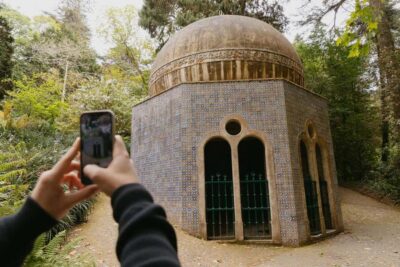
After the coast, the tour turns to one of Sintra’s most mysterious-feeling estates: the Palace of Monteiro the Millionaire. This property includes a romantic palace and chapel with Neo-Manueline architecture, plus a luxe park with lakes, grottoes, wells, fountains, and lots of themed structures.
What makes this stop more than another palace photo-op is the symbol story. The estate’s buildings have recurring references related to alchemy, Masonry, the Knights Templar, and Rosicrucians. Even if you don’t know the symbolism ahead of time, the result is an atmosphere that feels more puzzling than formal.
This stop is a great match if you enjoy architecture with attitude. You’re not just walking through rooms—you’re walking through an idea.
Sintra historic center: cobbles, shops, and easy sweet stops
Then you roll into Centro Histórico de Sintra, the village center with cobbled streets, cafés, and classic shops. Sintra is a World Heritage Cultural Landscape, and the center still keeps colors and architecture from the monarchy era when the town was used as a summer vacation place.
This is the time to slow down a bit. Even with a packed day, the village center makes sense as a decompression point: you’re walking, grabbing a pastry, and resetting your energy for the palace portion.
The day also cues up classic local sweets like travesseiros and queijadas. If you’re the type who likes tasting regional signatures, this is one of the easiest wins on the whole itinerary.
Sintra National Palace and the Moorish Castle: quick hits, different vibes
Sintra’s big historical backbone comes in two parts.
First is Sintra National Palace, one of the iconic landmarks in the center. The building is described as blending Gothic, Manueline, Moorish, and Mudéjar styles, shaped by different building campaigns across centuries. There are also two imposing chimneys from the kitchen visible from far away—so even from outside, you get a sense of the palace’s character.
This is the major ticketed stop in the tour data: admission for Sintra National Palace is not included, so plan to budget and allow time for the visit.
Then there’s the Moorish Castle, described as being built around the 8th century during Muslim Iberia. After the Christian conquest, it surrendered voluntarily, and Afonso Henriques entrusted the castle to inhabitants with privileges in the foral system to support security and development. This stop feels more like fortification history than palace aesthetics.
If you like the contrast—palace drama on one side, defensive topography on the other—this pairing hits well.
Pena Palace: romantic architecture with big views and garden time
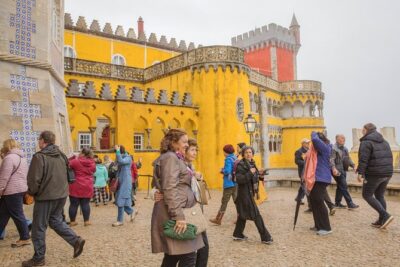
The last major monument stop is Pena Palace, built on top of Sintra Mountain using an abandoned 16th-century monastery as a base. The palace is strongly tied to King Ferdinand II’s love for his wife and for Portugal’s historic and cultural heritage.
Architecturally, it’s described as a colorful masterpiece of mid-19th-century romantic architecture, and the garden is part of what makes it worth your time—there’s an immense, luxurious garden environment surrounding the palace.
This is the point where the day’s theme clicks: the coast gives you wild Atlantic drama, and Pena gives you dramatic human creativity backed by prime viewpoints. If you only care about taking a few photos of palaces, you might feel this stop is “more than enough.” But if you enjoy walking through atmosphere, this is where the memory usually sticks.
Time, tickets, and the food reality
This tour runs about 8 hours, and it’s packed with multiple stop types: town strolls, viewpoint breaks, beaches, and monuments. That works best when you’re comfortable moving through a schedule without expecting long “sit and linger” breaks at every stop.
Two practical items to keep in mind:
- Lunch is not included, so you’ll need to plan your own meal time.
- Sintra National Palace admission isn’t included, so budget for that ticket in addition to the tour price.
Because many other stops are marked as free admission in the tour info, the extra cost is mainly about that one big palace ticket plus whatever you choose for lunch and drinks.
What I’d do to get the best day from it
If you’re photo-focused, I’d treat the ocean-and-cliff stops like priorities. Guincho, Cabo da Roca, Adraga, and Azenhas do Mar are the kinds of places where the light can change quickly, so it pays to be ready when you arrive.
If you care about history, pace yourself differently: the village center for sweets and cobbles is a great “recovery” break before you jump into the palace and castle segments.
Finally, listen to your driver/guide. The day is private, and the stops are designed to be adaptable. In the real world, that flexibility matters when weather shifts on the coast or when you want a little more time in Sintra’s historic lanes.
And yes, guide quality can make a big difference. The names Tiago and Paula show up in previous customer feedback for being especially engaging and making the day feel comfortable and safe with excellent driving.
Who this tour is best for (and who might want a different plan)
This is a smart fit for you if you want:
- A single-day way to see Sintra and Cascais without stitching it together with multiple transport hops
- A private experience with hotel pickup and drop-off
- A route that mixes famous monuments with coastal viewpoints and smaller stops
- Photo opportunities that aren’t limited to the busiest attractions
It may not be ideal if you want an unhurried, museum-style day where you spend hours at one site. This is structured as a full-day route with short to medium stops, so you’ll cover a lot rather than linger.
It also helps if you’re okay with a day that includes at least one ticketed attraction not included in the tour price and lunch on your own.
Should you book the Sintra Cascais 4×4 Photo Panoramic Private Tour?
I’d book it if you want the classic Sintra-Cascais hits with a better way to get there: 4×4 access, viewpoint-first stops, and the convenience of hotel pickup and drop-off. The route also has a strong sense of variety—coast cliffs, rural park villages, and a trio of major monuments—so the day doesn’t feel one-note.
I’d hesitate only if budget for extra tickets and your own lunch is tight, or if you’d rather spend half a day sightseeing than trying to cover a full loop in one go.
If your goal is a day that feels efficient but still scenic, this is one of the better ways to do it.
FAQ
Is this tour private?
Yes. It’s a private tour, meaning only your group participates.
How long is the Sintra Cascais 4×4 photo tour?
It runs about 8 hours (approx.).
Where does pickup happen?
You’ll be picked up from your hotel in Lisbon city. You just tell them where you’re staying.
Is hotel drop-off included?
Yes, hotel pickup and drop-off are included.
What language is the tour offered in?
The tour is offered in English.
Are tickets included for Sintra National Palace?
No. Admission for Sintra National Palace is not included.
Is lunch included?
No. Lunch is not included.
Are most other stops free?
Many stops are listed as admission free in the tour info (for example, Centro Histórico de Cascais, Santuario da Peninha, and Cabo da Roca). The main ticketed item shown is Sintra National Palace.
Are service animals allowed?
Yes, service animals are allowed.
Can I cancel for a full refund?
Yes. You can cancel up to 24 hours in advance for a full refund.
What are the operating hours for the tour?
Tours run daily within 8:30 AM to 5:00 PM, with the stated availability dates on the booking info.
More Tour Reviews in Lisbon
- Lisbon City Center Tour – The Unmissable Lisbon★ 5.0 · 22,234 reviews
- Lisbon: Sintra, Pena, Regaleira, Cabo da Roca & Cascais★ 4.7 · 19,656 reviews
- Lisbon Card: 24, 48, or 72-Hour Pass★ 4.5 · 17,944 reviews
- Lisbon: Jerónimos Monastery Entrance Ticket★ 4.1 · 14,164 reviews
- Lisbon: History, Stories and Lifestyle Walking Tour★ 4.8 · 10,902 reviews
Along the Coast to Cascais
- Lisbon: Sintra, Pena, Regaleira, Cabo da Roca & Cascais★ 4.7 · 19,656 reviews
- Lisbon: Sintra, Pena, Regaleira, Cabo da Roca, and Cascais★ 4.7 · 10,147 reviews
- Sintra and Cascais Small-Group Day Trip from Lisbon★ 5.0 · 7,018 reviews
- Lisbon: Sintra, Pena, Regaleira, Cabo Roca Coast & Cascais★ 4.8 · 6,499 reviews
- Lisbon: Sintra, Pena, Cabo da Roca, Cascais Tour with Pickup★ 4.8 · 5,445 reviews
Sintra, a Few More Fairy-Tale Days
- Lisbon: Sintra, Pena, Regaleira, Cabo da Roca & Cascais★ 4.7 · 19,656 reviews
- Lisbon: Sintra, Pena, Regaleira, Cabo da Roca, and Cascais★ 4.7 · 10,147 reviews
- Sintra and Cascais Small-Group Day Trip from Lisbon★ 5.0 · 7,018 reviews
- Lisbon: Sintra, Pena, Regaleira, Cabo Roca Coast & Cascais★ 4.8 · 6,499 reviews
- Lisbon: Sintra, Pena, Cabo da Roca, Cascais Tour with Pickup★ 4.8 · 5,445 reviews
Just in: fresh Lisbon reviews from the team




Sintra Day Trips, compared.
 ★ 4.7Sintra, Pena, Regaleira, Cabo da Roca & CascaisFrom $2319,656 reviews
 ★ 4.2Sintra: Pena Palace and Park Entrance TicketFrom $1117,410 reviews
 ★ 4.7Sintra, Pena, Regaleira, Cabo da Roca, and CascaisFrom $2110,147 reviews
 ★ 5.0Sintra and Cascais Small-Group Day Trip from LisbonFrom $607,018 reviews
 ★ 4.8Sintra, Pena, Regaleira, Cabo Roca Coast & CascaisFrom $236,499 reviews
 ★ 4.8Sintra, Pena, Cabo da Roca, Cascais Tour with PickupFrom $585,445 reviews
 ★ 4.8Sintra, Pena, Regaleira, Cabo & Cascais TourFrom $644,326 reviews
 ★ 5.0Small Group Tour to Sintra, Pena Palace, Cabo Roca and CascaisFrom $673,559 reviews