Reviewed · LISBON
Passeio Privado de Lisboa
Lisbon can feel like a puzzle on day one. This private tour helps you solve it fast, with a flexible itinerary and a guide who keeps everything moving at your pace. I like the fact that you can choose your start time, so the day fits your energy level instead of the other way around. I also like how the tour is private—your group gets the attention you need when you hit that classic Lisbon language moment.
The big practical thing to know: some sights cost extra. Monument admissions (like Lisbon Cathedral and Jerónimos/Pastéis) are not included, so you’ll want to budget for a couple of ticket purchases. Also, meals aren’t included, so if you want lunch, you’ll plan that separately.
What makes this work well is simple. You get a licensed guide, a very comfortable vehicle with WiFi, and hotel pickup plus curated city stops that cover both the old neighborhoods and the modern waterfront.
In This Review
- Key takeaways before you go
- Why a private Lisbon day works (especially when it’s your first visit)
- Price and logistics: what $254.50 gets you
- Parque das Nações: a modern start after Expo 98
- Alfama’s lanes and the story behind fado
- Lisbon Cathedral and Santo António: where the church connects to the man
- Baixa, Rossio & Restauradores: the 1755 earthquake rebuilt
- Parque Eduardo VII: a viewpoint with political backstory
- Belém in one hour: monuments, gardens, and the Tagus
- Jerónimos and Pastéis de Belém: where the ticketed part matters
- How to make the day feel truly flexible (instead of just scheduled)
- Should you book Passeio Privado de Lisboa?
- FAQ
- How long is the private Lisbon tour?
- What is the price per person?
- Is pickup included?
- Is this tour private?
- What’s included in the price?
- What is not included?
- Do I need tickets for Lisbon Cathedral and Jerónimos?
- Can I choose my start time?
- Is it family-friendly?
Key takeaways before you go
- Private and flexible: your schedule adapts to your interests, not a rigid bus route
- WiFi and bottled water in the car: small comfort boosts that matter on an 8-hour day
- First-time Lisbon coverage: Alfama, Baixa/Rossio, and Belém are all in one trip
- Expo 98 to the waterfront: Parque das Nações gives you a modern contrast right away
- Clear ticket picture: most stops are free, but Lisbon Cathedral and Jerónimos/Pastéis cost extra
- Guides with real confidence: the company has strong feedback for punctual, caring guides like André and Carlos Souza
Why a private Lisbon day works (especially when it’s your first visit)

If you’ve never been to Lisbon, the city can throw you curveballs—steep streets, tight alleys in older areas, and neighborhoods that feel like their own little worlds. A private tour is a smart way to get your bearings without racing. You’re not forced into a set pace, and you’re not standing around “figuring it out” while everyone else has already moved on.
I also like that this tour is built around a guide who can help you handle the language barrier. Lisbon is friendly, but asking for directions in Portuguese is easier when someone’s right there to translate and explain. It changes the day from a stressful scavenger hunt into a smooth sightseeing flow.
And since you can choose the start time, you can match the tour to your trip rhythm—late morning if you slept in, earlier if you want more daylight for viewpoints. That matters in Lisbon, where the light can make the hills and tiled streets look extra dramatic.
Still deciding? See how this one measures up against a few Lisbon favourites.
- Lisbon City Center Tour – The Unmissable Lisbon
★ 5.0 · 22,234 reviews - Lisbon: Sintra, Pena, Regaleira, Cabo da Roca & Cascais
★ 4.7 · 19,656 reviews - Lisbon: Jerónimos Monastery Entrance Ticket
★ 4.1 · 14,164 reviews - Lisbon: History, Stories and Lifestyle Walking Tour
★ 4.8 · 10,902 reviews
Price and logistics: what $254.50 gets you
At $254.50 per person for about 8 hours, this isn’t the cheapest way to see Lisbon. So I judge value like this: do you save time, avoid friction, and get help you’d otherwise pay for?
Here’s what’s included that you’d normally spend money or time on:
- Start and end at your hotel or another location you choose
- A licensed guide
- Private, fully flexible routing
- A very comfortable vehicle with WiFi
- Bottled water
The “hidden value” is the car and the guide together. Lisbon’s geography can wear you out quickly. Having transport means you can still see a lot without spending the whole day climbing between distant stops. WiFi is a quiet bonus too—helpful for maps, tickets, and checking your next plans.
What’s not included is equally important:
- Monument entrances
- Meals
So you’ll pay for a couple of ticketed experiences, while many other stops are free. If your plan includes Jerónimos and Pastéis de Belém anyway, this tour fits your goals rather than fighting them.
Parque das Nações: a modern start after Expo 98
I like starting Lisbon with the contrast of Parque das Nações. You get a city “then and now” feeling right away. This area was born shortly after Expo 98, in a massive 330-hectare urban transformation. It’s the kind of place that helps you understand how Lisbon has grown beyond its older hills.
The tour also points out why it’s practical: there’s direct connection to train and metro, so getting between neighborhoods feels less chaotic. It’s not just sightseeing. You’re also getting an idea of how Lisbon’s transportation web works.
There are cultural and business spaces tied to Expo-era buildings, including mention of the Pavilhão Atlântico (now MEO Arena). Even if you don’t go inside, seeing how the area re-used structures helps you “read” the city.
This stop is about an hour and the admission ticket is free. The only potential drawback: if you’re looking only for medieval streets and churches, this area may feel a bit more modern and business-like. But for first-timers, it’s a helpful warm-up.
Alfama’s lanes and the story behind fado
Then you jump into Alfama, and the city changes mood fast. Alfama is the oldest neighborhood in Lisbon, with small rows and narrow lanes that evolved over centuries. The tour frames it as an ancient defensive system—built to work during the period when Arabic influence shaped Portugal’s history from around the 8th to the 12th centuries.
After the Christian reconquest, the story shifts. The guide explains that Arabic civilization was moved to another hill, and that change is tied to the birth of Mouraria. It’s the kind of connection that helps you stop seeing neighborhoods as random dots on a map.
And then comes the fado link. You’ll hear that fado—the most typical and characteristic Portuguese music—was born in this area, along with that emotional blend people describe as saudade. Even if you’re not a lifelong music fan, this is one of the best places to understand why Lisbon has that bittersweet streak.
This stop runs about an hour and admission is free. Practical note: Alfama’s charm comes from its tight streets, so comfortable shoes help. Also, the guide’s help with directions is useful here—getting lost in Alfama is easy, getting out gracefully is harder.



Lisbon Cathedral and Santo António: where the church connects to the man
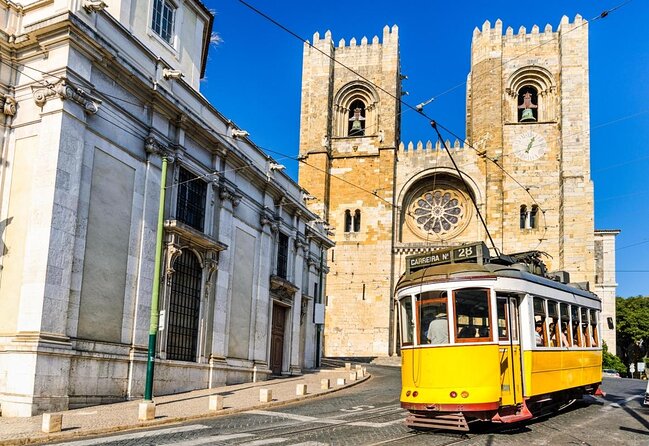
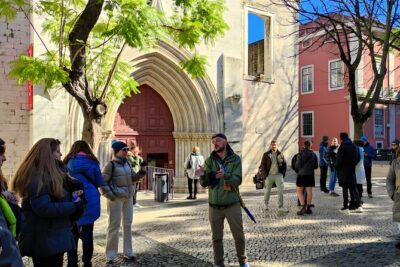
Next is Lisbon Cathedral, with a focus on the church of Santo António. The tour explains that the church was built on the exact site associated with Santo António’s birth, the Portuguese saint linked with Pádua in Italy.
You’ll also learn the timeline: the construction is attributed to D. Afonso Henriques, Portugal’s first king, in the 12th century, after Lisbon was conquered from the Moors. Being able to place a major landmark inside a clear historical sequence makes the cathedral area feel less like “just a photo stop” and more like a real piece of the city’s timeline.
This is about an hour. The admission ticket is not included. That means you’ll likely pay at the monument depending on what you want to see inside.
Possible consideration: if you’re hoping for a fully free tour with zero ticket add-ons, this is where the cost starts creeping in. But if you want the full Lisbon story, this is one of the most logical places to spend a few euros.
Baixa, Rossio & Restauradores: the 1755 earthquake rebuilt
Baixa is where Lisbon’s modern “center of gravity” becomes obvious. The tour focuses on the importance of the 1755 earthquake and how it reshaped the city—physically and psychologically. You’ll see why the rebuilding created broader streets and more squares, and why architecture in Baixa doesn’t look like the narrow medieval lanes behind Alfama.
Marquês de Pombal is a key name here. The guide connects him to reconstruction and to the economic and social changes that followed the earthquake. The tour also mentions anti-seismic construction concepts in the 18th century, tied to that rebuilding mindset.
This stop takes about two hours, and admission is free. Two hours is a good amount of time because Baixa/Rossio has rhythm: you can walk the main arteries, pause for viewpoint angles across streets, and still avoid feeling like you’re sprinting.
The only downside is weather and comfort. If it’s hot or windy, you’ll feel it in this open, street-and-square style area. Still, it’s one of the best places to get a clear sense of how Lisbon “planned” itself after disaster.
Parque Eduardo VII: a viewpoint with political backstory
After the city streets, you get a higher perspective at Parque Eduardo VII. The tour includes a viewpoint where you can see Lisbon and understand why the city is called the city of seven hills.
There’s also a specific political angle. The guide connects Portugal and England with treaties and alliances, and how these relationships influenced the Portuguese colony’s later story in Brazil after independence. It’s not a random history detour. The viewpoint is used as a way to interpret the city’s geography and development, not just a photo stop.
The tour also references the imponent statue of Marquês de Pombal, which ties nicely back to Baixa and the rebuilding story. You start to see a thread: Lisbon’s monuments aren’t isolated—they talk to each other across neighborhoods.
This stop runs about an hour and is free. If you’re sensitive to heights or if it’s a windy day, just keep an eye on comfort. Otherwise, it’s one of the easiest ways to reset your legs after hours of walking and to make sense of the city’s layout.
Belém in one hour: monuments, gardens, and the Tagus
Then you swing west to Belém, Lisbon’s district by the Tagus. The tour describes Belém as a must, combining historical monuments, museums, and attractive gardens along the water.
What I like about having Belém included in the 8-hour plan is that it explains the city beyond “pretty streets.” You’re reminded that Lisbon’s global importance came from the sea. The tour talks about shipyards and ports and the Portuguese explorers of the 15th century, linking them to routes toward India, Africa, and Brazil.
It also emphasizes the wealth flowing back to Portugal from the colonies. That context helps Belém’s monumental feel make more sense. It’s not only romance and marble; it’s tied to power and economics.
This part is about an hour and admission is free. One practical drawback: Belém is big, so one hour means you’ll see highlights rather than a full deep dive. Still, for a first visit, that’s a feature, not a bug. It sets you up to return later if you want to go museum-by-museum.
Jerónimos and Pastéis de Belém: where the ticketed part matters
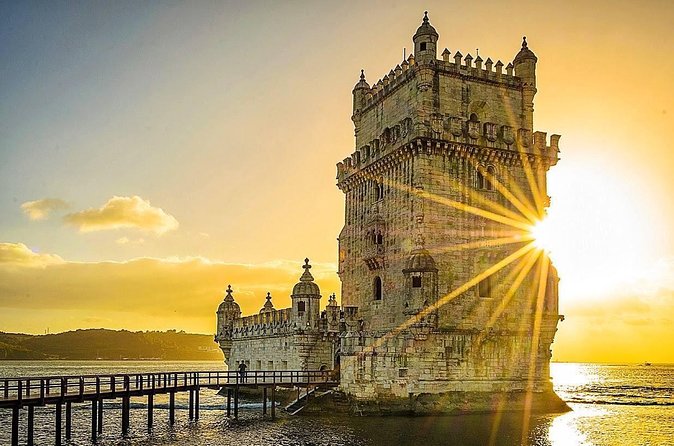
This is the tour’s most iconic finale: Mosteiro dos Jeronimos and the nearby Tower of Belém. The tour positions the Jerónimos monastery as a 16th-century landmark and describes it alongside the monument connected to the explorers.
And then you get the big food moment: Pastéis de Belém. The tour frames a visit and tasting here as a must-do. It’s described as a centenarian pastry shop, and the guide explains how the family worked to keep the place special in the sale of this classic Portuguese sweet.
This is about an hour, and admission is not included. So here’s your reality check: the sweet and the monument both come with costs, but they’re the kind of costs you’d likely pay on your own anyway. If you want the “Lisbon ending” that people actually remember, this is it.
Practical tip: plan for a ticketed stop and a treat. If you eat light earlier in the day, you’ll enjoy this more. If you’re already full, you can still taste, but you might end up sharing or taking more slowly.
How to make the day feel truly flexible (instead of just scheduled)
The private format is the whole point, but only if you use it. Here’s how I’d approach it so the guide can tailor the day to you:
Tell the guide what kind of Lisbon you want most. If you’re drawn to history and architecture, lean into Alfama, Lisbon Cathedral, Baixa, and Jerónimos. If you prefer views, spend extra time in Parque Eduardo VII and Belém’s waterfront gardens.
Also, use the guide for micro-decisions. You’re going to hit moments where you’ll wonder where to walk next or how long something will take. Since the tour is designed for dealing with language barriers, ask questions early and keep the day smooth.
Finally, don’t try to “beat the clock.” This is about 8 hours, but it’s private and flexible. If you want to linger for one extra photo in Alfama or in Belém, you usually can. The more you treat it like your day, the less it feels like a checklist.
Should you book Passeio Privado de Lisboa?
I’d book this tour if:
- You’re seeing Lisbon for the first time and want coverage without navigating alone
- You want help with directions and language so you don’t waste time
- You care about comfort—an easy ride between neighborhoods plus WiFi and bottled water
- You’re excited about hitting both old Lisbon (Alfama/Baixa) and the sea side (Belém/Jerónimos)
I’d think twice if:
- You hate paying separate monument fees (since some key stops are not included)
- You’re hoping for a fully meal-included day
- You already know Lisbon well and don’t need a guide to connect the dots between neighborhoods
One more nudge: the guide quality seems to be a strength of this company, with positive feedback on punctuality and enthusiasm from guides such as André and Carlos Souza. For a first-timer day, that matters.
FAQ
How long is the private Lisbon tour?
It’s about 8 hours.
What is the price per person?
The price is $254.50 per person.
Is pickup included?
Yes. The tour starts and ends at your hotel or another location you choose.
Is this tour private?
Yes. It’s private, and only your group participates.
What’s included in the price?
A licensed guide, a private and fully flexible tour, a very comfortable vehicle with WiFi, bottled water, and hotel or chosen-location pickup.
What is not included?
Monument entrances and meals are not included.
Do I need tickets for Lisbon Cathedral and Jerónimos?
Admission for Lisbon Cathedral is not included, and Mosteiro dos Jerónimos and the related Pastéis de Belém stop also aren’t included in admission.
Can I choose my start time?
Yes. You can choose a start time that fits your schedule.
Is it family-friendly?
You’ll have child-related support available, including child seats/chairs for children, and it’s stated that most travelers can participate.
More Tour Reviews in Lisbon
- Lisbon City Center Tour – The Unmissable Lisbon★ 5.0 · 22,234 reviews
- Lisbon: Sintra, Pena, Regaleira, Cabo da Roca & Cascais★ 4.7 · 19,656 reviews
- Lisbon Card: 24, 48, or 72-Hour Pass★ 4.5 · 17,944 reviews
- Lisbon: Jerónimos Monastery Entrance Ticket★ 4.1 · 14,164 reviews
- Lisbon: History, Stories and Lifestyle Walking Tour★ 4.8 · 10,902 reviews