
Reviewed · 1-HOUR EXPERIENCES
Medieval Tour 1H
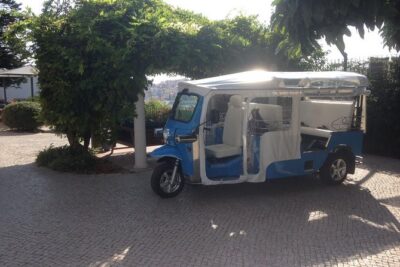
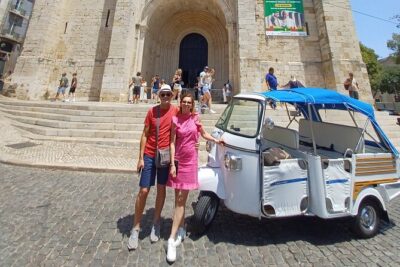
Lisbon on a tuk-tuk feels like cheating. This private medieval tour uses a quiet electric tuk-tuk to get you up and around the city fast, while still stopping at churches, monasteries, and viewpoints so you’re not just passing by.
I like that it keeps the day moving without turning into a sore-feet marathon, and I love the way the route follows the hills rather than fighting them. I also appreciate the guide, often André, who explains what you’re looking at in a way that’s easy to follow.
The big reason it works is the mix of sights you actually enter and the ones you see from key corners. You’ll go inside the Lisbon Cathedral (Sé) and end with a short walk through Alfama’s lanes, while the tuk-tuk handles the steep, narrow stretches.
One thing to consider: not every stop includes admission. Several sites are listed as tickets not included, so you should plan to pay some entry fees separately.
In This Review
- Key highlights worth your time
- A quiet electric tuk-tuk that fits Lisbon’s hills
- How the route handles medieval Lisbon: pass, enter, then look out
- Praça da Figueira meet-up, and what to expect from the timing
- Lisbon Cathedral (Sé): the stop where you actually go inside
- Baixa to the Roman Theatre area: classic Lisbon streets with one eye on the past
- Two viewpoints that change how Lisbon looks: Portas do Sol and Senhora do Monte
- São Vicente de Fora and the monastery atmosphere
- Santa Engrácia, the National Pantheon zone, and why the ride still matters
- Alfama’s lanes at the end: the best payoff for medieval vibes
- Price and value: what $93.92 buys in 1–1.5 hours
- Who this tour fits (and who should skip it)
- Guide energy: why André tends to make the ride better
- Should you book this medieval tuk-tuk tour?
- FAQ
- How long is the Medieval Tour by tuk-tuk in Lisbon?
- Is this tour private?
- Do I need to pay admission tickets during the tour?
- Where does the tour start?
- Is pickup available?
- What is the cancellation policy?
Key highlights worth your time
- Electric tuk-tuk comfort for Lisbon’s steep streets, so you see more than a standard walking tour
- Private format means only your group and a more personalized pace through medieval sights
- Church and monastery visits with explanations at multiple stops, not just photo stops
- Two major viewpoints on the route: Portas do Sol and Senhora do Monte for classic Lisbon views
- Alfama finishing walk gives you the old-street feel after the ride
- English available, with guides who can also try other languages depending on your group
A quiet electric tuk-tuk that fits Lisbon’s hills

Lisbon is a city of angles. Streets climb, staircases cut through neighborhoods, and you can feel your legs start to complain long before you finish your sightseeing plan. That’s why a tuk-tuk works so well here: it keeps you close to the action while avoiding the worst uphill grinds.
This tour is built for that reality. Instead of spending your entire time on foot, you ride in a quiet electric tuk-tuk through the city’s tighter streets and steeper segments. You’re still getting stops with real context, but you’re not spending the whole outing trapped in slow foot traffic or trying to match your pace to the city’s constant climbs.
The private setup is a bonus for comfort and flow. With only your group, you can usually settle in for short check-ins, quick photos, and the next viewpoint without feeling rushed by strangers. That matters on a 1 hour to 1 hour 20 minute experience, because you want your time to feel full, not stretched thin.
Worth a look before you lock anything else in around Lisbon:
- Lisbon: 1-Hour Portuguese Wine Tasting Session
★ 4.6 · 368 reviews - Lisbon: 1-Hour Beer Bike Tour with Draft Beer & Sangria Ride
★ 4.2 · 260 reviews - Lisbon: 1-Hour Beer, Sangria or Wine Bike Sightseeing Tour
★ 4.3 · 110 reviews - City of Neighborhoods Tour 1H 30M Private Tour by Tuk Tuk
★ 5.0 · 38 reviews
How the route handles medieval Lisbon: pass, enter, then look out
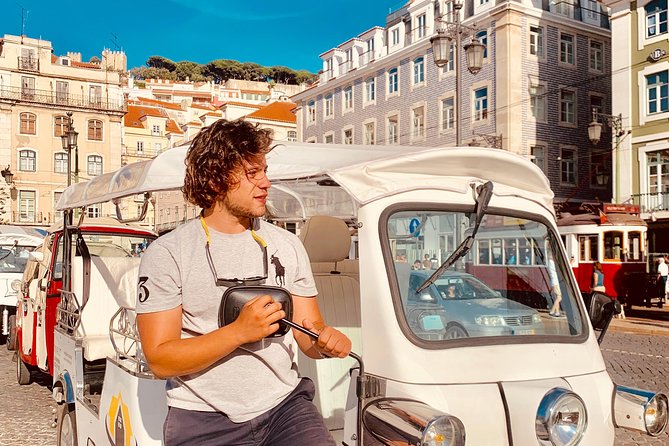
The tour’s structure is simple: you pass major medieval-area neighborhoods, you stop for explanation and key sights, you go inside select monuments, and you end in Alfama. The tuk-tuk does the heavy lifting between areas, and the guide fills in the story while you’re stopped.
Here’s how the sequence plays out in real life:
- You start in Baixa de Lisboa (downtown area) and move from there into the older core.
- You then shift to major religious landmarks where you can step inside.
- After that, you climb to viewpoints where Lisbon makes sense as a city built on hills.
- Then you work your way down toward the monastery area and more churches.
- Finally, you finish with a walking section inside Alfama, where the old streets are part of the experience.
This rhythm is a big part of the value. A regular walking tour can cover some sights, but it often forces you to choose between comfort and coverage. This one aims for both by using the vehicle as a tool, not a novelty.
Praça da Figueira meet-up, and what to expect from the timing
Your meeting point is Praça da Figueira 1B, 1100-052 Lisboa. The tour ends back at the meeting point, so you’re not trying to map your way home mid-day. That’s a small detail, but in Lisbon it can save you stress because neighborhoods can feel like they run in loops.
Duration is listed as about 1 hour to 1 hour 20 minutes, so this is not a long, sit-down museum day. It’s an efficient overview with actual entry time at some highlights. If your goal is to see the medieval spine of Lisbon without using up half your sightseeing schedule, the timing fits.
You can also choose from several tour times to match your day. And pickup is offered, though transfer fees may apply. If you’re staying a bit outside the center, it’s worth looking at pickup options early so you don’t end up spending your tour time on transport instead of views and monuments.
Lisbon Cathedral (Sé): the stop where you actually go inside
One of the best ways to understand medieval Lisbon is to step into a building that still carries the city’s long timeline. Here, that happens with Lisbon Cathedral, Sé.
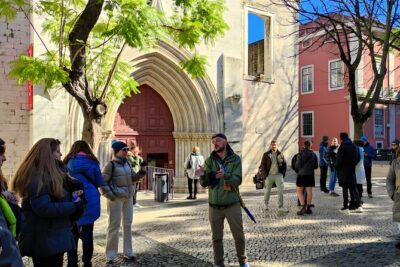
You stop your tuk-tuk and go inside to visit. Admission for the cathedral is marked as not included, so plan for an entry fee on the day. Even so, it’s usually worth paying because you’re getting something more than a façade photo.
Why this stop matters: cathedrals work as anchors. When you see the building from outside and then step in, the city’s medieval story stops being abstract. You also get a break from riding and walking nonstop—just enough time to reset before you continue on to viewpoints and monastery areas.
Practical tip: if you’re deciding between a cathedral visit and rushing to photos, pick the cathedral. The views are great, but buildings you can enter give you a more grounded sense of Lisbon’s past.


Baixa to the Roman Theatre area: classic Lisbon streets with one eye on the past
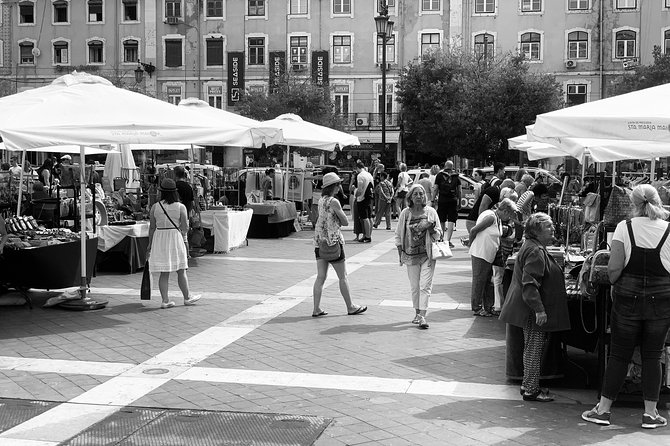
Before you reach the biggest religious landmarks, you spend time moving through Baixa de Lisboa—downtown Lisbon. This part of the day is more about orientation. You’ll pass through downtown streets, and the tour includes a stop there where admission is listed as free.
Then you pass the area connected to Museu de Lisboa – Teatro Romano. The Roman Theatre is mentioned as something you can go out to explore and take pictures. Admission is marked as not included, so treat it as a viewing opportunity unless you plan to pay separately.
This is a smart way to use time. Roman remnants are spread out in the city, and a tuk-tuk lets you reposition quickly without losing momentum. You also get a sense that Lisbon wasn’t born medieval—its layers go back much further, even if today’s charm is mostly in the medieval and post-medieval streets.
If you like your sightseeing with variety—medieval churches plus a quick Roman reference—this stop pattern will feel balanced rather than repetitive.
Two viewpoints that change how Lisbon looks: Portas do Sol and Senhora do Monte
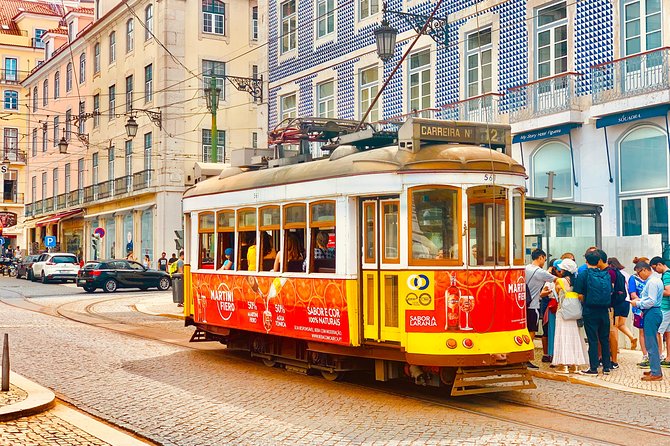
Lisbon views can make you understand the city in seconds. The tour uses two of the most recognizable viewpoints on the route, and it does it at the right moments so the views feel like a progression rather than random stops.
First you pass Miradouro das Portas do Sol. Then you continue up to Miradouro da Senhora do Monte, described as the highest point of the city. For both, admission is marked as not included—so you’re going for the scene, not ticketed attractions.
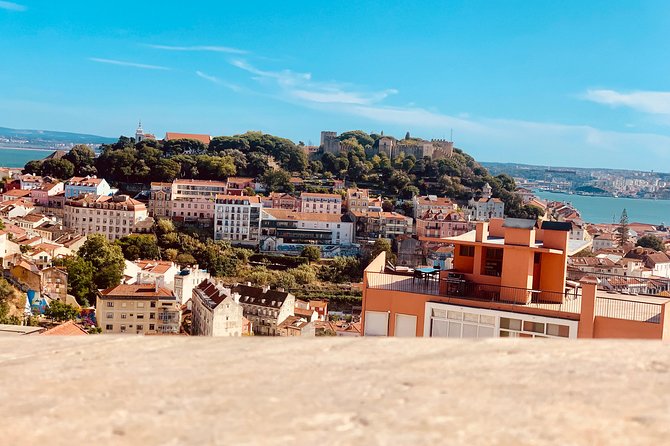
What I like about this viewpoint pair is the contrast. Portas do Sol gives you that iconic, postcard-ready feeling early on. Then Senhora do Monte shifts the perspective. When you climb to a higher vantage, Lisbon’s rooftops and neighborhoods spread out in a way that makes the hills feel real—not just something you hear about.
This is also where the tuk-tuk really earns its keep. You’re not burning your energy walking up steep segments. You’re saving that energy for standing still, looking, and taking photos with breathing room.
São Vicente de Fora and the monastery atmosphere

After the highest viewpoints, the tour changes tone. You go back down the hill toward the older religious complex area, including Mosteiro de São Vicente de Fora.
This is one of those stops where you’re likely to feel the neighborhood’s mood shift. Monasteries and church complexes often have a different sound and pace than the surrounding streets, and that contrast is part of the value of including them rather than only riding past.
Admission is listed as not included, so again, budget for entry if you choose to go inside parts of the complex during the stop. Even if you spend only a short time there, the stop matters because it connects the earlier cathedral stop into a wider theme: Lisbon’s medieval religious geography.
If your ideal tour includes atmosphere—not only architecture—this part of the route is a good match.
Santa Engrácia, the National Pantheon zone, and why the ride still matters
You continue down and pass Church of Santa Engrácia, with the National Pantheon also mentioned along the way. Admission is marked as not included for Santa Engrácia.
This segment is likely to feel like a “keep moving, but keep your eyes open” moment. The tour is structured for efficiency, so not every stop becomes a long interior visit. But the benefit of the tuk-tuk is that you can see multiple important landmarks in one outing without losing the bigger picture.
It’s also a handy way to learn what belongs to what. Santa Engrácia and the pantheon-related area are big identifiers in the city. Seeing them within a route that also includes Sé and São Vicente de Fora helps you connect dots between Lisbon’s religious sites and the city’s evolving story.
Even if you don’t plan to pay entry fees at every single stop, passing these landmarks with explanation can make later self-guided visits much easier.
Alfama’s lanes at the end: the best payoff for medieval vibes
Most Lisbon neighborhoods are best when you walk them. The tour understands that by ending with a short walking tour inside Alfama.
Alfama is where the medieval feel turns from idea into street reality: narrow lanes, turns you didn’t expect, and that old-city sense that you’re moving through something lived-in rather than staged. After the riding segments, the walking portion gives you a change of pace and a chance to absorb the neighborhood texture.
Admission is not listed for this final walk, which makes the end feel like a flexible, low-stress finish. The tour’s timing keeps it short enough that you’re not exhausted, but long enough that you don’t feel like you missed the point.
If you only do one organized segment in Lisbon’s old area, this ending helps you get your bearings fast for the rest of your day.
Price and value: what $93.92 buys in 1–1.5 hours
At $93.92 per person, this tour isn’t the cheapest option in Lisbon. But it’s also not trying to be. You’re paying for a private tuk-tuk, a guide, and coverage that would be hard to match with walking alone, especially in a hilly city.
The value comes from three places:
- Transport efficiency: You cover more ground than a straight walking route would allow.
- Guided stops: You don’t just get motion; you get explanations during the stops.
- Some paid entries included by default? Not exactly, but the cathedral is a real stop: Sé is included for the visit, even though its admission isn’t included, so the main cost uncertainty is on ticket fees you may pay separately.
Also, the tour supports mobile tickets and has group discounts, which can bring the effective cost down if you’re traveling with friends or family.
One practical note: since several sights list admission as not included, you’ll want to treat the base price as your tour fee, then budget extra for entries you decide to do. That doesn’t make the tour bad—it just keeps expectations realistic.
Who this tour fits (and who should skip it)
This experience is best for you if:
- you want a private way to see medieval highlights without spending the whole day on steep stairs
- you like the combo of guided stops plus viewpoints, with at least one major interior visit like Sé
- you’re short on time and want a route that gives shape to Lisbon fast
It may be less ideal if:
- you want a long, slow museum day with multiple ticketed interiors (this is only about 1 to 1.5 hours)
- you don’t want to pay any monument fees at all (some stops are explicitly not included for admission)
- you strongly prefer walking as your only mode of sightseeing (this tour uses the tuk-tuk as the backbone)
On the plus side, the tour notes that most travelers can participate, and service animals are allowed. It’s also near public transportation, which helps if you’re coordinating your day around transit.
Guide energy: why André tends to make the ride better
A key reason this tour earns high marks is the guide approach. André is repeatedly singled out for being friendly and for telling the story in a way that clicks. The tour also notes English service, and in real use the guide can try other languages depending on your group.
That matters because medieval Lisbon can feel overwhelming if you’re just looking at buildings with no thread. The explanation connects the stops—cathedral to viewpoints to monastery sites to Alfama—so the route feels like a guided story, not a checklist.
If you like tours where you can ask quick questions while stopped at viewpoints or at church entrances, a private format helps. You’re not competing with a big group for the guide’s attention.
Should you book this medieval tuk-tuk tour?
Book it if you want a fast, fun, and practical way to see medieval Lisbon without turning your day into a fitness test. The tuk-tuk is not just for photos—it’s what lets you reach viewpoints and landmarks efficiently, then still enjoy a walk in Alfama.
Consider a different option if you’re trying to maximize ticketed museum time or you dislike the idea of paying entry fees at multiple sites. Also, if you’re traveling during a period when you need a tight plan for specific interiors, you may want to check entry expectations day-of, since admission is not included for several stops.
In most Lisbon first-weekend plans, this tour works as a “get your bearings” hit: you leave understanding where the medieval story sits on the hills, and you know what areas you’ll want to return to on foot later.
FAQ
How long is the Medieval Tour by tuk-tuk in Lisbon?
The tour runs about 1 hour to 1 hour 20 minutes.
Is this tour private?
Yes. It’s a private tour/activity, so only your group participates.
Do I need to pay admission tickets during the tour?
Some stops are listed as free (for example, Baixa de Lisboa), but others are listed as not included (such as Lisbon Cathedral Sé and multiple viewpoints/monuments). You should expect to pay some entry fees separately if you go inside.
Where does the tour start?
The meeting point is Praça da Figueira 1B, 1100-052 Lisboa, Portugal, and the tour ends back at the meeting point.
Is pickup available?
Pickup is offered, but transfer fees may apply.
What is the cancellation policy?
You can cancel for a full refund up to 24 hours before the experience starts. If you cancel less than 24 hours before, the amount paid is not refunded. Free cancellation is listed as available.
More 1-Hour Experiences in Lisbon
- Lisbon: 1-Hour Portuguese Wine Tasting Session★ 4.6 · 368 reviews
- Lisbon: 1-Hour Beer Bike Tour with Draft Beer & Sangria Ride★ 4.2 · 260 reviews
- Lisbon: 1-Hour Beer, Sangria or Wine Bike Sightseeing Tour★ 4.3 · 110 reviews
- City of Neighborhoods Tour 1H 30M Private Tour by Tuk Tuk★ 5.0 · 38 reviews
- 1h Secret Lisbon by Tuk Tuk – Mouraria, Graça & Alfama★ 5.0 · 35 reviews
More Tours in Lisbon
- Lisbon City Center Tour – The Unmissable Lisbon★ 5.0 · 22,234 reviews
- Lisbon: History, Stories and Lifestyle Walking Tour★ 4.8 · 10,902 reviews
- True 4Hour Private Tuk Tuk Tour: Discover Lisbon with a Local!★ 5.0 · 8,008 reviews
- Winner 2025 Undiscovered Lisbon Food & Wine Tour by Eating Europe★ 5.0 · 6,390 reviews
- Lisbon: Sintra, Pena, Cabo da Roca, Cascais Tour with Pickup★ 4.8 · 5,445 reviews
More Tour Reviews in Lisbon
- Lisbon City Center Tour – The Unmissable Lisbon★ 5.0 · 22,234 reviews
- Lisbon: Sintra, Pena, Regaleira, Cabo da Roca & Cascais★ 4.7 · 19,656 reviews
- Lisbon Card: 24, 48, or 72-Hour Pass★ 4.5 · 17,944 reviews
- Lisbon: Jerónimos Monastery Entrance Ticket★ 4.1 · 14,164 reviews
- Lisbon: History, Stories and Lifestyle Walking Tour★ 4.8 · 10,902 reviews
Just in: fresh Lisbon reviews from the team





1-Hour Experiences, compared.
 ★ 4.61-Hour Portuguese Wine Tasting SessionFrom $22368 reviews
 ★ 4.21-Hour Beer Bike Tour with Draft Beer & Sangria RideFrom $35260 reviews
 ★ 4.31-Hour Beer, Sangria or Wine Bike Sightseeing TourFrom $35110 reviews
 ★ 5.0City of Neighborhoods Tour 1H 30M Private Tour by Tuk TukFrom $16138 reviews
 ★ 5.01h Secret Lisbon by Tuk Tuk – Mouraria, Graça & AlfamaFrom $5935 reviews
 ★ 5.0Private 1 hour and half Sintra Guided TourFrom $5434 reviews
 ★ 4.51H power catamaran up to 18 people in LisbonFrom $66031 reviews
 ★ 5.0Lisbon Tuk Tuk Tour – 1-Hour Old Town ExperienceFrom $8623 reviews
Browse the lists this tour appears in