
Reviewed · LISBON TUK-TUK TOURS
Lisbon Private Tuk Tuk Tour: City Highlights
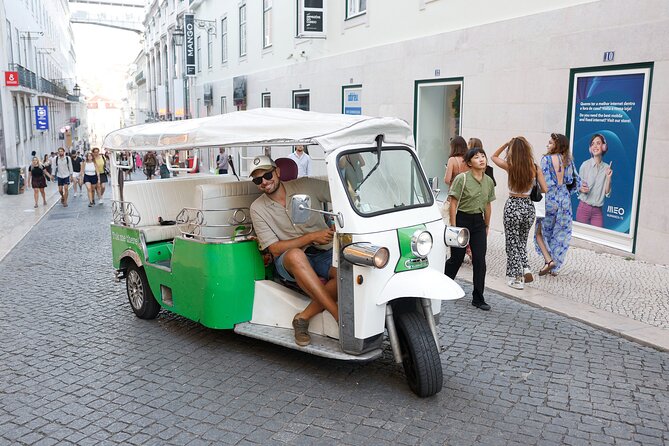
Lisbon starts to make sense in hours. It uses a private electric tuk-tuk and hits the city’s best viewpoints, so you get big-picture photos without turning the day into a long hike. I love the Alfama sequence with the Fado Museum and a chance to try ginjinha, but plan for a bit of bounce on cobblestone streets.
This is the kind of tour that works especially well early in your trip. You’ll be in English, you can request city-center pickup, and the pace is set for seeing a lot while still getting off at key spots to look around.
In This Review
- Key things I’d circle before you book
- Why a tuk tuk is a smart way to start Lisbon
- Restauradores and Rossio: Lisbon’s big landmarks in fast context
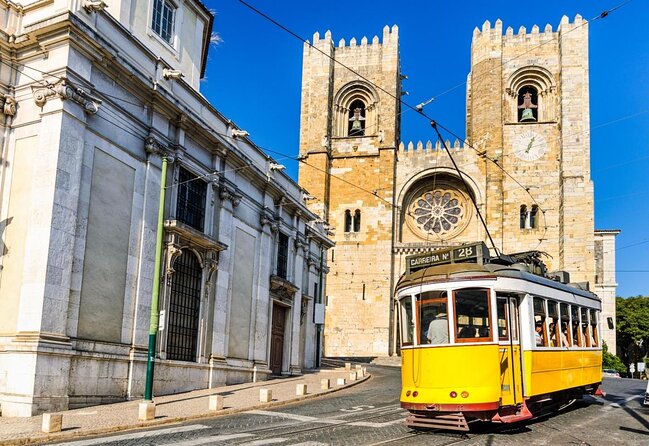
- The oldest church stop that helps you read the city
- Portas do Sol and Senhora do Monte: two viewpoints, two different stories
- Miradouro das Portas do Sol
- Miradouro da Senhora do Monte
- Feira da Ladra and National Pantheon: local rhythm plus major monuments
- Feira da Ladra (flea market)
- National Pantheon at Igreja de Santa Engrácia
- Alfama: Fado Museum, Fado context, and ginjinha in the oldest streets
- Praça do Comércio and Rua Augusta Arch: Lisbon’s rebuilt center
- Praça Luís de Camões and Largo do Carmo: Portuguese pavement plus earthquake memory
- Bairro Alto and Chiado plus Miradouros and gardens: the city’s mood shift
- Basílica da Estrela: a neoclassical finish with royal ties
- Price and what you really get for $83.27
- The guide quality is a big part of the value
- Is it worth your time? Who this tour fits best
- Should you book this Lisbon tuk-tuk highlights tour?
- FAQ
- How long is the tour?
- What’s included in the price?
- Are museum or church entrance fees included?
- Is this tour private?
- Do they offer hotel pickup?
- What if the weather is bad?
Key things I’d circle before you book
- Private electric tuk-tuk, not a crowded bus: it’s just your group, so the guide can steer the timing to your interests.
- Viewpoints are the star of the show: Portas do Sol and Senhora do Monte are built for instant photo payoff.
- Alfama is more than a drive-by: the Fado Museum stop and the ginjinha moment give you context for the neighborhood.
- You’ll pass through Lisbon’s major “story locations”: Restauradores, Rossio, Praça do Comércio, and the 1755-earthquake reminders.
- Built-in rhythm for first-timers: shorter stops (often 10–20 minutes) help you get oriented fast.
- Ask the guide for food ideas: many guides share practical local recommendations for what to try next.
Why a tuk tuk is a smart way to start Lisbon

Lisbon is hilly, tight, and full of turns. That’s great for wandering, but it’s a pain if you only have a short window and you’re trying to cover multiple neighborhoods.
This tour solves that by using a 100% electric tuk-tuk to link the dots. You don’t spend your energy wrestling with staircases or waiting for buses. Instead, you focus on the fun parts: viewpoints, squares, and neighborhoods where Lisbon’s personality shows up fast.
It’s also private. That matters more than you’d think. A private setup means your driver/guide can take little timing decisions on the fly—like lingering a bit longer at a viewpoint if the light is good or moving on quickly when streets get busy.
One heads-up: Lisbon roads can be bumpy. Even with the electric tuk-tuk, expect some vibration on cobblestones. If you’re sensitive to motion, I’d keep that in mind (and sit where you feel most stable).
The hills done the easy way, more tuk-tuk runs
- True 4Hour Private Tuk Tuk Tour: Discover Lisbon with a Local!
★ 5.0 · 8,008 reviews - Lisbon: Private Guided Tuk-Tuk Tour with Hotel Pickup
★ 4.9 · 4,552 reviews - Private Lisbon Sightseeing Tuk-Tuk Tour: Alfama, Belém & More
★ 5.0 · 4,277 reviews - Lisbon Highlights: Private Tuk Tuk Tour Adventure Sightseeing
★ 5.0 · 3,284 reviews
Restauradores and Rossio: Lisbon’s big landmarks in fast context
You’ll start with Monument to the Restauradores, a standout obelisk (about 30 meters tall) inaugurated on April 28, 1886. It commemorates Portugal’s liberation from Spanish rule on December 1, 1640. This is one of those moments where a quick stop pays off because you understand what you’re seeing instead of just snapping a photo.
From there, the tour heads to Praça de D. Pedro IV, better known as Rossio. It’s one of central Lisbon’s main squares and has been a meeting point for locals for centuries. Rossio is where you feel the city’s “daily life” energy—still central, still busy, still a natural starting point for exploring on your own afterward.
Why these stops matter: they’re anchors. Once you know where Restauradores sits and how Rossio functions, you start recognizing the city’s layout. Later, when you walk those streets yourself, the geography feels less random.
The oldest church stop that helps you read the city
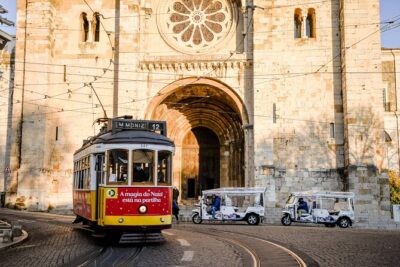
Next comes a stop at Lisbon’s oldest church, the seat of the Patriarchate of Lisbon. Even if you don’t go into every detail, this is the kind of place that gives you a time anchor: it signals how long Lisbon has been shaped by religion, power, and civic life.
A quick note on expectations: the tour covers lots of sites, so you’re not doing deep museum work at every stop. If your priority is interior time—chapels, tombs, major exhibits—you’ll want to treat this as orientation, then add your own follow-up visits.
Still, this kind of stop is valuable. It turns your “Lisbon photo day” into something more meaningful because you’re picking up threads as you go.
Portas do Sol and Senhora do Monte: two viewpoints, two different stories
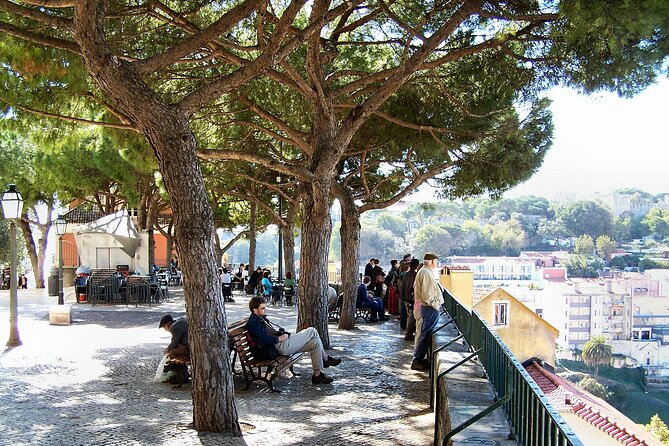
If there’s one part of the itinerary that consistently earns the best energy, it’s the viewpoints.
Worth a look before you lock anything else in around Lisbon:

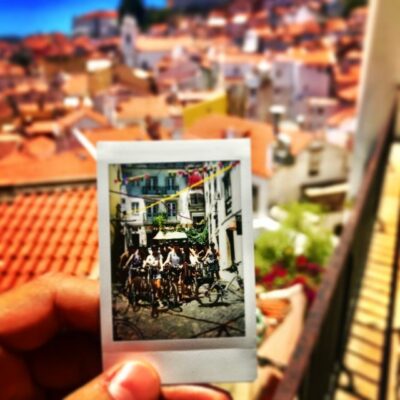

Miradouro das Portas do Sol
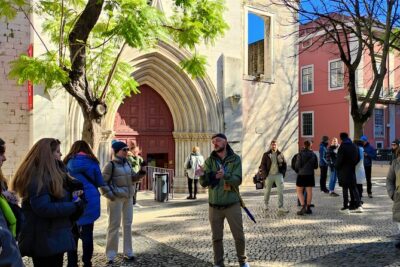
This viewpoint is a classic for a reason. You’ll get a look over the eastern part of Lisbon, with red rooftops of Alfama and the Tagus River in the frame. It’s a short stop (about 10 minutes) and that’s perfect here—enough time to get your bearings and take pictures without losing the rest of your day.
Miradouro da Senhora do Monte
Then you climb your way into a broader panorama at Miradouro da Senhora do Monte (about 15 minutes). From here you can see the Castle of São Jorge, downtown Lisbon, the Tagus estuary, Bairro Alto, and even the Monsanto Forest Park area.
Practical tip: bring your phone battery mindset seriously. Viewpoints are the easiest places to burn through photos fast. If you want the cleanest shots, give yourself a minute to pick where the sun sits on the buildings before you start firing.
Why this pair works: the city changes depending on which angle you see it from. Portas do Sol feels intimate and colorful. Senhora do Monte feels expansive and strategic. Seeing both helps you understand why Lisbon’s viewpoints aren’t just “pretty”—they’re part of how the city was built to be seen.
Feira da Ladra and National Pantheon: local rhythm plus major monuments

After the viewpoint hits, you shift to culture and city texture.
Feira da Ladra (flea market)
Feira da Ladra is a popular flea market that runs in Lisbon every Tuesday and Saturday. If your trip lands on one of those days, this stop can add a fun, human layer to what’s otherwise a highlight-tour day. Even if you don’t plan to buy anything, it’s a good moment to absorb daily life.
National Pantheon at Igreja de Santa Engrácia
Then you’ll visit the National Pantheon, installed in the Church of Santa Engrácia. This is another “big meaning” location—one of those Lisbon landmarks that makes you slow down a touch.
Again, because entrance fees aren’t included, I’d treat this as: you’ll get the stop and the context, then decide on your own whether you want to pay for interior access.
Alfama: Fado Museum, Fado context, and ginjinha in the oldest streets
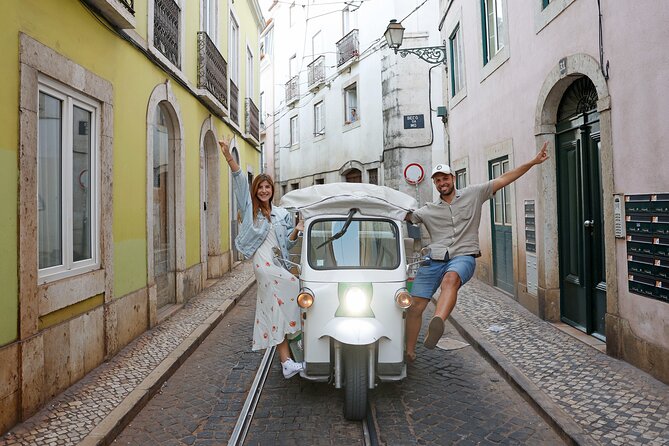
Alfama is Lisbon’s oldest and one of its most typical neighborhoods. This is where Lisbon feels the most “unplanned,” in a good way—narrow streets, layered history, and the kind of atmosphere that makes you want to wander even when you planned not to.
The tour’s Alfama portion includes the Fado Museum, which is devoted to the universe of fado and the Portuguese guitar. That’s smart, because fado isn’t just a soundtrack—it’s part of how Portuguese identity shows up. Even a quick introduction helps you hear the music differently later when you spot fado performances.
And yes, there’s a ginjinha moment. The itinerary includes a chance to try ginjinha, the famous cherry liqueur you’ll hear about all over Portugal. If you like sweet, tart drinks, it’s an easy win. If you don’t, your guide will still help point you to other local options.
One more practical thing: Alfama streets can be tight and busy. That makes a tuk-tuk approach useful. You can get close to the sights without doing a long shuffle from one hilltop to the next.
Praça do Comércio and Rua Augusta Arch: Lisbon’s rebuilt center

You’ll then reach Praça do Comércio, a stunning square by the water where a royal palace once stood before it was lost in the 1755 earthquake. This isn’t a “look but don’t think” stop. The earthquake connection is part of Lisbon’s identity, and the setting makes it easy to imagine how the city reorganized itself afterward.
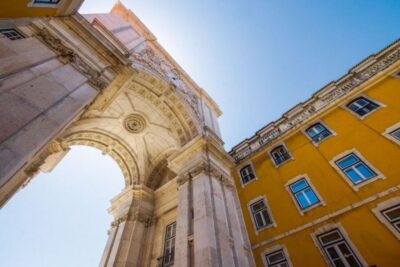
The tour also passes the Rua Augusta Arch, a prominent structure tied to the square’s grand architecture. This is one of those places where you feel the scale of Lisbon’s public space planning.
Tip for your photos: stand slightly back from the arch so you can capture the full effect, then move closer for details. It’s easier than trying to solve composition on the spot.
Praça Luís de Camões and Largo do Carmo: Portuguese pavement plus earthquake memory

Next is Praça Luís de Camões, a pleasant open space with trees and stone benches. What makes it memorable is the floor—Portuguese pavement with geometric effects and designs that allude to the sea, mermaids, and caravels. It’s a playful artistic detail, and it’s also a quick reminder that Lisbon loves mixing function and decoration.
Then you’ll get to Largo do Carmo, known for the ruins of the Carmo Convent, built in the 14th century and destroyed by the 1755 earthquake. This is a strong contrast point after all the bright, open squares. Ruins do that: they make your brain slow down and your eyes adjust.
If you like history but don’t want a full day in museums, this kind of stop is a good compromise.
Bairro Alto and Chiado plus Miradouros and gardens: the city’s mood shift
The tour doesn’t keep you stuck only in the old quarters. You’ll pass through the areas of Bairro Alto and Chiado, known for their bohemian and alternative side. Expect creativity, street art, cafés, and shopping that feels more “lived in” than staged.
After that, you’ll hit two garden/view stops that give you a breather:
- Miradouro São Pedro de Alcântara, a garden viewpoint built in 1864 on two terraces. It’s an outside view of the old part of the city and feels like a reset button after busy streets.
- Jardim do Príncipe Real, built in the mid-19th century with a romantic layout. It’s a quieter moment where you can let the day catch up.
This is also where you’ll notice why the tour balances architecture with “pause spaces.” Lisbon is easier to enjoy when you’re not only moving.
Basílica da Estrela: a neoclassical finish with royal ties
To close out the highlights circuit, you’ll stop at Basílica da Estrela. It’s known for its neoclassical beauty and the story behind its construction: it was built in honor of Queen Maria I and inaugurated in the late 18th century.
This final stop is useful because it rounds out the day. You’ve covered medieval-feeling areas, earthquake memory, royal-era Lisbon through squares, and now a grand church tied to a monarchy. It’s a nice last chapter before you head off to your own dinner plan.
Price and what you really get for $83.27
At $83.27 per person, this isn’t a budget “just ride around” activity. It is, however, priced like a tour that delivers a lot of high-value stops in a short time window—without needing you to figure out transport between hills and neighborhoods.
You’re paying for:
- a private experience (only your group participates)
- hotel pickup if you’re in the city center (on request)
- a driver/local guide
- a 100% electric tuk-tuk
- English service
What you should not assume: museum entrances. Entrance fees for museums are listed as not included. That means if you want to go inside places like the National Pantheon or the Fado Museum for extended time, you’ll need to budget separately.
Also plan for no snack setup. Snacks aren’t included, so if you’re prone to getting hungry mid-afternoon, grab something before you meet your tuk-tuk or plan for a café break during your free time.
The guide quality is a big part of the value
The strongest recurring theme in feedback is that guides make the day better. Names that show up with praise include Sergio, Luis, Catarina, Dominique, Adriano, Filipa, Rui, Tiago, and João. The pattern is consistent: punctual, safe driving, friendly energy, and stories that connect the dots.
This matters for you because you’re not just collecting sights—you’re learning how to interpret them. A good guide helps you see why Rossio matters, what Alfama symbolizes, and how the earthquake shaped the city’s layout.
If you’re the type who likes asking questions, this format is ideal. You’ll have time to ask and time to get answers without rushing.
Is it worth your time? Who this tour fits best
This Lisbon Private Tuk Tuk City Highlights tour is a great fit if:
- you want a first-day orientation or a “best of” day without planning a complex route
- you prefer short stops over long museum marathons
- you’re traveling as a group and want your own pacing
- you want a mix of views, plazas, neighborhoods, and culture stops
You might want to rethink it if:
- you hate any bumps on cobblestone roads
- you want deep museum time and long interior visits (entrance fees aren’t included)
- you’re mostly looking for offbeat, far-from-everything experiences (this tour is built around major highlights)
Also, the tour runs based on good weather. If Lisbon’s having a weather mood swing, expect the operator to adjust your options.
Should you book this Lisbon tuk-tuk highlights tour?
Yes, I think it’s a smart booking for most visitors. If you’re in Lisbon for a short stay, this tour is one of the fastest ways to get your bearings, then enjoy the city more on your own.
Book it if you want:
- viewpoint photos that actually explain the city
- Alfama context with the Fado Museum and ginjinha moment
- a private, electric-tuk-tuk format that saves energy
Skip it only if you’re committed to long indoor museum time or you can’t handle a little ride discomfort. Otherwise, this is the kind of “do it early, thank yourself later” experience that helps your whole trip feel easier.
FAQ
How long is the tour?
It runs about 2 to 4 hours, depending on timing and the flow of stops.
What’s included in the price?
You get a driver/local guide, a 100% electric tuk-tuk, and hotel pickup for city-center locations on request. It’s also offered in English and uses a mobile ticket.
Are museum or church entrance fees included?
No. Entrance fees for museums are listed as not included, so if you want to go inside paid sites, plan for extra costs.
Is this tour private?
Yes. It’s a private tour/activity, and only your group participates.
Do they offer hotel pickup?
They do, but only for city center locations and on request.
What if the weather is bad?
This experience requires good weather. If it’s canceled due to poor weather, you’ll be offered a different date or a full refund. Free cancellation is available up to 24 hours in advance for a full refund.
More Tours in Lisbon
- Lisbon City Center Tour – The Unmissable Lisbon★ 5.0 · 22,234 reviews
- Lisbon: History, Stories and Lifestyle Walking Tour★ 4.8 · 10,902 reviews
- True 4Hour Private Tuk Tuk Tour: Discover Lisbon with a Local!★ 5.0 · 8,008 reviews
- Winner 2025 Undiscovered Lisbon Food & Wine Tour by Eating Europe★ 5.0 · 6,390 reviews
- Lisbon: Sintra, Pena, Cabo da Roca, Cascais Tour with Pickup★ 4.8 · 5,445 reviews
More Tour Reviews in Lisbon
- Lisbon City Center Tour – The Unmissable Lisbon★ 5.0 · 22,234 reviews
- Lisbon: Sintra, Pena, Regaleira, Cabo da Roca & Cascais★ 4.7 · 19,656 reviews
- Lisbon Card: 24, 48, or 72-Hour Pass★ 4.5 · 17,944 reviews
- Lisbon: Jerónimos Monastery Entrance Ticket★ 4.1 · 14,164 reviews
- Lisbon: History, Stories and Lifestyle Walking Tour★ 4.8 · 10,902 reviews
More Hills by Tuk-Tuk
- True 4Hour Private Tuk Tuk Tour: Discover Lisbon with a Local!★ 5.0 · 8,008 reviews
- Lisbon: Private Guided Tuk-Tuk Tour with Hotel Pickup★ 4.9 · 4,552 reviews
- Private Lisbon Sightseeing Tuk-Tuk Tour: Alfama, Belém & More★ 5.0 · 4,277 reviews
- Lisbon Highlights: Private Tuk Tuk Tour Adventure Sightseeing★ 5.0 · 3,284 reviews
- Welcome Lisbon Tour with Local Guide in Private Eco Tuk Tuk★ 5.0 · 1,691 reviews
Just in: fresh Lisbon reviews from the team





Lisbon Tuk-Tuk Tours, compared.
 ★ 5.0True 4Hour Private Tuk Tuk Tour: Discover Lisbon with a Local!From $1088,008 reviews
 ★ 4.9Private Guided Tuk-Tuk Tour with Hotel PickupFrom $1534,552 reviews
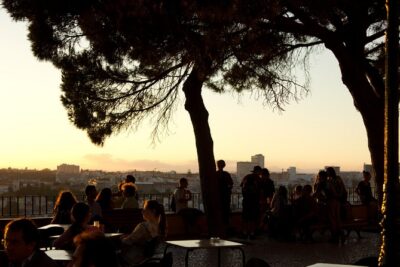 ★ 5.0Private Lisbon Sightseeing Tuk-Tuk Tour: Alfama, Belém & MoreFrom $524,277 reviews
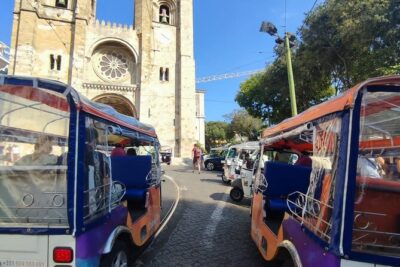 ★ 5.0Lisbon Highlights: Private Tuk Tuk Tour Adventure SightseeingFrom $843,284 reviews
 ★ 5.0Welcome Lisbon Tour with Local Guide in Private Eco Tuk TukFrom $171,691 reviews
 ★ 4.9Private City Tour by Eco Tuk TukFrom $281,215 reviews
 ★ 5.0Old Town TukTuk Tour and Scenic Viewpoints in AlfamaFrom $35974 reviews
 ★ 5.0Explore Lisbon by Tuk Tuk: History and ViewpointsFrom $19840 reviews
Browse the lists this tour appears in