
Reviewed · PRIVATE
Lisbon Highlights for Newcomers Private Tour
Lisbon in two hours, with real stops. This is a newcomer-friendly walk that strings together Chiado squares, must-see churches, and the panoramic Elevador de Santa Justa, then finishes at the Tejo near Praça do Comércio. I love how it pairs a quick architecture-and-story hit with the Carmo Archaeological Museum ruins tied to the 1755 earthquake. One thing to keep in mind: it moves fast, with lots of brief stops, so you’ll get impressions rather than long stays.
You’ll tour in English with a guide for your private group only, and you’ll start at Largo do Chiado and end at Praça do Comércio. It’s designed to help you get your bearings without spending the whole day hunting for the right places.
In This Review
- Key highlights at a glance
- Chiado to Praça do Comércio: a quick route that gets your bearings fast
- Price and value: what you’re paying for (and what you aren’t)
- The private, English-guided experience you’ll feel immediately
- Stop 1: Praca Luis de Camoes in lively Chiado
- Stop 2: Church of Our Lady of Loreto of the Italians (a small chapel with a big story)
- Stop 3: Igreja de São Roque, baroque Jesuit presence
- Stop 4: Trindade and the look of a restored monastery site
- Stop 5: Elevador de Santa Justa, 1902 engineering and major viewpoints
- Stop 6: Largo do Carmo for shade, calm, and a breather
- Stop 7: Carmo Archaeological Museum and the 1755 earthquake scars
- Stop 8: Estacao do Rossio in Neo-Manueline style
- Stop 9: R. das Portas de Santo Antão 6 and ginjinha
- Stop 10: Igreja de S Domingos and a National Monument setting
- Stop 11: Casa do Alentejo, neo-Moorish and Art Nouveau character
- Stop 12: Rua Augusta and the monumental arch into Comercio Square
- Stop 13: Praça do Comércio and Tejo River views
- Stop 14: Praça Dom Pedro IV for Lisbon’s link to Brazil and constitutional monarchy
- How long is too long at each stop?
- Who should book this Lisbon newcomers highlights tour?
- Should you book it?
- FAQ
- How long is the Lisbon Highlights for Newcomers private tour?
- What language is the tour offered in?
- Is this a private tour or a shared group tour?
- Where does the tour start and where does it end?
- Are tickets included for the stops?
- Do I need to bring a paper ticket?
- Is there a skip-the-line option?
- Is free cancellation available?
- When will I get confirmation after booking?
Key highlights at a glance

- Chiado orientation at Praca Luis de Camoes in the heart of Lisbon’s historic center
- Church of Our Lady of Loreto of the Italians linked to 16th-century Italian merchants
- Igreja de São Roque: first Jesuit church in the Portuguese empire, baroque and 17th-century
- Santa Justa panoramic payoff from the 1902 lift overlooking Baixa Pombalina, Alfama, and São Jorge
- Skip-the-line Carmo Archaeological Museum with gothic temple ruins from the 1755 earthquake
- Rua Augusta and Praça do Comércio for Lisbon’s grand “city entrance” moments plus Tejo River views
Chiado to Praça do Comércio: a quick route that gets your bearings fast
This tour is built for first-timers who don’t want to spend their precious morning guessing where to go next. In about 2 hours, you cover a strong chunk of central Lisbon, starting in Chiado and gradually working toward the riverfront area around Praça do Comércio. The route is compact, so you’re not constantly reorganizing your day.
What makes it feel practical is the mix of places that “teach” you Lisbon in different ways. You’ll pause in major squares, step into churches with very specific historical roles, then end with big city-view moments—so you understand both the street level and the bigger geography.
Worth a look before you lock anything else in around Lisbon:
- True 4Hour Private Tuk Tuk Tour: Discover Lisbon with a Local!
★ 5.0 · 8,008 reviews - Lisbon: Private Guided Tuk-Tuk Tour with Hotel Pickup
★ 4.9 · 4,552 reviews - Private Lisbon Sightseeing Tuk-Tuk Tour: Alfama, Belém & More
★ 5.0 · 4,277 reviews - Lisbon Highlights: Private Tuk Tuk Tour Adventure Sightseeing
★ 5.0 · 3,284 reviews
Price and value: what you’re paying for (and what you aren’t)
At $82.21 per person, this isn’t a bargain bus tour. The value is in three things you actually feel during the experience: private pacing, a short time commitment, and ticket value.
First, it’s private, meaning only your group participates. That matters when the plan includes many quick stops—your guide can keep the timing tight for your pace instead of forcing everyone into the same rhythm.
Second, most stops are listed as free admission, which helps you avoid the constant “do we pay for this too?” mental load. And for the one place that’s more complicated—Carmo Archaeological Museum—your ticket is included with skip-the-line access. In a short tour, saving time at the museum is a big deal.
Lastly, there’s a cultural payoff that fits your price point. This route doesn’t just show you famous façades. It connects the dots between Lisbon’s churches, its 1755 earthquake scars, and the viewpoints that explain why the city’s layout looks the way it does.
The private, English-guided experience you’ll feel immediately
Lisbon can be confusing on a first day. Streets curve, hills complicate distances, and many of the biggest landmarks are tucked into dense neighborhoods. That’s where a private guide helps: you get human context, not just a checklist.
One theme you’ll likely notice from the guide style is storytelling. André is specifically mentioned as a fan of Lisbon and someone who brings Portuguese history to life through fun anecdotes. The big practical benefit is timing: when your guide is animated and organized, the whole tour feels like it moves smoothly—without you getting bored or lost.
Stop 1: Praca Luis de Camoes in lively Chiado
You start at Praca Luis de Camoes, described as the most important square in Chiado, and it’s a smart opener. Squares like this are where you’ll naturally sense the neighborhood’s vibe—people moving through, historic buildings nearby, and a sense of Lisbon’s social pulse.
In just a few minutes, you’re not meant to “solve” Chiado. You’re meant to orient. Use this first stop to notice the direction of movement: where people stream, what streets feel like main connectors, and what buildings visually anchor the area.

Stop 2: Church of Our Lady of Loreto of the Italians (a small chapel with a big story)
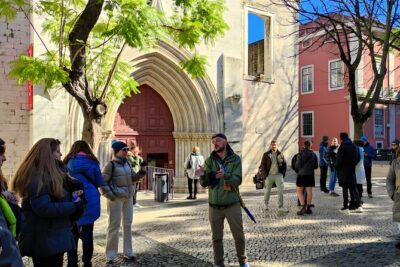
Next is the Church of Our Lady of the Loreto of the Italians, a charming chapel tied to the 16th century. The key detail here isn’t just the beauty—it’s the backstory: Italian merchants dedicated this chapel to Our Lady of Loreto.
This stop is valuable because it shows Lisbon as a trading and community crossroads, not only a capital of kings and earthquakes. Even if you’re not a church-architecture expert, the concept is easy to grasp: different groups left marks, and you can still read those marks today.
Stop 3: Igreja de São Roque, baroque Jesuit presence
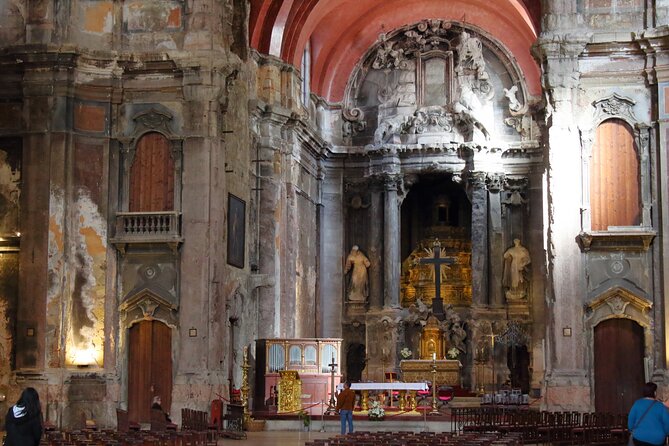
Then you step into Igreja de São Roque, noted as the first Jesuit church in the Portuguese empire and a 17th-century baroque treasure. If you like when a place explains larger history, this is one of the strongest stops on the route.
What to do in the short time you have: look for the baroque style cues. Think about how the Jesuits used grand church design to communicate authority and spiritual message in that era. You’re not just viewing art—you’re seeing a visible strategy.
A practical consideration: a 10-minute church stop means you may not get the full experience if you’re the type who wants to read every panel slowly. But for a newcomers route, it’s often the right balance.
Stop 4: Trindade and the look of a restored monastery site
At Trindade, you’re pointed toward a restaurant space famous for tiles, frescoes, and arches, rebuilt from an older monastery. This is one of those “Lisbon reuse” moments that feels very real once you start noticing it.
The value is that you’ll see how older structures and artistic traditions can keep living in modern public spaces. You don’t have to plan a meal to appreciate the setting—your stop is a quick chance to spot the visual motifs and understand the layered past.
Stop 5: Elevador de Santa Justa, 1902 engineering and major viewpoints
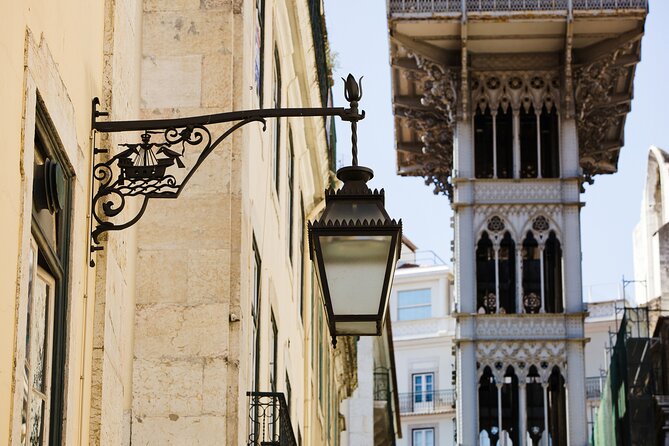
Now comes the tour’s physical reward: Elevador de Santa Justa. It’s described as a wonderful engineering work from 1902, and the big payoff is the panoramic perspective. From here, you can look out over Baixa Pombalina, the Alfama hill, and São Jorge Castle.
This stop does two helpful jobs for newcomers. It shows you the city’s geography at a glance (hills, lower districts, major landmarks), and it gives you a “why Lisbon looks like this” moment. Even if you don’t spend forever at the viewpoint, one good look can make the rest of your self-guided exploring easier.
Tip for your time: don’t rush your eyes. Spend a few minutes finding the named areas. When you can match what you see to what you learned, the whole day clicks.
Stop 6: Largo do Carmo for shade, calm, and a breather
After the lift, you get a quieter pause at Largo do Carmo, one of Lisbon’s charming squares. The instructions focus on one simple joy: take a minute to relax under the shade of the trees.
In a tour with lots of religious and historic sites, a breather matters. It keeps you from turning the day into a constant “look, look, look” sprint. Also, squares are great reset points for photos and for checking where you’ll be headed next.
Stop 7: Carmo Archaeological Museum and the 1755 earthquake scars
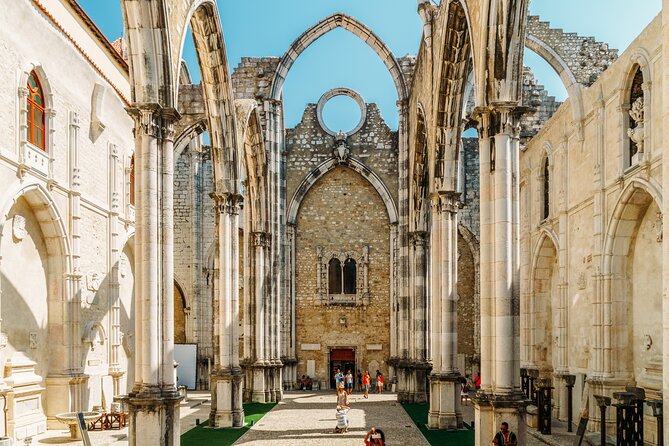
Next is Carmo Archaeological Museum, with a skip-the-line ticket included. Here you’re shown the ruins of a gothic temple destroyed by the earthquake that hit Lisbon in 1755.
This stop is emotionally different from the churches. It’s not about intact interiors and decorative programs. It’s about evidence—stone remnants tied to a turning point in Lisbon’s story. That’s why it’s one of the most meaningful parts of the route: you see the city’s history as physical survival.
Because your time is limited (about 15 minutes), you’ll want to prioritize what you can grasp quickly: the scale of the ruin and the sense of what was lost. Then you can decide on your own later how deeply you want to study the earthquake era.
Stop 8: Estacao do Rossio in Neo-Manueline style
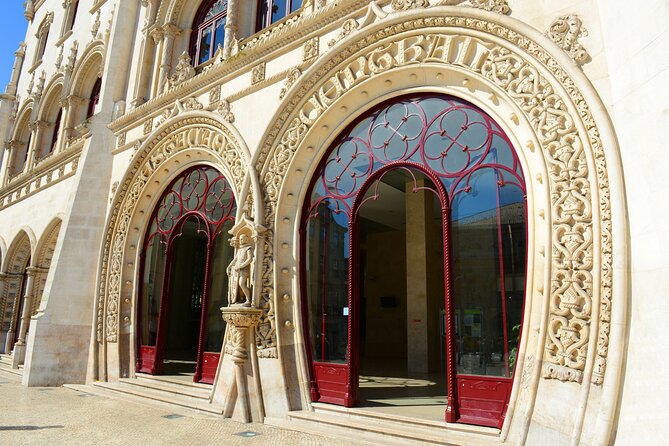
Moving toward Estacao do Rossio, you get a short look at the train station in Neo-Manueline style. For newcomers, this is useful because stations are often the most practical orientation points in a city.
A style note helps your eyes: Manueline-inspired design is known for ornamental, expressive details. Even if you only have a few minutes, you’ll likely spot distinctive design cues that make the station more than just a transit hub.
Stop 9: R. das Portas de Santo Antão 6 and ginjinha
At R. das Portas de Santo Antão 6, you stop to taste ginjinha, described as the most typical Portuguese liquor. This is a brief but memorable sensory break in the middle of the day.
Think of it as a cultural punctuation mark: after churches, ruins, and architecture, you get something Lisbon-themed you can share and remember. If you don’t usually do strong drinks, keep it small and enjoy the moment rather than treating it like a full tasting.
Stop 10: Igreja de S Domingos and a National Monument setting
Then it’s Igreja de S Domingos, noted as a National Monument and connected to a square where tragic events occurred for the city. The point here is that the building sits inside a larger public-history landscape.
Even without specific incident details provided, you can still read the context: a church can be a religious landmark and also a historical reference point for a city’s collective memory. In Lisbon, that combination shows up again and again.
Stop 11: Casa do Alentejo, neo-Moorish and Art Nouveau character
At Casa do Alentejo, you see a historic palace with neo-Moorish and Art Nouveau character, built in the last quarter of the 17th century. Today it’s described as one of Lisbon’s distinctive restaurants.
This stop is helpful if you’re interested in how different design styles show up side by side. You’re not only seeing one era frozen in time—you’re seeing how Lisbon’s architectural language kept evolving.
Stop 12: Rua Augusta and the monumental arch into Comercio Square
Then you walk Rua Augusta, highlighted as elegant, with an imposing monumental arch leading toward Comercio Square. This is one of the most “postcard-proof” sections of Lisbon.
In practical terms, it also works as a walking corridor to move you toward the riverfront. You’ll likely find it easier to navigate after this section because it’s visually structured.
Stop 13: Praça do Comércio and Tejo River views
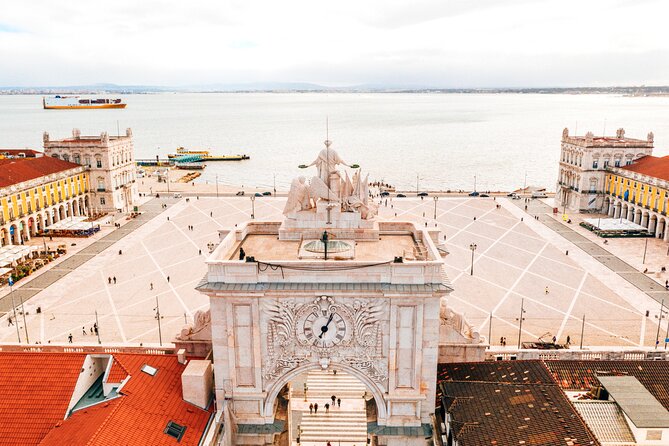
Next is Praça do Comércio, described as the majestic entrance to the city, with Masonic symbolism, views of the Tejo River, and the Cais das Colunas—an old footbridge for kings and presidents.
This is a strong ending because it ties together what you’ve learned. You’ve been moving through Lisbon’s neighborhoods and sacred spaces, and now you’re at the large civic opening toward the water.
If you want a simple way to make this stop stick: scan from the square’s architectural statement toward the river view. That makes it clear why the riverfront mattered so much to Lisbon’s identity.
Stop 14: Praça Dom Pedro IV for Lisbon’s link to Brazil and constitutional monarchy
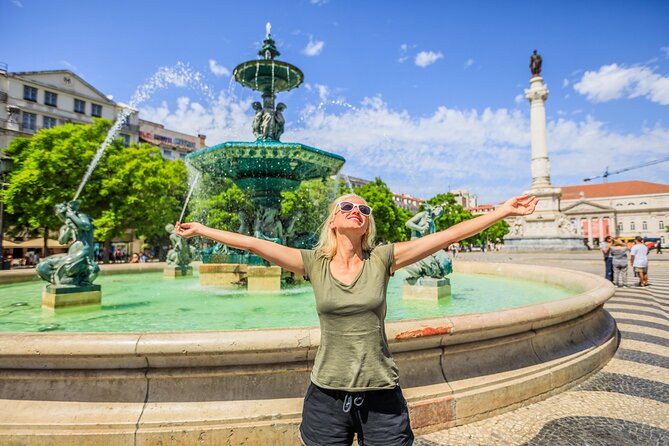
You finish with a quick visit to Praça Dom Pedro IV, dedicated to the first emperor of Brazil and the Portuguese constitutional king. Even if you only spend a few minutes, it gives Lisbon a global lens.
This final square helps you remember that Portuguese history isn’t only local streets and local churches. It connects to larger political stories, and you can see that connection in the way public monuments choose names.
How long is too long at each stop?
Because this route packs many points together, most stops are short—think about 5 to 15 minutes at each. That’s intentional. You’re not meant to do slow museum mode for the whole day. You’re meant to see enough to know what you want to return to later.
So if you’re the type who reads every sign and wants to linger in churches, plan to return on your own. If you’re a newcomer who wants a structured, guided overview, this pacing will feel efficient and satisfying.
Who should book this Lisbon newcomers highlights tour?
I’d book this if you:
- are in Lisbon for a short time and want a focused first-day route
- like churches, squares, and architecture with clear historical context
- want a private English guide who can keep the day moving smoothly
- appreciate ticket value, especially with skip-the-line access at Carmo Archaeological Museum
I might skip it (or expect a lighter experience) if you:
- want long, in-depth museum time for every stop
- hate walking-and-standing tours that change scenery every few minutes
- plan to spend extra time shopping or eating between locations
Should you book it?
Yes, if your goal is to get grounded fast. This tour’s strength is how it blends orientation, standout sights, and a few very Lisbon-specific touches like ginjinha—without turning your day into a logistics headache.
The one caution is pacing: it’s a sampler route. If you like that style, you’ll come away knowing what you want to revisit. If you prefer slow travel, treat it as your day-one map and plan longer returns for the places you loved.
FAQ
How long is the Lisbon Highlights for Newcomers private tour?
It’s approximately 2 hours.
What language is the tour offered in?
It’s offered in English.
Is this a private tour or a shared group tour?
It’s a private tour/activity. Only your group will participate.
Where does the tour start and where does it end?
It starts at Largo do Chiado, 1200-273 Lisboa, Portugal and ends at Praça do Comércio, 1100-148 Lisboa, Portugal.
Are tickets included for the stops?
Most stops list admission ticket Free. The Carmo Archaeological Museum ticket is included (with skip-the-line).
Do I need to bring a paper ticket?
You’ll use a mobile ticket.
Is there a skip-the-line option?
Yes. The Carmo Archaeological Museum stop includes a skip-the-line ticket.
Is free cancellation available?
Yes. You can cancel up to 24 hours in advance for a full refund.
When will I get confirmation after booking?
Confirmation is received at the time of booking.
More Private in Lisbon
- True 4Hour Private Tuk Tuk Tour: Discover Lisbon with a Local!★ 5.0 · 8,008 reviews
- Lisbon: Private Guided Tuk-Tuk Tour with Hotel Pickup★ 4.9 · 4,552 reviews
- Private Lisbon Sightseeing Tuk-Tuk Tour: Alfama, Belém & More★ 5.0 · 4,277 reviews
- Lisbon Highlights: Private Tuk Tuk Tour Adventure Sightseeing★ 5.0 · 3,284 reviews
- Welcome Lisbon Tour with Local Guide in Private Eco Tuk Tuk★ 5.0 · 1,691 reviews
More Tours in Lisbon
- Lisbon City Center Tour – The Unmissable Lisbon★ 5.0 · 22,234 reviews
- Lisbon: History, Stories and Lifestyle Walking Tour★ 4.8 · 10,902 reviews
- True 4Hour Private Tuk Tuk Tour: Discover Lisbon with a Local!★ 5.0 · 8,008 reviews
- Winner 2025 Undiscovered Lisbon Food & Wine Tour by Eating Europe★ 5.0 · 6,390 reviews
- Lisbon: Sintra, Pena, Cabo da Roca, Cascais Tour with Pickup★ 4.8 · 5,445 reviews
More Tour Reviews in Lisbon
- Lisbon City Center Tour – The Unmissable Lisbon★ 5.0 · 22,234 reviews
- Lisbon: Sintra, Pena, Regaleira, Cabo da Roca & Cascais★ 4.7 · 19,656 reviews
- Lisbon Card: 24, 48, or 72-Hour Pass★ 4.5 · 17,944 reviews
- Lisbon: Jerónimos Monastery Entrance Ticket★ 4.1 · 14,164 reviews
- Lisbon: History, Stories and Lifestyle Walking Tour★ 4.8 · 10,902 reviews
Just in: fresh Lisbon reviews from the team





Private, compared.
 ★ 5.0True 4Hour Private Tuk Tuk Tour: Discover Lisbon with a Local!From $1088,008 reviews
 ★ 4.9Private Guided Tuk-Tuk Tour with Hotel PickupFrom $1534,552 reviews
 ★ 5.0Private Lisbon Sightseeing Tuk-Tuk Tour: Alfama, Belém & MoreFrom $524,277 reviews
 ★ 5.0Lisbon Highlights: Private Tuk Tuk Tour Adventure SightseeingFrom $843,284 reviews
 ★ 5.0Welcome Lisbon Tour with Local Guide in Private Eco Tuk TukFrom $171,691 reviews
 ★ 5.0Sintra Full-Day Private Tour – A Journey through WonderlandFrom $1871,665 reviews
 ★ 5.0Sintra Private Trip from Lisbon Customizable Dreamlike ExperienceFrom $1631,414 reviews
 ★ 5.0Airport Private Transfer to/from LisbonFrom $271,284 reviews