
Porto in one day feels totally doable. I love how this trip strings together the city’s riverside Ribeira views, major churches, and a stop at the port wine cellars, all in one long, well-timed day. You get an English-speaking guide who helps you connect what you see with the story behind it, from baroque facades to tile-covered walls.
I also like that you’re not stuck at one “pretty spot.” You cross the Douro on the most famous bridge, climb the hill to Sé do Porto, and round out the day with São Bento station azulejos and Vinho do Porto caves. The main drawback is simple: it’s a long day and you’re doing a lot of walking on older streets, plus food isn’t included, so you’ll want to plan your meal time.
In This Review
- Key highlights
- Lisbon to Porto in 11 hours: what that really means
- Ribera del Duero and Largo do Terreiro: start where Porto’s character lives
- Crossing the Douro on Dom Luis I: the view and the orientation
- Clérigos Tower and baroque Porto: why this skyline landmark matters
- Sé do Porto on the hill: Romanesque, Gothic, Baroque in one facade
- São Bento station tiles: a fast hit of Portugal in azulejos
- Vinho do Porto caves: wine-focused Porto, without the detour
- Food and timing: plan your meal, not just your route
- Price and value: is $125 worth it for an 11-hour Porto highlights day?
- Meeting point and how to make the day run smoothly
- Who this Lisbon-to-Porto day trip suits best
- Should you book the Lisbon to Porto Highlights Day Trip?
- FAQ
- How long is the Lisbon to Porto highlights day trip?
- What is the price per person?
- What’s included in the tour?
- Are food and drinks included?
- Where do we meet the tour group?
- Where does the tour end?
- Is the tour wheelchair accessible?
- What cancellation and payment options are available?
Key highlights
- Ribera del Duero (UNESCO-listed) at Largo do Terreiro with the Chapel of Nossa Senhora de Ó nearby
- Dom Luis I bridge crossing for big Douro views and quick orientation
- Clérigos Church and Tower and its marble-and-granite baroque presence
- Sé do Porto with a facade mix of Romanesque, Gothic, and Baroque styles
- São Bento station tiles that show Portugal’s history in color
- Vinho do Porto Caves area across the river for a wine-focused finish
Lisbon to Porto in 11 hours: what that really means
This is a true day trip: about 11 hours from central Lisbon to Porto, then back. That time includes travel by air-conditioned bus plus a guided sightseeing route that hits the city’s top visual landmarks.
The upside is efficiency. Porto is big enough that you could burn a half-day just figuring out where to go. Here, you get a clear path: riverfront, skyline towers, cathedral hill, and then the wine-cellar area.
The trade-off is pace. You’ll be on the move, so this isn’t the kind of day trip to book if you want slow, relaxed wandering for hours.
Heading north? Other long days up to Porto
- Three Cities in One Day: Porto, Nazare and Obidos from Lisbon
★ 4.5 · 3,572 reviews - From Lisbon: Day Trip to Porto, Óbidos, and Nazaré
★ 4.5 · 1,311 reviews - Lisbon: Fátima, Nazaré, Óbidos & São Martinho do Porto Tour
★ 4.8 · 748 reviews - Lisbon to Porto Up to 4 Stops: Obidos, Nazare, Fatima and Aveiro
★ 5.0 · 362 reviews
Ribera del Duero and Largo do Terreiro: start where Porto’s character lives
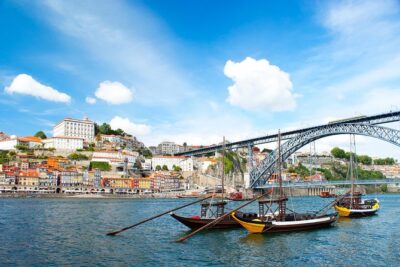
Your day begins in the Ribera del Duero area, framed by the Douro’s bridges and the riverfront atmosphere. This is one of those places that immediately helps you understand why Porto feels different from other Portuguese cities: you’re seeing the city’s relationship to water, trade, and daily life.
A key stop is Largo do Terreiro, often treated as the heart of this riverside zone. You’ll also notice the Chapel of Nossa Senhora de Ó, originally dating to the 17th century and then remodeled in the 19th century. That mix of periods matters, because Porto’s look is rarely one uniform style.
Right nearby, you’ll see the Fuente Taurina, described as a kind of entrance to the restaurant area. I like this detail because it signals what to expect next: a stretch of places where you can eat while looking over the river.
If you’re the type who likes photos that actually tell a story, this is a strong starting point. You’re not just seeing buildings; you’re walking into Porto’s riverfront layout.
Crossing the Douro on Dom Luis I: the view and the orientation
From the Ribeira side, the route takes you up toward Porto’s best-known bridge: Dom Luis I. Crossing here is more than a photo stop. It gives you fast orientation: you see how the historic center hangs along the river, and how the city’s viewpoints connect.
Once you’re across, the city starts to feel vertical. Streets rise toward the church-and-cathedral zone, and the architecture gets more dramatic. This bridge crossing is one of those moments that helps the rest of the day click into place.
I’d suggest keeping your phone charged and ready, because the best views come in quick seconds as you move. This tour covers ground, so don’t wait until you’re halfway through the bridge to decide you want a picture.
Clérigos Tower and baroque Porto: why this skyline landmark matters
After the bridge, you head into the church area with Clérigos. The highlight is the Clérigos Tower, described as nearly 80 meters high, and one of the easiest monuments in Porto to spot from different viewpoints.
This tower is often linked with baroque art in the city. You’re not just looking at something tall; you’re seeing the kind of ambition that shaped Porto’s skyline in the 18th century.
A few facts help you appreciate it more while you’re standing there:
- It dates to the 18th century.
- The facade is marble and granite, built to last and to impress.
- The origins connect to the Brotherhood of the Poor Clerics, who financed the construction and made the church their home.
- Inside, the church is described as having treasures behind a rococo style facade.
If you like churches more for what they say about a city than for their “pretty factor,” this stop is worth the time. Clérigos is basically Porto’s loudest architectural voice, and it’s easy to see why people treat it like a signature.
Worth a look before you lock anything else in around Lisbon:

Sé do Porto on the hill: Romanesque, Gothic, Baroque in one facade
Next comes the uphill walk to Sé do Porto, also called the Cathedral of Oporto. This is a 12th-century temple, and the facade gives you a real style mix: Romanesque, Gothic, and Baroque elements all in the same visual frame.
I like cathedral stops on guided days because a guide can point out what you might otherwise miss. Here, you’ll learn about the cathedral’s history and the main elements you can find inside, so the visit feels more than a quick “check it off” stop.
Even if you don’t go inside for long, Sé is a useful anchor. It helps you understand Porto’s timeline: you’re standing in a place that has defined the city for centuries, then watching the surrounding streets lead you back toward the river.
Just be aware that the area involves walking on older streets. Wear shoes you trust, especially if you’re visiting in warmer months when stone surfaces stay hot longer.
São Bento station tiles: a fast hit of Portugal in azulejos
On your way through the city, you pass by São Bento railroad station, famous for its tile artwork. The tiles show images of Portugal’s history, and they’re striking enough that even a short stop can feel meaningful.
This is a smart inclusion because not every major landmark is a church or a tower. São Bento offers a different kind of Porto lesson: art as storytelling, applied to everyday spaces.
If you like visual history, you’ll enjoy this. And if you’re not sure where to look, focus on scanning the wall areas rather than trying to read everything at once. The goal here is to get the images into your memory, not to memorize dates.
Vinho do Porto caves: wine-focused Porto, without the detour
Before the guided portion ends, the tour crosses to the other side of the river to the Vinho do Porto Caves area. This is a classic move for Porto highlights, because wine isn’t a side topic here. It’s part of the city’s identity and economy.
You’ll get the wine connection through the cave stop itself, with guidance that ties what you’re seeing to the broader Porto story. I’d treat this as your transition from sightseeing mode to tasting-and-eating mode, even though the tour’s included items do not list food or drinks.
The practical takeaway: after the caves, you’ll have free time to explore more at your own pace. That’s your window to grab lunch or an early dinner based on what your guide recommends.
Food and timing: plan your meal, not just your route
Food and drinks are not included, so your day will run on your own meal plan. The good news is that Porto has plenty of restaurant options near the places you’ll already be seeing, including the riverside restaurant area connected with the Largo do Terreiro zone.
I’d recommend treating the guided tour like the skeleton of the day. You fill in the flesh with meals whenever there’s a natural break and when the views fit your mood.
Also, because you’re returning to Lisbon after the sightseeing, don’t assume you’ll want a heavy meal at the very end. If you can, aim for something earlier or at least near the middle of your free time so the ride back feels easier.
Price and value: is $125 worth it for an 11-hour Porto highlights day?
At $125 per person, the value depends on what you’d otherwise do on your own.
This price covers:
- Air-conditioned transportation
- A guided tour in English
- An organized route through Lisbon’s meeting point area and Porto’s highlights
For an 11-hour day trip, that structure matters. You’re buying time-saving route planning and a guide to connect what you see—especially at places like Clérigos and Sé, where architectural details add meaning.
What’s not included matters, too. Since food and drinks aren’t included, you should budget for at least one meal (and possibly snacks) during the free time portion. If you come prepared with that in mind, the day feels like a strong deal for a guided highlights package that covers a lot of ground.
If you’re the kind of traveler who hates coordinating transport and prefers to spend energy on the sights, you’ll likely feel good about the cost.
Meeting point and how to make the day run smoothly
You meet at Plaza Rossio (Plaza Dom Pedro IV) by the fountain, across from Teatro Nacional. Look for your guide wearing the Buendía Tours logo.
The activity ends back at the meeting point, which is comforting. It means you’re not left figuring out how to get back to Lisbon from Porto after a long day.
One more practical note: this tour is not suitable for wheelchair users, which usually means there’s enough walking and uneven streets that it wouldn’t be comfortable.
For everyone else, the best move is simple: keep a small water bottle, wear comfortable shoes, and don’t overpack. You’ll be moving between viewpoints and walking uphill in at least one section of the day.
Who this Lisbon-to-Porto day trip suits best
This is a strong pick if you want Porto’s major highlights in one organized day, especially if you’re short on time and you’re starting in Lisbon.
It also fits well if you like guidance that turns monuments into context. The route includes major architectural landmarks—Clérigos and Sé—and a quick cultural stop at São Bento station tiles, plus the port caves area.
If you’re hoping for a super slow, photo-by-photo day with lots of spare time between stops, you might find the schedule a bit tight. This is more of a highlights sprint with enough free time to eat and wander briefly.
Should you book the Lisbon to Porto Highlights Day Trip?
Book it if you want a reliable, guided way to see Porto’s key landmarks without spending your precious time figuring out logistics. The combination of Ribeira, Dom Luis I, Clérigos Tower, Sé Cathedral, São Bento tiles, and the Vinho do Porto caves area gives you a full map of the city’s identity.
Skip it if you want a more flexible day with longer free time for deep exploring, or if walking long stretches on older streets won’t work for you. If you’re comfortable with a full day and you plan for your own meals, this is a practical way to turn one day into a Porto story.
FAQ
How long is the Lisbon to Porto highlights day trip?
It lasts 11 hours. Starting times vary, so you’ll need to check availability.
What is the price per person?
The price is $125 per person.
What’s included in the tour?
It includes air-conditioned transportation, a guided tour with an English-speaking guide, and the tour portion in both Lisbon and Porto.
Are food and drinks included?
No. Food and drinks are not included.
Where do we meet the tour group?
You meet at Plaza Rossio (Plaza Dom Pedro IV) by the fountain, across from Teatro Nacional. Look for the guide with the Buendía Tours logo.
Where does the tour end?
The tour ends back at the meeting point.
Is the tour wheelchair accessible?
No, it is not suitable for wheelchair users.
What cancellation and payment options are available?
You can cancel up to 24 hours in advance for a full refund, and you can reserve now & pay later.
More 1-Day Tours in Lisbon
- Sintra and Cascais Small-Group Day Trip from Lisbon★ 5.0 · 7,018 reviews
- Three Cities in One Day: Porto, Nazare and Obidos from Lisbon★ 4.5 · 3,572 reviews
- Fátima, Nazaré and Óbidos Small-Group Day Trip from Lisbon★ 4.5 · 3,444 reviews
- From Lisbon: Day Trip to Porto, Óbidos, and Nazaré★ 4.5 · 1,311 reviews
- Lisbon: 4 Cities in One Day Óbidos, Nazaré, Batalha & Fátima★ 4.3 · 796 reviews
More Tour Reviews in Lisbon
- Lisbon City Center Tour – The Unmissable Lisbon★ 5.0 · 22,234 reviews
- Lisbon: Sintra, Pena, Regaleira, Cabo da Roca & Cascais★ 4.7 · 19,656 reviews
- Lisbon Card: 24, 48, or 72-Hour Pass★ 4.5 · 17,944 reviews
- Lisbon: Jerónimos Monastery Entrance Ticket★ 4.1 · 14,164 reviews
- Lisbon: History, Stories and Lifestyle Walking Tour★ 4.8 · 10,902 reviews
The Long Haul North to Porto
- Three Cities in One Day: Porto, Nazare and Obidos from Lisbon★ 4.5 · 3,572 reviews
- From Lisbon: Day Trip to Porto, Óbidos, and Nazaré★ 4.5 · 1,311 reviews
- Lisbon: Fátima, Nazaré, Óbidos & São Martinho do Porto Tour★ 4.8 · 748 reviews
- Lisbon to Porto Up to 4 Stops: Obidos, Nazare, Fatima and Aveiro★ 5.0 · 362 reviews
- Lisbon: Sunset DJ & Porto Tonic Premium Boat Experience★ 4.6 · 250 reviews
Just in: fresh Lisbon reviews from the team




Porto Day Trips, compared.
 ★ 4.5Three Cities in One Day: Porto, Nazare and Obidos from LisbonFrom $1333,572 reviews
 ★ 4.5From Lisbon: Day Trip to Porto, Óbidos, and NazaréFrom $971,311 reviews
 ★ 4.8Fátima, Nazaré, Óbidos & São Martinho do Porto TourFrom $70748 reviews
 ★ 5.0Lisbon to Porto Up to 4 Stops: Obidos, Nazare, Fatima and AveiroFrom $287362 reviews
 ★ 4.6Sunset DJ & Porto Tonic Premium Boat ExperienceFrom $58250 reviews
 ★ 5.0Fátima, Nazaré, Óbidos and S. Martinho do Porto Small-Group Tour from LisbonFrom $72229 reviews
★ 4.5Sunset DJ & Porto Tonic Premium Boat ExperienceFrom $60163 reviews
★ 5.0Fátima, Nazaré, Óbidos and S. Martinho do Porto Small-Group Tour from LisbonFrom $72229 reviews
★ 4.5Sunset DJ & Porto Tonic Premium Boat ExperienceFrom $60163 reviews
 ★ 4.5Porto Private Personalized Full Day Journey from LisbonFrom $483112 reviews
Browse the lists this tour appears in