
Reviewed · TAGUS RIVER CRUISES
Boat Cruise with Champagne
Sunset on the Tagus turns heads fast. This 2-hour boat cruise from Marina Belém gives you Lisbon’s landmarks in a fresh order, with champagne and plenty of time to shoot great photos.
What I really like is how the crew keeps the ride smooth and on schedule, so you’re not rushing. I also love that you get short, usable photo stops at big-name sights—enough time to frame the shot without feeling trapped on a long walking tour.
One thing to consider: the trip is weather- and sea-state dependent. If conditions are rough or safety comfort is low, you may face a cancellation, sometimes on short notice.
In This Review
- Key highlights at a glance
- Where the cruise starts: Marina Belém and the river-view advantage
- Champagne-on-the-Tagus timing in a 2-hour loop
- Ponte 25 de Abril to Cristo Rei: the Almada angle you don’t get on foot
- Portuguese Fisheries Company ruins, Jardim do Rio, and Cacilhas viewpoints
- Fragata D. Fernando II e Glória and the Barracuda submarine sightline
- Praça do Comércio, Castelo de São Jorge, and the river-to-city transition
- Santa Engrácia, Cais do Sodré and Santos: Lisbon’s changing faces
- MAAT, the Central Tejo Energy story, and modern Lisbon by the river
- Belém finish: Padrão dos Descobrimentos, Torre de Belém, and the seaplane memorial
- Price and value: what $40.64 buys you on the river
- Who this cruise fits best (and who should adjust expectations)
- Quick note on comfort and safety
- Booking basics you’ll want to know
- FAQ
- FAQ
- How long is the boat cruise?
- Where is the meeting point?
- Is champagne included?
- How many people are on the boat?
- Is it wheelchair accessible?
- Can I bring a service animal?
- What happens if the weather is bad?
- What landmarks will we see?
- Should you book this Lisbon champagne boat cruise?
Key highlights at a glance
- Champagne and water onboard while the river does the lighting work
- Small group size (max 12 travelers), which makes Q&A actually possible
- Photo-friendly stops at both Lisbon and Almada viewpoints
- A mix of old and modern Lisbon from historic towers to MAAT’s riverfront architecture
- Wheelchair accessible vessel and service animals allowed
- Operates in good weather only, so plan a little flexibility in your schedule
Where the cruise starts: Marina Belém and the river-view advantage
You kick off near Marina Belém, by the Padrão dos Descobrimentos area. The location matters because it sets the whole tone: instead of seeing Lisbon from street level, you’ll watch the city build itself around you as you move along the Tagus (Rio Tejo).
From this side of the river, you get that best “Lisbon + water” perspective fast. Belém landmarks tend to look their most dramatic when photographed from a moving angle, and a boat lets you do that without climbing stairs or weaving through crowds.
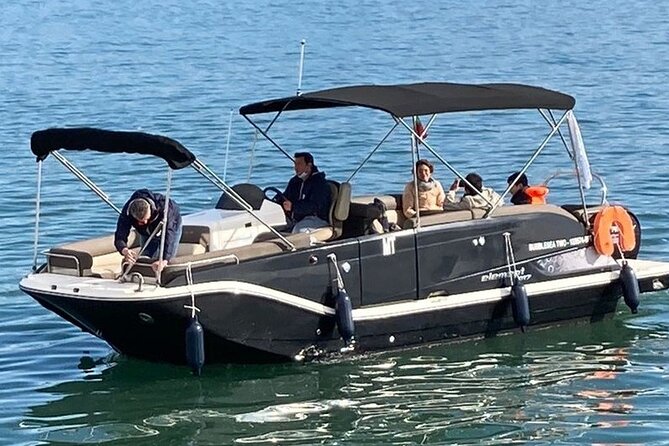
Also, the company runs this as a personalized service with a maximum of 12 travelers. In plain terms, it feels less like a herd and more like a guided ride with room to ask questions and adjust your photos.
Back on the Tagus: more hours on the water
- Lisbon: Sunset Boat Party Cruise with DJ and Open Bar
★ 4.5 · 10,378 reviews - Lisbon: Sunset Boat Tour with Music and Drinks
★ 4.6 · 3,908 reviews - Lisbon: Tagus River Cruise with Welcome Drink
★ 4.2 · 3,717 reviews - Lisbon: Daytime/Sunset/Night City Sailboat Tour with Drink
★ 4.9 · 3,114 reviews
Champagne-on-the-Tagus timing in a 2-hour loop
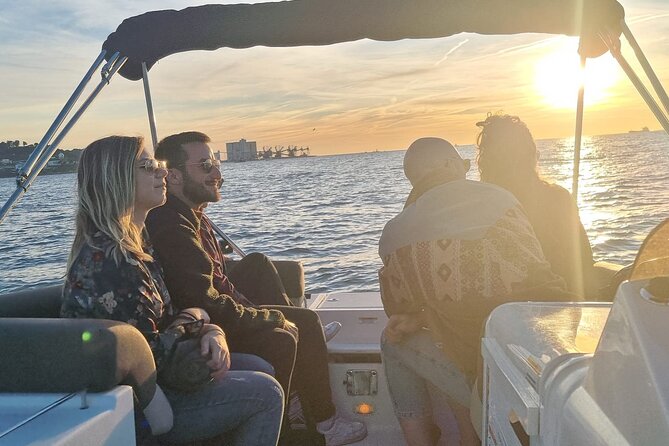
This is an approx. 2-hour experience, and you’ll feel the timing. The ride is long enough to cover a lot of riverbank, but short enough that it stays easy on your legs and attention span.
The schedule is built around travel time plus quick stopovers (many marked around five minutes) so you can photograph and look back at what you just passed. When you’re comparing boat options, that pacing is a big deal: too-short cruises can feel like a drive-by; this one is designed for viewing without dragging.
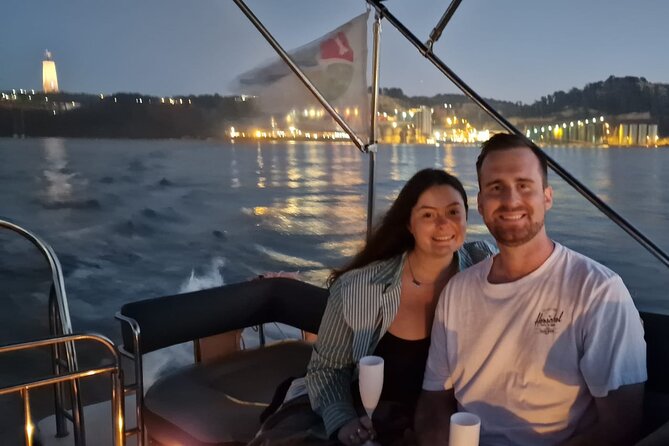
Champagne and water are provided onboard, which is a nice touch for a sunset cruise. If you prefer non-alcoholic drinks, plan to focus on the water as your default and consider asking ahead about alternatives if that matters to your group.
Ponte 25 de Abril to Cristo Rei: the Almada angle you don’t get on foot
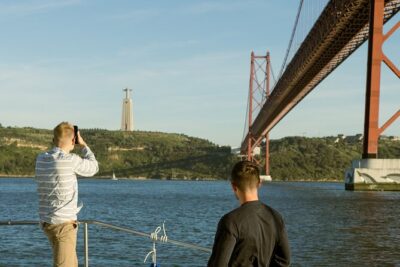
Early on, the cruise turns your attention to the biggest “Lisbon from the outside” signature: Ponte 25 de Abril. This suspension bridge connects Lisbon to Almada and spans 2,277 meters—and from the water, the scale is easier to understand than it is from the sidewalks below.
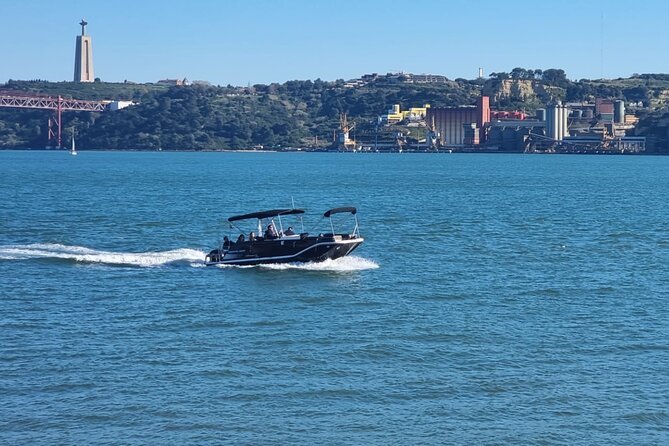
Then you head toward the Santuario Nacional de Cristo Rei in Almada. It’s the Portuguese take on the Christ statue idea, inspired by the famous monument in Rio. The story behind it is part of the point: it was inaugurated in 1959, and the huge presence here is tied to Portuguese gratitude after World War II—Portuguese people were spared the direct destructive effects.
What makes these two stops work together is contrast. The bridge is all engineering and symmetry. Cristo Rei is all spiritual monument and vertical drama. From the river, both hit at once, and both photograph well.
Portuguese Fisheries Company ruins, Jardim do Rio, and Cacilhas viewpoints
After the big monuments, the cruise starts showing you the less-touristy river edges. You’ll pass the Portuguese Fisheries Company Ruins, connected to how Lisbon’s coastal fishing operations expanded over time—especially as support infrastructure shifted to the south bank.
Then there’s Jardim do Rio in Almada, a spacious strip of green by the water. It’s not just “a park view.” This is where you can slow down: the garden stretches along the escarpment, with features like Fonte da Pipa, a fountain built by King João V in 1736. The panoramic elevator at Boca do Vento also gives access from viewpoints above, which helps explain why this area feels like a terrace looking over the river.
Cacilhas (the riverside area across from Lisbon) rounds out the south-bank feel. This part of the city is closer to everyday life—still scenic, just less “museum postcard.” It’s a good reminder that Lisbon isn’t only Alfama and towers; the river supports real neighborhoods too.
Worth a look before you lock anything else in around Lisbon:
Fragata D. Fernando II e Glória and the Barracuda submarine sightline

Two of the most fun parts of this cruise are the military-history sightings on the Almada side.
First: Fragata D. Fernando II e Glória, a wooden-hulled Portuguese Navy frigate launched in 1843 and with a maiden voyage in 1845. It was built at the shipyard of Daman in Portuguese India, and it’s described as Portugal’s last sailing warship built there. During its long service, it also became tied to the Carreira da Índia, the regular military connection between Portugal and its colonies in India.
Then, across the river, you may catch the Barracuda submarine. The fact that you can spot it from the Lisbon side is the clever bit: you get a ship-and-sub look without needing a museum ticket. The submarine served 40 years, with more than 52,000 hours navigated—numbers that make the object feel less like a decoration and more like a chapter of naval life.
If you enjoy ships, this section is one of the reasons the cruise feels more than just pretty scenery.
Praça do Comércio, Castelo de São Jorge, and the river-to-city transition
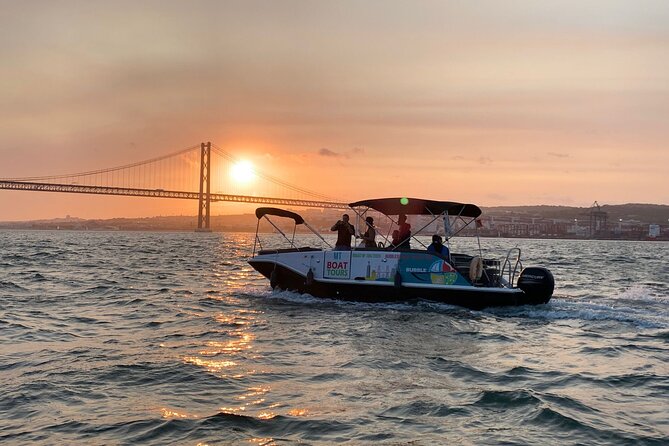
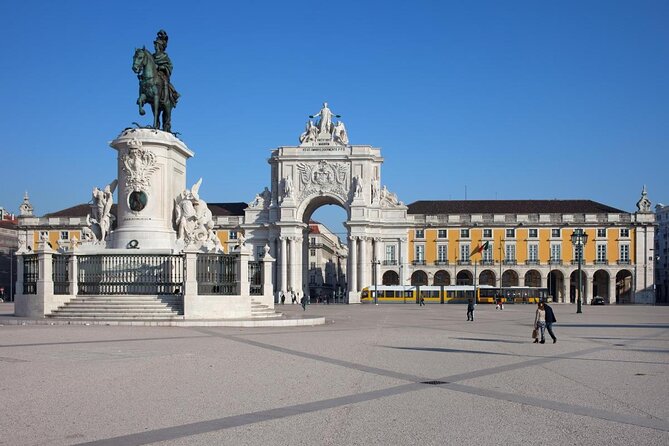
As the cruise returns toward central Lisbon, you’ll hit the city’s classic “big open space” energy at Praca do Comercio (Terreiro do Paço). This plaza is the iconic harbor-facing square by the Tagus. The 1755 earthquake destroyed the old Paço da Ribeira, and the plaza was later remodeled as part of the Pombaline Downtown rebuilding under the Marquis of Pombal.
The river viewpoint helps you see how the square was designed to work with the waterfront. From land, it can feel like a stop. From the water, it feels like a stage set.
Next comes Castelo de São Jorge, with occupation on the hill dating back to at least the 8th century BC and fortifications from Roman and earlier periods. It was conquered by the Portuguese in 1147 and then served as palace, barracks, and—later—the site tied to the Torre do Tombo National Archive. Even just looking at it from the river, you’ll feel why the hill position mattered.
These two stops give you a clean transition: open square and hill fortress, both shown as physical shapes across the water. It’s an easy way to get your bearings fast.
Santa Engrácia, Cais do Sodré and Santos: Lisbon’s changing faces
You’ll also pass by the Church of Santa Engrácia, now the National Pantheon. Built as a 17th-century church and turned into a burial site for important Portuguese personalities, it adds a solemn note to what can otherwise be a fun, champagne-forward cruise.
Then you’ll see Cais do Sodré and nearby Santos, areas that used to be known for tougher nightlife and even red-light history. Today, that identity has shifted: you’ll find more bistros and a more creative mix, with docks-turned-industrial spaces now used for studios, cafes, shops, and galleries.
This part of the cruise is useful if you like context. It’s one thing to memorize sights. It’s another to watch neighborhoods evolve while you move past them on the water.
MAAT, the Central Tejo Energy story, and modern Lisbon by the river
Near Belém’s riverfront, the cruise includes MAAT (Art, Architecture and Technology). MAAT is designed as a modern cultural project on the Tagus, built to connect the new museum to the nearby Tejo Power Station, an early 20th-century industrial architecture highlight. The museum’s design is credited to Amanda Levete Architects.
If you like museums but don’t want a full museum day, this boat stop acts like a teaser. You get the shape of the architecture, the river setting, and the link to the industrial past.
Adjacent to MAAT, you’ll also pass the Electricity Museum, now integrated under MAAT’s programming as Circuito Central Elétrica. It’s described as covering past, present, and future of energies, with science-and-industrial-archaeology style exhibits. From the water, it’s mostly about the building and context, but that context is what makes it memorable.
Belém finish: Padrão dos Descobrimentos, Torre de Belém, and the seaplane memorial
The cruise ends by returning to the Belém side and hitting some of Lisbon’s biggest “send-off” imagery.
You’ll pass the Padrão dos Descobrimentos, a monument celebrating the Age of Discoveries. Ships departed here to explore and trade with India and the Orient, so you’ll be standing near the setting that links ocean travel to Portuguese identity.
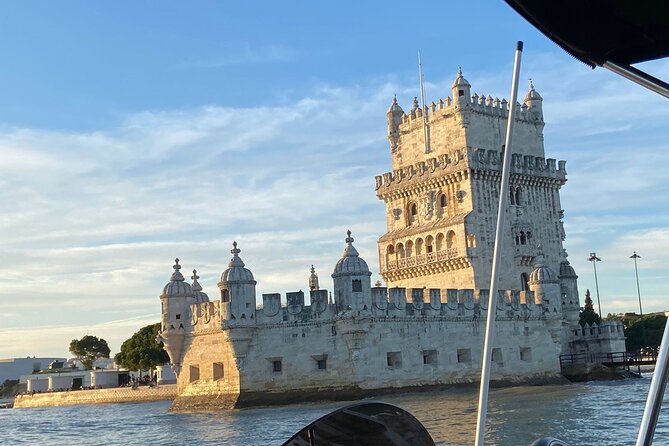
Then comes Torre de Belém (Tower of Saint Vincent), a 16th-century fortification and ceremonial gateway to Lisbon. The Manueline style is a big part of why it’s photographed nonstop, and the tower’s construction in lioz limestone gives it that distinctive look. It’s a UNESCO World Heritage site since 1983 (with the Jerónimos Monastery).
Finally, near the Torre de Belém area, you’ll see a life-size reproduction of the seaplane Lusitânia, used by Gago Coutinho and Sacadura Cabral for the first crossing of the South Atlantic in 1922. That detail gives the cruise a nice “story arc”: Lisbon as bridge between continents, not just Lisbon as postcard.
Price and value: what $40.64 buys you on the river
At $40.64 per person, the price sits in the “you’re paying for time + access” category. You’re not buying just transportation; you’re buying a curated river view of many highlights in a short window, plus onboard champagne and water.
The value improves because this is a max-12 format. If you’re traveling with someone and you want a smooth shared experience without a lot of walking, this kind of cruise can feel like good ROI. And if you land on a departure with low demand, you may find the experience feels extra relaxed—one of the joys of small-capacity boats is that they don’t always feel crowded.
Who this cruise fits best (and who should adjust expectations)
This works well for:
- First-timers who want a “big picture” sweep of Lisbon without doing a nonstop walking day
- Couples and friends who want easy sightseeing with a fun drink onboard
- Anyone who likes architecture, bridges, and monuments shown from a moving angle
You might want a second plan if:
- You’re traveling when weather and sea conditions are unpredictable and you can’t be flexible
- You’re strict about non-alcoholic options—since champagne is included, it’s smart to plan around water and ask what’s available if needed
Quick note on comfort and safety
The vessel is described as allowing rides for wheelchairs and reduced mobility, and service animals are allowed. The company is also certified under CLEAN & SAFE health measures, and it holds a Portugal RNAAT permit (No. 190/2020). That’s the kind of background detail that matters when you’re planning a relaxation day.
Booking basics you’ll want to know
You’ll receive a mobile ticket, and the departure area is near public transportation. The activity ends back at the meeting point at Av. Brasília 1400-038, Lisboa.
Booking tends to happen about 8 days in advance on average, so if you’re set on a particular day, don’t wait until the last minute.
FAQ
FAQ
How long is the boat cruise?
It lasts about 2 hours.
Where is the meeting point?
You meet at Av. Brasília 1400-038, 1400-038 Lisboa, Portugal, and the tour ends back at the same meeting point.
Is champagne included?
Yes. Champagne and water are offered onboard.
How many people are on the boat?
This experience has a maximum of 12 travelers.
Is it wheelchair accessible?
Yes. The vessel allows the ride of people in wheelchairs and with reduced mobility.
Can I bring a service animal?
Yes. Service animals are allowed.
What happens if the weather is bad?
The cruise requires good weather. If it’s canceled due to poor weather, you’ll be offered a different date or a full refund.
What landmarks will we see?
You’ll pass by major Lisbon and Almada highlights such as Ponte 25 de Abril, Cristo Rei, Praca do Comercio, Castelo de São Jorge, MAAT, Padrão dos Descobrimentos, and Torre de Belém, plus sights around Cais do Sodré/Santos and other riverfront points.
Should you book this Lisbon champagne boat cruise?
If you want the easiest way to see a lot of Lisbon in a short time, I’d book it. The combo of sunset timing, champagne included, and photo-friendly stops makes it feel like a real experience, not just a ride past landmarks.
Just give yourself a little buffer for weather. Lisbon can be gorgeous and also a little moody on the river. If you’re flexible and want that Tagus-from-the-deck perspective, this is a strong pick.
More Cruises & Boat Tours in Lisbon
- Lisbon: Sunset Boat Party Cruise with DJ and Open Bar★ 4.5 · 10,378 reviews
- Lisbon: Sunset Boat Tour with Music and Drinks★ 4.6 · 3,908 reviews
- Lisbon: Tagus River Cruise with Welcome Drink★ 4.2 · 3,717 reviews
- Lisbon: Daytime/Sunset/Night City Sailboat Tour with Drink★ 4.9 · 3,114 reviews
- Lisbon: Sunset Cruise with Welcome Drink and Snacks★ 4.4 · 3,021 reviews
More Tour Reviews in Lisbon
- Lisbon City Center Tour – The Unmissable Lisbon★ 5.0 · 22,234 reviews
- Lisbon: Sintra, Pena, Regaleira, Cabo da Roca & Cascais★ 4.7 · 19,656 reviews
- Lisbon Card: 24, 48, or 72-Hour Pass★ 4.5 · 17,944 reviews
- Lisbon: Jerónimos Monastery Entrance Ticket★ 4.1 · 14,164 reviews
- Lisbon: History, Stories and Lifestyle Walking Tour★ 4.8 · 10,902 reviews
More Hours on the Tagus
- Lisbon: Sunset Boat Party Cruise with DJ and Open Bar★ 4.5 · 10,378 reviews
- Lisbon: Sunset Boat Tour with Music and Drinks★ 4.6 · 3,908 reviews
- Lisbon: Tagus River Cruise with Welcome Drink★ 4.2 · 3,717 reviews
- Lisbon: Daytime/Sunset/Night City Sailboat Tour with Drink★ 4.9 · 3,114 reviews
- Lisbon: Sunset Cruise with Welcome Drink and Snacks★ 4.4 · 3,021 reviews
Just in: fresh Lisbon reviews from the team




Tagus River Cruises, compared.
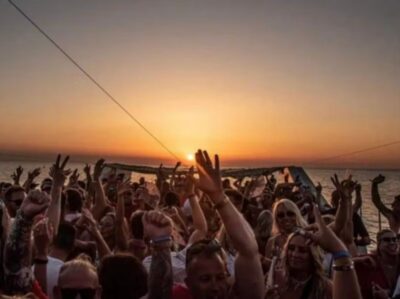 ★ 4.5Sunset Boat Party Cruise with DJ and Open BarFrom $2710,378 reviews
 ★ 4.6Sunset Boat Tour with Music and DrinksFrom $183,908 reviews
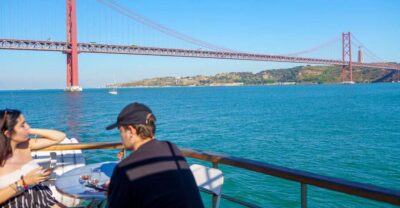 ★ 4.2Tagus River Cruise with Welcome DrinkFrom $163,717 reviews
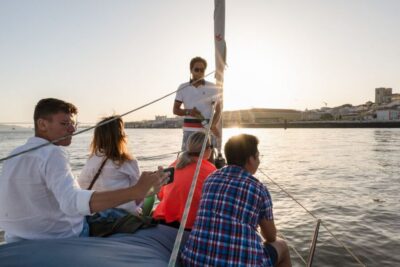 ★ 4.9Daytime/Sunset/Night City Sailboat Tour with DrinkFrom $413,114 reviews
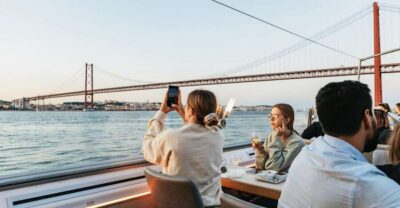 ★ 4.4Sunset Cruise with Welcome Drink and SnacksFrom $353,021 reviews
 ★ 4.0Tagus River Cruise to the Ocean & Dolphin WatchingFrom $383,019 reviews
 ★ 4.7Sunset Catamaran Boat Tour with Music and DrinksFrom $262,834 reviews
 ★ 4.2Tejo River Sightseeing CruiseFrom $212,799 reviews
Browse the lists this tour appears in